
Care and Maintenance
Home Window Cleaning Services: What to Expect in 2026
Learn what professional home window cleaning services include, how pricing works, and how to choose a trusted local provider in 2026.


You've probably seen the shortcut: a homeowner pours concentrate straight onto a dusty pane, wipes it around, and wonders why the glass looks worse when the sun hits it. The window may feel clean, but streaks, drag, haze, and a sticky film often appear once the surface dries. In desert climates, hard water and rapid evaporation make that shortcut even less forgiving.
Concentrate window cleaner can be economical and effective, but only when the chemistry, water quality, and application method work together. Professional crews don't rely on one universal mixture, and they don't treat stronger as cleaner. They use one of only two professional window-cleaning methods, a squeegee system or a pure-water system, and they match the solution and technique to the glass, soil, weather, and access requirements.
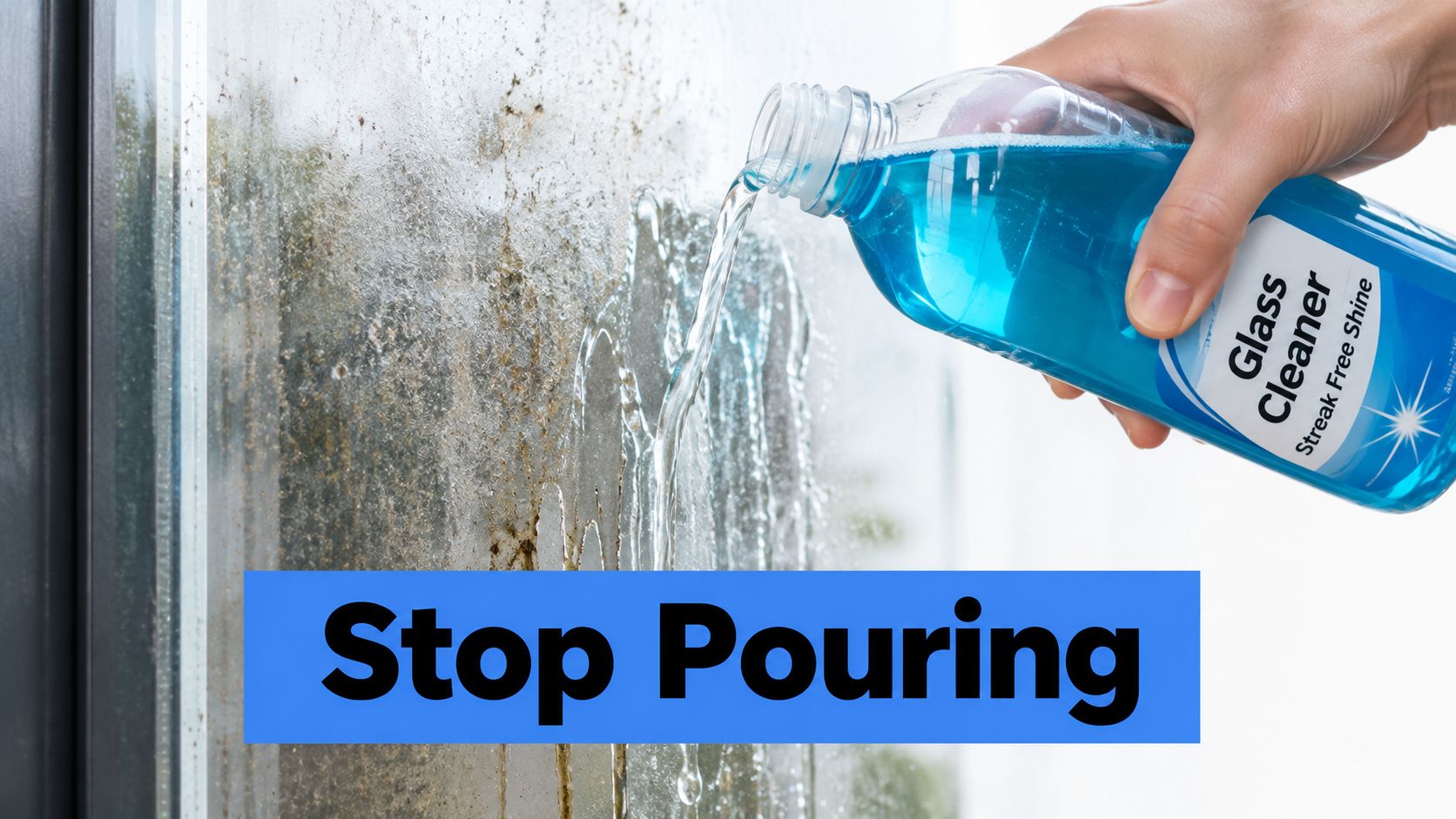
The most common mistake happens before the first scrub. Someone opens a bottle of concentrate, tips a little onto the glass, and starts wiping. It feels efficient because the cleaner looks powerful, but direct application places the undiluted chemical exactly where it can dry, smear, and leave a heavier residue.
A homeowner might then add more product to the next pane because the first one still shows marks. That creates a cycle of excess surfactant, more wiping, and more visible film. On sun-heated glass, the solution can dry before it's properly removed, locking residue into the surface instead of suspending soil for easy removal.
A Safety Data Sheet for Simple Green Clean Building Glass Cleaner Concentrate specifies a 1:30 dilution, meaning 1 fluid ounce of concentrate is mixed with 30 fluid ounces of water for hard, non-porous surfaces. The resulting mixture produces approximately 31 fluid ounces of ready-to-use solution, and a one-gallon container could theoretically yield about 31 gallons of working solution if that ratio remains consistent. The Simple Green Safety Data Sheet provides the product-specific basis for those figures.
That ratio isn't just a purchasing calculation. It controls how much solvent and surfactant reaches the glass, how easily the squeegee moves, and how much residue remains after finishing. Double the intended concentrate and you materially increase chemical consumption while changing the handling characteristics. Dilute it excessively and cleaning performance can weaken.
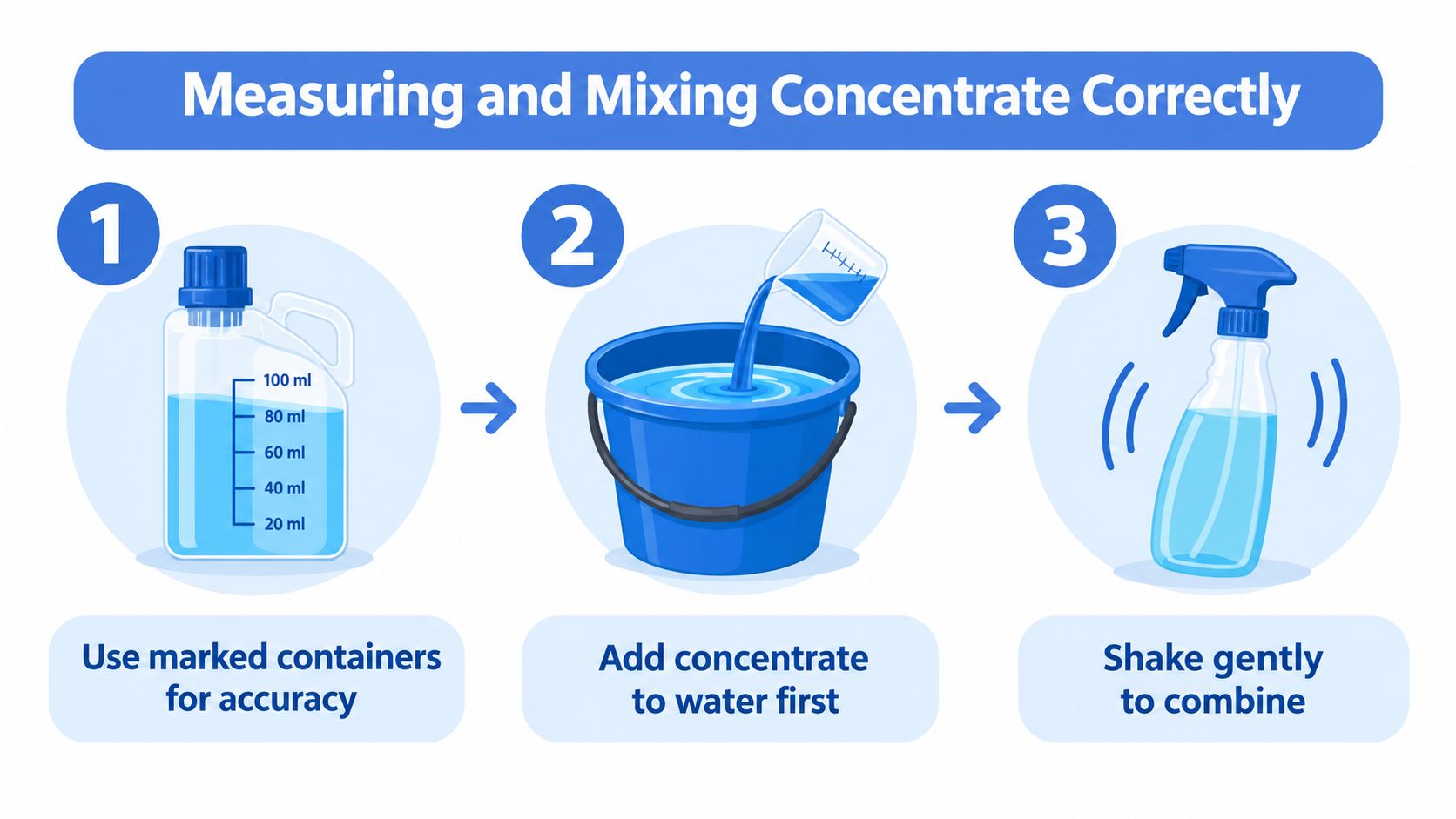
Practical rule: If the bottle isn't marked, don't guess. Measure the concentrate in a calibrated container, record the ratio, and test one pane before mixing a full bucket.
Professional work magnifies small errors because the same mixture may be used across homes, offices, dealerships, medical facilities, or high-rise properties. A weak mix creates rework. A strong mix wastes product and can create drag. Professional Window Cleaning has been cleaning windows for over 26 years, with a company profile documenting the business since 1999. Its company profile also identifies service growth across Arizona and Colorado.
Start with the label and the product's Safety Data Sheet. A concentrate is a formulation category, not a universal chemical standard. One product may be water-heavy and non-flammable, while another may contain substantial solvent and require controls around ventilation and ignition sources.
Use this mixing sequence:
Hard water deserves special attention in Arizona and Nevada, and in parts of Colorado. Calcium and magnesium can interact with surfactants and contribute to mineral or soap residue when the solution dries. A published low-film formulation specifies a 1:128 concentrate-to-water ratio and reports hard-water tolerance up to 400 ppm as calcium-carbonate equivalent when used with deionized water or water at no more than that hardness level. The Stepan formulation document describes the formulation and its stated test procedure.
That 400 ppm figure is a formulation benchmark, not a guarantee for every product or pane. Test tap water, softened water, reverse-osmosis water, and deionized water separately when streaking persists. Don't compensate for hard water by adding more concentrate. The stronger mixture may increase drag and film rather than solve the mineral problem.
A water-quality log should sit beside the chemical log. Note the water source, measured ratio, glass type, weather, and test-panel result. The commercial glass cleaner formula guidance is useful background, but the product label remains the controlling instruction for any specific concentrate.
Ready-to-use cleaner wins on convenience. The bottle is already mixed, the technician doesn't need a dispenser, and the risk of a ratio error is lower. That can make sense for occasional residential work, small touch-ups, or locations where storage and mixing equipment aren't practical.
Concentrate has a different advantage. A small container can produce substantially more working solution than its original volume, which can simplify supply planning for a route with repeated work at storefronts, medical offices, dealerships, or large residential properties. The meaningful comparison is cost per completed gallon of working solution, not the price of the container alone.
Simple Green's SDS describes a colorless, odorless product classified as non-flammable, non-combustible, non-explosive, and non-reactive under that document. Another glass-cleaner concentrate SDS lists isopropanol at 30% to 60% by weight, a surfactant group at 3% to 15%, and butyl glycol ether at 2% to 7%, while classifying the product as highly flammable. The Gliptone Safety Data Sheet shows why one concentrate can't be used as a safety model for another.
Ready-to-use products may also reduce field decisions. The trade-off is that the supplier has already added water, so more liquid must be purchased, stored, transported, and handled for the same cleaning route. Concentrate shifts some responsibility to the crew. Measuring, water selection, labeling, and storage must be controlled.
Concentrate isn't automatically greener. Reuse matters, packaging matters, and transport matters. A refill pouch shipped by air may have a different footprint from a virgin bottle moved by rail, and a refill system used only occasionally may perform differently from one used repeatedly on a high-volume route. This refill-packaging analysis highlights why broad packaging claims need to be tested against actual purchasing and reuse behavior.
For teams serving Phoenix, Denver, Las Vegas, and Scottsdale, the practical choice depends on route volume, available water, storage conditions, and whether the operation can document bottle reuse and disposal. Concentrate is a strong option when those controls are already part of the workflow. Ready-to-use cleaner is reasonable when simplicity matters more than maximum supply efficiency.
Professional window cleaning has only two methods: the traditional squeegee method and the pure-water method. A concentrate belongs mainly in the first method, while the second depends on treated water rather than a conventional glass-cleaner mixture.

The traditional process starts with clean water and a mild, non-abrasive cleaning solution. Apply enough diluted concentrate to suspend fingerprints, dust, oily soil, or construction residue. Agitate with a clean applicator, remove the bulk solution with a squeegee, and detail the edges with a lint-free cloth while the glass is still uniformly damp.
The order matters. The applicator loosens the soil. The squeegee removes the dirty solution. The cloth handles the narrow edge that the rubber channel can't reach. A saturated cloth merely moves residue from one corner to another, so it must be replaced or turned before it becomes a source of streaks.
The squeegee and bucket guide shows the basic equipment relationship clearly. For residential double-hung windows, this method offers direct control over the amount of solution and the final wipe. For commercial storefronts, technicians can adjust the working area to keep the glass wet long enough for proper agitation without allowing the mixture to dry.
The pure-water method uses treated water delivered through a specialized extension pole. A non-scratching brush agitates the glass, and the final rinse is generally allowed to evaporate instead of being removed with a squeegee. The National Glass Association method summary distinguishes this approach from traditional squeegee cleaning.
That distinction matters for concentrate users. Don't add ordinary glass-cleaner concentrate to a pure-water system unless the equipment and product manufacturer specifically allows it. The system relies on treated water and controlled rinsing. Surfactant residue defeats the reason for using pure water and may leave the brush, pole, or glass contaminated.
A sunny desert storefront can expose weaknesses in either method. With a squeegee, work in manageable sections and remove the solution before it dries. With pure water, use enough agitation and rinse quality to carry loosened soil away. Neither method benefits from rushing across hot glass.
High-rise work adds another layer beyond chemical choice. Cited OSHA-related guidance states that rope descent generally may not be used above 300 feet from grade unless another access method is infeasible or creates a greater hazard, and descents exceeding 130 feet require stabilization at the work location. Each worker needs a separate independent personal fall-arrest system, equipment must be inspected at the beginning of each shift, and tools must be secured against falling. This high-rise safety guidance explains why technique is only one part of professional access work.
The word concentrate should trigger a product check, not a generic assumption. Simple Green's document describes a non-flammable formulation with water making up more than half of the product, while another glass-cleaner concentrate identifies substantial solvent content and highly flammable liquid and vapor. Store and transport each product according to its own label and Safety Data Sheet.
Solvent-heavy formulations need ventilation and separation from sparks, flames, hot surfaces, and ignition sources. That matters in hot Arizona and Nevada conditions, where crews may leave supplies in vehicles or work near sun-heated equipment. A closed vehicle, an unventilated utility room, or a container placed beside a generator is not an acceptable substitute for proper storage instructions.
Flagstaff, Tempe, Chandler, Gilbert, and mountain communities can present different temperature, ventilation, and transport conditions. The label remains more reliable than a rule borrowed from another product. Concentrate should be measured, secured, and returned to controlled storage after every job.
Streaks don't automatically mean the cleaner is defective. Start by separating the possible causes: mixture strength, water chemistry, glass temperature, cloth condition, and technique.
Haze after a heavy application often points to too much surfactant or solvent. Reduce the mixture only within the product's documented range, prepare a fresh test batch, and use a clean applicator. Adding even more concentrate is usually the wrong response because excess chemical can increase drag, attract dust, and leave a visible film.
Mineral spotting points toward water quality or a separate hard-water stain problem. Switch to deionized or otherwise suitable treated water for a controlled comparison. Don't reach immediately for an acidic stain remover. Acids can damage frames, coatings, and surrounding materials, so they require separate product-specific procedures.
If the solution dries in patches on sun-heated glass, evaporation is part of the problem. Work in smaller sections, shade the pane where possible, and squeegee while the surface remains evenly damp. A reused microfiber cloth can also redeposit soil, especially after it has absorbed dirty solution from several panes.
A useful diagnostic sequence is simple:
Desert operations in Arizona, Nevada, and Colorado often need this discipline because mineral-rich water and fast drying can amplify a minor process error. If a controlled water change fixes the result, the problem was likely water quality. If a fresh cloth fixes it, the chemistry may have been fine. If neither helps, inspect the glass, coating, soil type, and product compatibility.
The strongest working mixture isn't the one with the most chemical. Excess surfactant can increase drag, haze, and dust attraction. Professional results come from separating soil removal from final glass finishing, then checking the result before leaving the site.
Identify the glass, frame material, coatings, access needs, and visible contaminants. Confirm whether the work calls for a squeegee system or a pure-water system. Prepare clean applicators, a calibrated dispenser, lint-free cloths, secure containers, and the relevant SDS.
Record the water source and product ratio before mixing. If the site has uncertain water quality, run a test pane with the available water and a comparison pane with treated water. That small check can prevent an entire route from being repeated.
Apply enough solution to suspend soil, not enough to flood the pane. Agitate with a clean applicator, remove the bulk solution with the squeegee, and finish the edges while the glass remains damp. Keep saturated cloths and dirty water away from the final wipe.
For pure-water work, use treated water, a non-scratching brush, and a thorough final rinse. Don't introduce concentrate into that workflow just because a pane looks heavily soiled. Select the method first, then use chemistry only where it belongs.
Inspect from multiple angles, especially where sunlight reveals haze and drag. Log streaks, residue, rework, and callbacks by location. A commercial property manager can use those records to identify recurring water, glass, access, or technique problems instead of blaming every failure on the product.
This workflow applies to homes, storefronts, car dealerships, medical offices, high-rise condominiums, and larger buildings. It also gives crews serving Flagstaff, Las Vegas, Phoenix, Denver, Scottsdale, Tempe, Chandler, and Gilbert a consistent way to adapt to local water and weather without guessing.
Professional Window Cleaning provides residential, commercial, and high-rise window washing services, including work where dilution decisions and method selection need to be handled by an experienced crew. If streaks, hard-water residue, difficult access, or high glass volume are costing you rework, visit Professional Window Cleaning to discuss the right service approach for your property.
Read our blog posts regularly and keep learning.