
Care and Maintenance
8 Home Window Cleaning Tips for a Clearer View
Use these home window cleaning tips for better tools, timing, seasonal care, DIY methods, and knowing when professional help makes sense.


You're standing below a high window with a cloth in one hand and no safe way to reach the upper glass. A ladder may put you too close to the frame, a chair is out of the question, and the dust is already visible in the afternoon light. A duster on a pole looks like the simple answer, but reach is only part of the job. The tool must stay controlled, the glass must avoid scratches and residue, and the finished pane must be clear rather than merely less dusty.
Professional Window Cleaning has been cleaning windows for over 26 years, and the practical lesson is consistent: a pole-mounted duster can handle maintenance dust, but professional window cleaning uses only two methods, a squeegee or a pure-water system. Knowing where the duster fits, and where it falls short, helps homeowners and facility managers choose the safer and more effective approach.
A duster on a pole is a cleaning head attached to a handle that extends the operator's reach. The head may be made from microfiber, synthetic fibers, cotton, or another soft material. Instead of standing directly beside the glass, you guide the head from the floor or another stable position, using the pole as an extension of your arm.
That makes the tool useful when the main problem is loose dust, cobwebs, pollen, or light surface debris on hard-to-reach glass, frames, and corners. It can also be useful for a quick maintenance pass between deeper cleans. It doesn't automatically wash the window, remove mineral deposits, or produce the polished finish expected from professional work.

The basic idea has been part of window-cleaning history for decades. In 1955, Irv Tucker introduced a consumer car-and-home washing kit that included a 3- to 6-foot pole, a hose, and horsehair brushes, allowing cleaners to work from the ground rather than directly at the window, as documented in the history of window cleaning. By the 1960s, the Tucker pole system had moved into commercial window cleaning, and by the 1970s, 30% of all Tucker poles were sold outside the United States, according to the same historical account.
Modern dusters borrow that same basic principle, but the attachment and pole design vary widely. A short fixed handle can feel rigid and predictable indoors. A telescopic pole provides more reach, but every extension changes the balance and increases the effort required to keep the head flat against the glass.
Practical distinction: A duster removes loose material. It doesn't replace the water, agitation, and drying control required for a complete window wash.
Professional cleaners use a squeegee or a pure-water system for window cleaning. With a squeegee, the operator applies cleaning solution, then pulls water across the pane with a controlled blade. Professional guidance commonly describes working with a 30-degree to 45-degree blade angle and overlapping each stroke by about an inch to prevent streaks and water lines, as explained in this professional squeegee technique guide.
A pure-water system takes a different route. Tap water passes through purification stages, travels through a water-fed hose to a pole-mounted brush, and is used to scrub and rinse the glass so it can air-dry without spots or streaks. That process is far more suitable than a dry duster when the pane has bonded dirt, residue, or a finish standard that must hold up under close inspection. For a broader look at safe ground-based access, readers can review this resource on the safest way to clean windows.
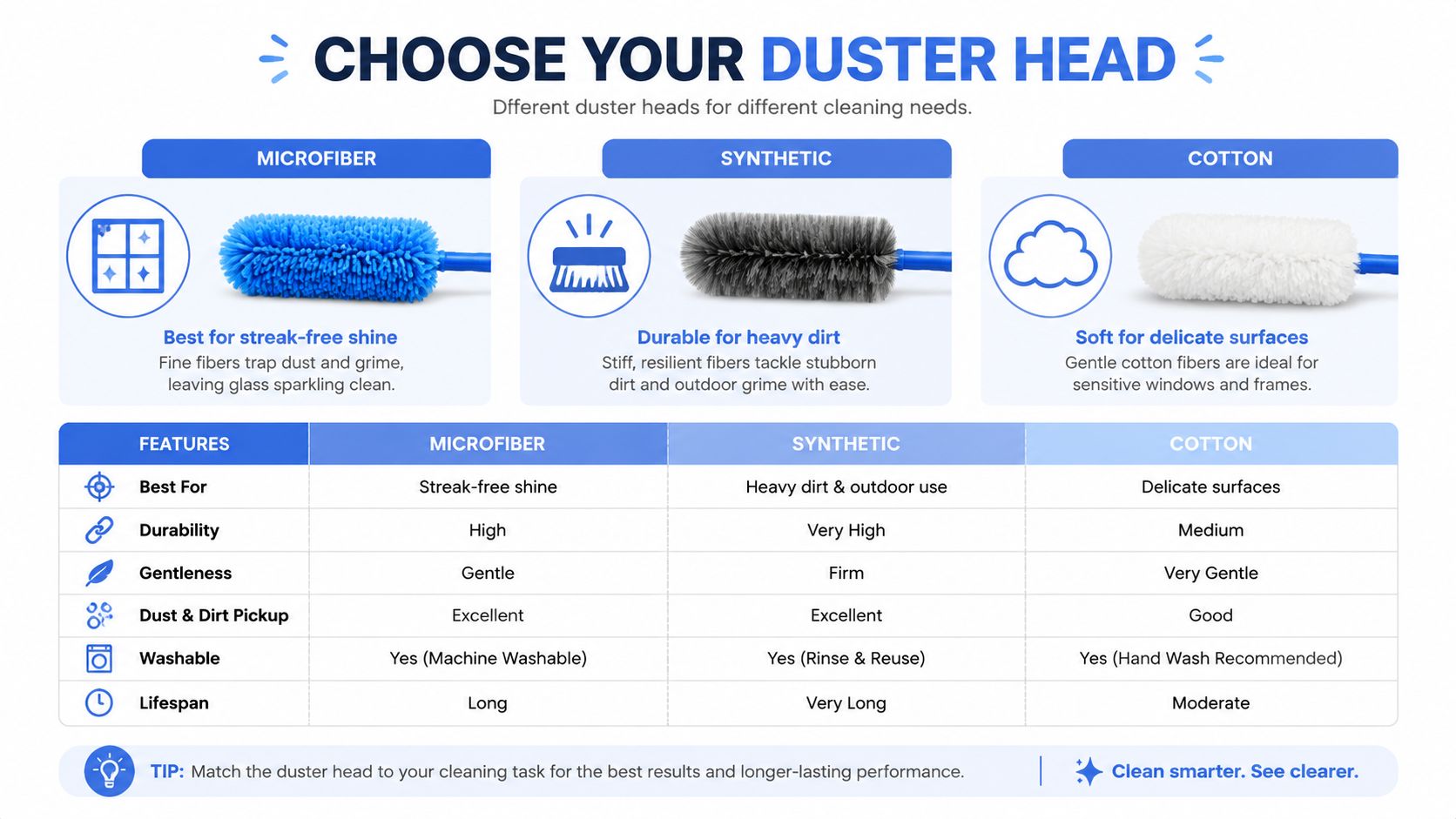
The duster head determines what happens between the pole and the glass. A soft, clean head can lift loose dust without marking the pane. A dirty, abrasive, or poorly designed head can drag grit across the surface and leave lint behind. Material choice matters most when the window has delicate coatings, painted frames, or visible sunlight that exposes every remaining fiber.
Microfiber is usually the most useful choice when the goal is to collect fine dust and leave a relatively clean surface. Its dense fibers can hold small particles better than a loose feather-style head, and a washable microfiber sleeve can serve as a practical maintenance tool for interior glass and trim.
Microfiber still has limits. If the sleeve is loaded with grit, dragging it across the window defeats the purpose of using a soft material. Wash it separately from heavily soiled cloths, avoid fabric softener, and let it dry fully before storage. A damp or contaminated sleeve can smear rather than lift.
Synthetic heads are durable and often keep their shape when used around frames, corners, and exterior surfaces. They're a sensible choice for heavier dry dust, cobwebs, and routine commercial maintenance where the head needs to tolerate repeated handling.
The trade-off is feel. A stiff synthetic head may provide better agitation, but it requires a lighter touch on glass. Don't force a rigid brush into the pane, and don't use it to attack stuck-on grit. Dry particles should be loosened carefully before any wet cleaning begins.
Cotton is soft and familiar, while traditional wool heads can provide gentle contact for delicate surfaces and light dusting. These materials can be useful where the priority is a low-abrasion touch rather than aggressive debris removal.
They may also shed, absorb moisture, or lose their shape more readily than a well-made synthetic or microfiber head. That makes them less predictable for a final glass finish. Test any unfamiliar material on a small, inconspicuous area, especially when the pane has a film, tint, coating, or unusual surface treatment.
Use the head as part of a sequence rather than expecting one attachment to do everything.
Professional squeegee work depends on a rubber blade, a washer or applicator, clean solution, and disciplined stroke control. Pure-water cleaning depends on purified water, a water-fed hose, and a brush that can scrub and rinse the glass, frames, and sills. The duster belongs earlier in the process, mainly as a dry-maintenance or debris-removal tool.
The right pole is the shortest one that reaches the work without forcing you to lean, twist, or fight the attachment. A fixed-length pole offers simple handling and consistent weight distribution, but storage and access can be inconvenient. A telescopic pole is more adaptable, though each section adds another point where flex, weight, and movement affect control.
For a single-story home, a modest pole with a soft microfiber head is often easier to manage than a long, fully extended setup. Commercial buildings may need a stronger pole and a synthetic head for exterior dust and cobwebs, but the operator still needs to select the minimum extension that reaches the target. High-rise work is a different category. A duster isn't a substitute for engineered access, trained technicians, or equipment selected for the building and conditions.
| Job Type | Recommended Pole Length | Best Head Material |
|---|---|---|
| Single-story residential windows | The shortest pole that reaches from a stable position | Microfiber for light dust |
| Commercial exterior maintenance | A controlled extension matched to the facade | Synthetic for heavier dry debris |
| High-rise or difficult-access glass | Specialist access equipment rather than a consumer duster | Professional brush or attachment selected for the system |
These are practical categories, not permission to work beyond your ability. A longer pole can reach farther, but it also magnifies small wrist movements at the head. A heavy head may remove debris faster while making shoulder fatigue arrive sooner. A narrow head can fit beside muntins and frames, while a broad head covers more glass but can be harder to keep flat.
A padded grip reduces discomfort, but it doesn't solve poor technique. Keep both hands positioned so you can guide the pole rather than push it upward. If the pole flexes excessively, shortness and control matter more than theoretical reach.
A long-handle squeegee is a different tool with a different purpose, and this long-handle squeegee guide can help clarify why pole length, attachment choice, and surface contact must be considered together. For dusting, choose a head that stays secure and presents a broad, even face to the glass. For washing, use the professional method that controls both cleaning and drying.
A pole that feels manageable in a shop or garage may behave differently outdoors. Wind catches the exposed length, the head can rotate, and the operator may compensate by leaning or pulling sideways. That's when a supposedly convenient tool becomes a control problem.
A duster on a pole changes the physical demand of cleaning. The farther the head extends, the greater the force at your hands and shoulders. Health-and-safety guidance recommends that poles up to about 10 m can be operated mainly with arm movement, but above that height operators should use more leg and whole-body movement because prolonged upper-body loading increases fatigue and strain, according to the Ergolite pole guidance.
The same guidance recommends selecting the shortest pole that reaches the target. A longer pole than necessary makes the pole less stable, and raises the effort needed to keep the brush or duster aligned with the glass. That loss of alignment often leads to more pressure, more fatigue, and less accurate movement.
Your posture matters as much as the pole. Keep the shaft as upright as the job allows, maintain a stable stance, and move your feet instead of stretching through the shoulders. Avoid horizontal “haul-up” motions, where the pole is pulled across the body or lifted from a low sideways position. Off-axis loading increases bending moment at the hands and shoulders and reduces control of the attachment, as explained in industry safety guidance for long water-fed poles.
Independent ergonomics research on long-handled cleaning tools also found that extendable handles can significantly reduce physical workload and low-back injury risk during vertical cleaning and furniture-dusting tasks, while window-cleaning guidance based on wearable-sensor data recommends specific movement patterns to reduce musculoskeletal disorders, as summarized in this ergonomics research record.
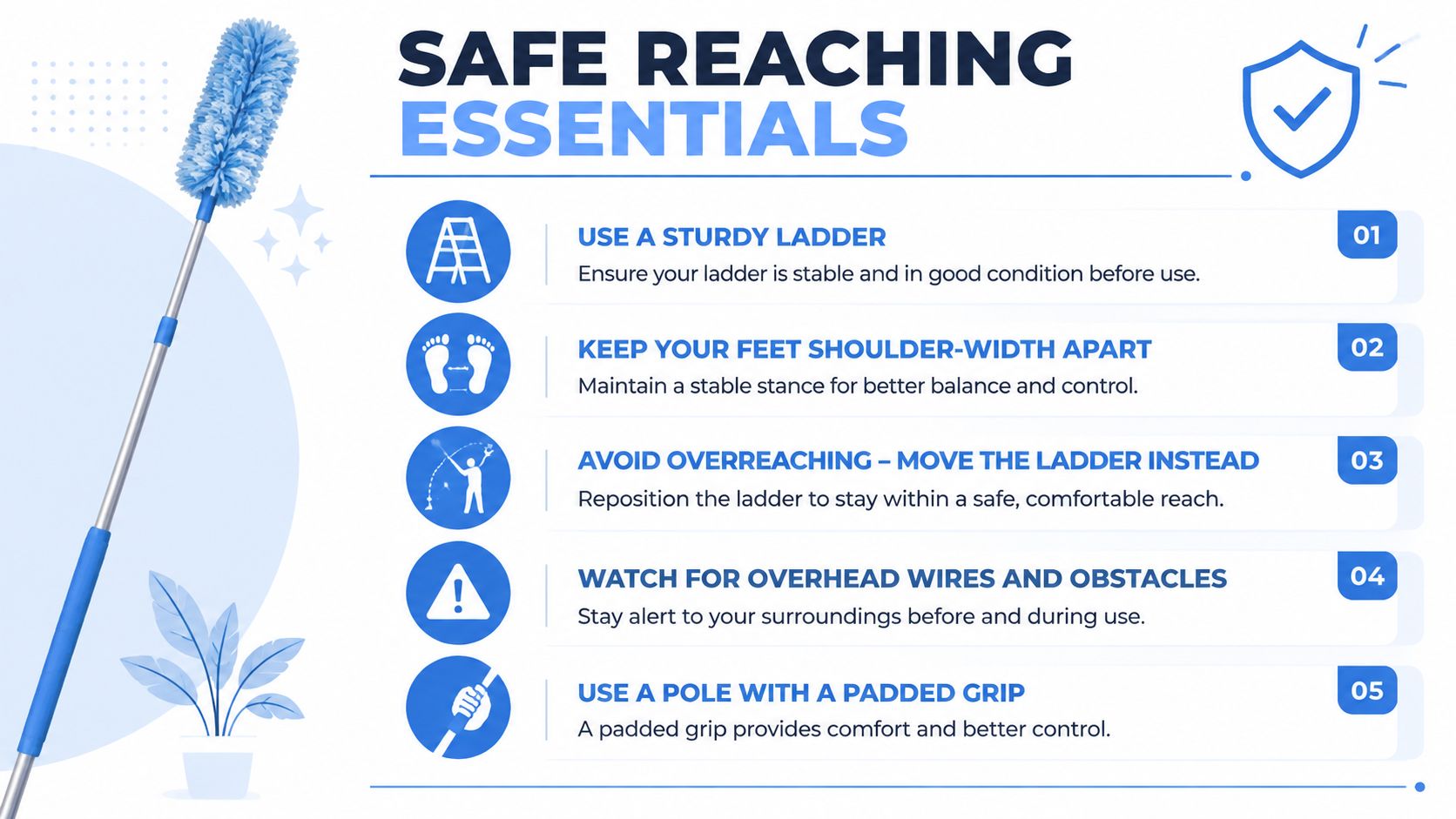
Aluminum poles should not be used close to high-voltage electricity sources. Long poles also shouldn't be used in high winds or near overhead power lines, because their exposed length increases the chance of unintended contact and control loss.
Before raising the pole, inspect the area for wires, branches, roof edges, balconies, lights, and unstable ground. A ladder doesn't make a risky reach safe if you're still leaning sideways or working beneath a hazard. Guidance on second-story window cleaning is useful because height, stance, access, and tool control must be considered together.
Stop if your grip is slipping, your shoulders are burning, the pole is bowing away from the glass, or wind is moving the head. A clean window isn't worth an electrical contact, a fall, or a damaged frame.
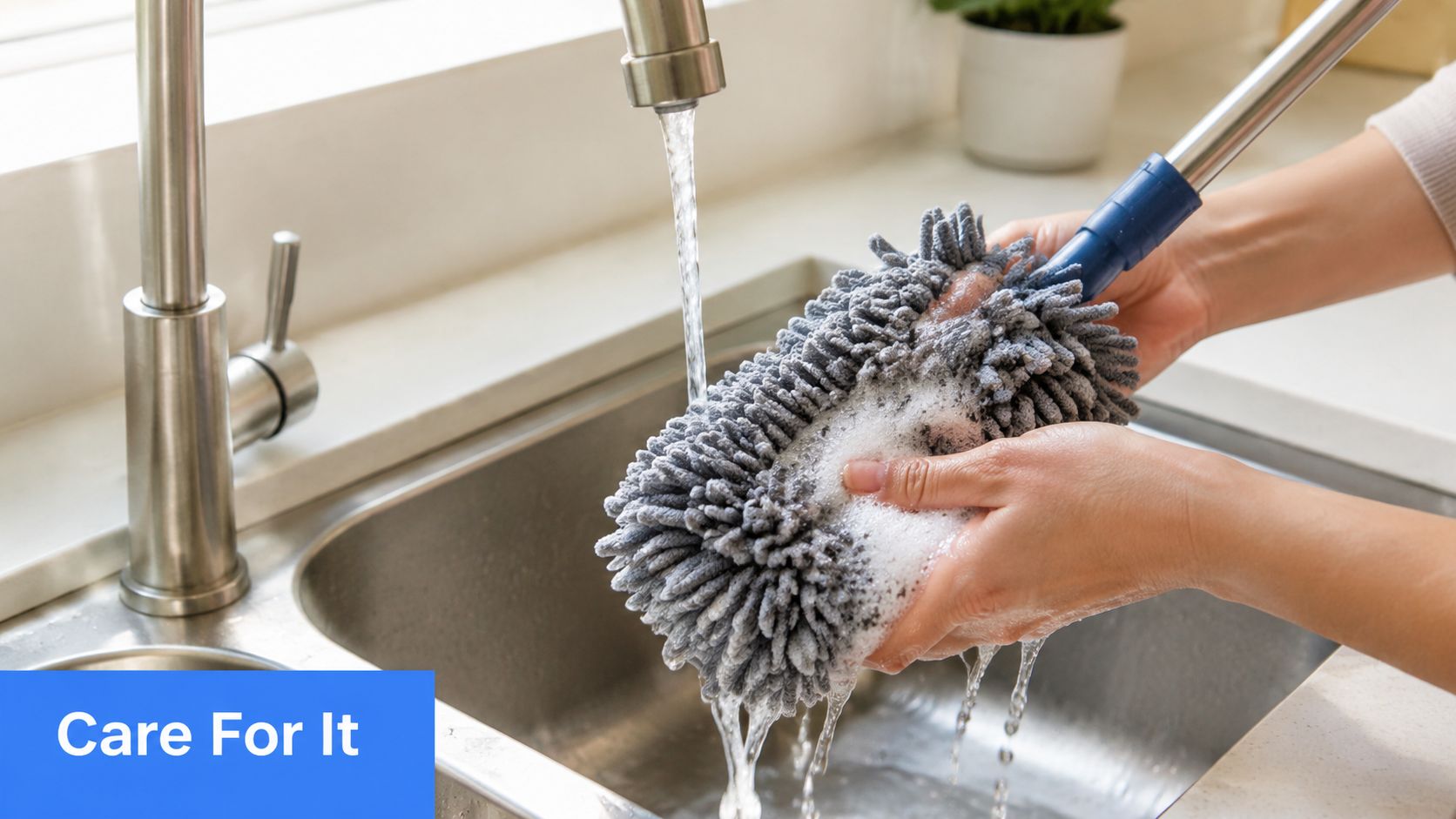
A duster head can redeposit the very dirt it removed if you don't clean it after use. Dust, grit, and oily residue stay in the fibers, then transfer to the next pane. That's why the basic maintenance routine begins before storage, not when the tool looks visibly dirty.
Remove the head from the pole when the design allows it. Shake or vacuum loose debris outdoors, then wash the microfiber, cotton, or synthetic component according to the manufacturer's care instructions. Rinse away soap thoroughly, allow the head to dry completely, and store it where it won't collect garage dust.
Inspect the pole at the same time. Check clamps, locking sections, threads, the attachment socket, and the grip. A head that twists under pressure won't track evenly, and a telescopic section that slips can create a sudden movement toward the glass or the operator.
Start at the upper corners and work across the pane in controlled vertical or horizontal passes. Keep the head flat and let the fibers collect dust instead of grinding it into the surface. Aggressive scrubbing can drag abrasive particles across the glass and may damage coatings or frames.
For cobwebs, lift the webbing away with the edge or face of the head. Don't jab at the glass. If debris feels stuck, stop dry dusting and use an appropriate wet-cleaning method after checking that the surface can tolerate it.
A duster can improve the first stage of a window-cleaning job, but it can't deliver the same result as a controlled wash. With a squeegee, the cleaner applies solution and removes it through consistent blade contact. With pure water, the cleaner brushes the glass, frames, and sills, then completes a top-to-bottom rinse with purified water so the surface can air-dry without manual drying, as described in this pure-water washing process.
Use a duster on a pole when the task is straightforward, the debris is loose, the glass is reachable from a stable position, and a maintenance-level result is acceptable. It's a useful tool for cobwebs around upper corners, light exterior dust, and quick care between full cleanings. It can also reduce the temptation to climb onto furniture or improvise with an unstable ladder.
Call a professional when the work demands more than reach. Heavy hard-water staining, bonded construction residue, difficult screens, fragile coatings, and high or awkward windows require judgment that a consumer duster can't provide. A dry head may remove loose material, but it won't dissolve mineral deposits or remove a film of grime from the pane.
If you need glass to look clear from close range, reach alone won't guarantee success. A duster may leave fine particles, lint, or a haze, especially when the head is old or the surface has oily residue. Professional window cleaners use only a squeegee or a pure-water system for the actual window-cleaning process.
The squeegee method gives the technician direct control over solution, blade angle, overlap, and drying. The pure-water method uses purification, a water-fed hose, and a brush to scrub and rinse the glass, frames, and sills before the final rinse. Those methods take more equipment and training, but they address the full cleaning cycle rather than only the loose dirt on top.
Residential owners may handle accessible windows themselves, while property managers need consistent results across many panes. Commercial buildings, medical offices, car dealerships, stadiums, condominiums, and high-rise properties also introduce public-safety concerns, worksite coordination, and access limitations. A pole that is acceptable in a quiet living room may be unsuitable near pedestrians, traffic, electrical lines, or wind-exposed facades.
Professional Window Cleaning provides residential window cleaning, commercial window cleaning, and high-rise window cleaning services, including work in Las Vegas, Phoenix, Denver, and Scottsdale. The company also serves Flagstaff, Tempe, Chandler, and Gilbert. The sensible choice is simple: dust what you can control safely, and bring in trained cleaners when height, staining, access, or finish quality makes the job hazardous or unpredictable.
Professional Window Cleaning can assess your windows and choose between a squeegee or pure-water system based on the building, access, and finish required. Visit Professional Window Cleaning to request service for residential, commercial, or high-rise windows in the communities served across Arizona, Colorado, and Nevada.
Read our blog posts regularly and keep learning.