Care and Maintenance
Casement Window Cleaning the Right Way at Home
Learn safe, streak-free casement window cleaning techniques. Covers tools, prep, hardware care, frequency, and when to call a pro.


Late afternoon sun hits the upper glass, and every flaw jumps out at once. Dust, pollen, water spots, and old streaks suddenly look impossible to ignore. Then you step outside, look up at that second-story window, and realize the actual task is not wiping glass. It is choosing a method you can control safely.
That decision is where many homeowners go wrong. They treat second story window cleaning like a basic chore with a longer reach. It is a different job. Height changes your footing, your tool control, your line of sight, and the margin for error. A method that works fine on a first-floor picture window can become sloppy, tiring, or dangerous a floor higher.
After more than 26 years in the trade, I can tell you the glass itself is only part of the problem. The bigger question is access. Can the window be cleaned well from the ground with a pole? Does the layout force ladder work? Are there shrubs, sloped soil, deep flower beds, or awkward screens that turn a simple plan into a risky one? The right answer depends on the house and on the person doing the work.
Professional results come from two things working together. Sound technique and safe setup. If either one is weak, the job usually goes sideways. The smartest approach is to assess the window first, then pick the method that matches the height, the obstacles, and your actual skill level.
Most second-story jobs look easier from the driveway than they are once you start. A homeowner sees a few dusty upper panes and thinks, “I'll grab a ladder, a bucket, and knock this out.” But then the genuine issues appear. The window sits above shrubs. The grade slopes away from the wall. The screens are awkward. The sun is baking the glass. The pole feels controllable at first, then starts flexing and wobbling at full extension.
That's why high-window work needs a decision before it needs a tool. The first question isn't how to clean the glass. It's how to reach it without turning a maintenance job into a fall risk.
Second-floor windows collect a different kind of mess than lower panes. Wind pushes dust upward. Pollen sticks to warm glass. Spider webs build in upper corners and under trim. On many homes, sprinkler mist or runoff leaves spotting where you can't easily see it until the sun lights it up.
The cleaning itself also gets less forgiving as height increases:
Practical rule: If the method makes you fight the equipment, stop and rethink the setup before you keep going.
For professional work, it comes down to squeegee or pure water.
The squeegee method is direct-contact cleaning. You scrub the glass, remove the solution with a blade, and detail the edges. It gives excellent control and close inspection, but it demands skill. At height, it also demands safe access.
The pure-water method uses filtered water through a water-fed pole. You agitate the surface with a brush, rinse thoroughly, and let pure water dry on the glass without leaving mineral spots. On many second-story homes, that's the safer and more efficient route because it keeps the operator on the ground.
Neither method is magic. Both work when the setup fits the house. Neither works well when the operator chooses the wrong access plan.
Professionals don't start by filling a bucket. They start by reading the site. That habit prevents streaks, broken glass, damaged screens, and bad ladder decisions.
Before you touch a window, walk the whole side of the house and look up. Then look down. Upper-glass work fails as often because of what's under the window as what's on it.
Consumer Reports advises checking for loose panes, damaged putty, and nearby electrical wiring before extending a pole, and notes that a telescoping pole with interchangeable heads is safer than standing on a ladder for high windows in many situations (Consumer Reports on cleaning high windows).
Use that as your baseline checklist:
Glass condition
If a pane looks loose, cracked, or poorly set, don't scrub aggressively. Pressure can turn a cleaning job into a repair bill.
Frames and seals
Old caulk, brittle glazing, and failing seals don't like heavy water exposure or rough pads.
Overhead hazards
Wires change the whole plan. A long pole near electrical lines is not a casual risk.
Ground conditions
Soft beds, decorative rock, wet concrete, uneven pavers, and sloped soil all affect footing and ladder stability.
Reach reality
Don't assume because a pole extends that you can control it well at full length.
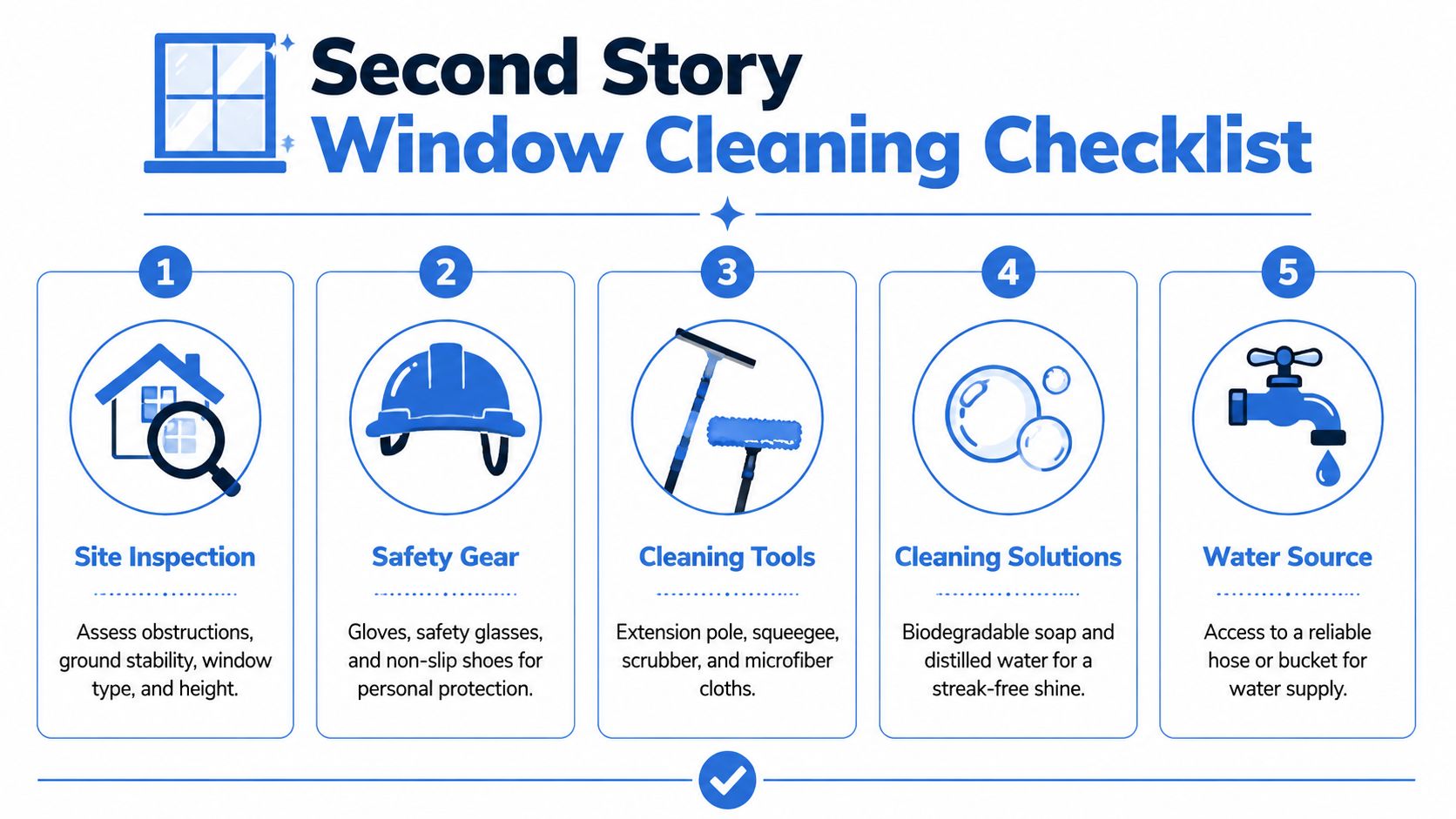
A proper setup isn't about owning more tools. It's about owning the right ones.
| Tool | Why it matters |
|---|---|
| Telescoping pole | Lets you work from the ground on many second-story windows |
| Interchangeable scrubber and squeegee heads | Keeps the workflow controlled without makeshift attachments |
| Microfiber cloths | Handles edge detailing, frame wipe-downs, and cleanup |
| Gloves with grip | Improve control on wet tools and reduce hand fatigue |
| Safety glasses | Protect against drips, debris, and dirty runoff from above |
| Non-slip footwear | Matters on wet driveways, stone, and pool decks |
| Pure-water pole setup | Best for homes where ground-based rinsing is the smarter option |
For ladder-based work, the ladder itself has to fit the house and the terrain. If you're unsure how height selection changes safety and reach, this guide on what size ladder for a 2 story house is worth reading before you buy or borrow anything.
Some DIY shortcuts cause more trouble than they solve:
Good second-story work starts before the first swipe. If the inspection is rushed, the cleaning usually is too.
If a window can be cleaned well from the ground, that's usually the right call. Ground-based cleaning removes the biggest hazard in one move. You keep both feet planted, your body stays more stable, and you can stop the moment the tool becomes hard to control.
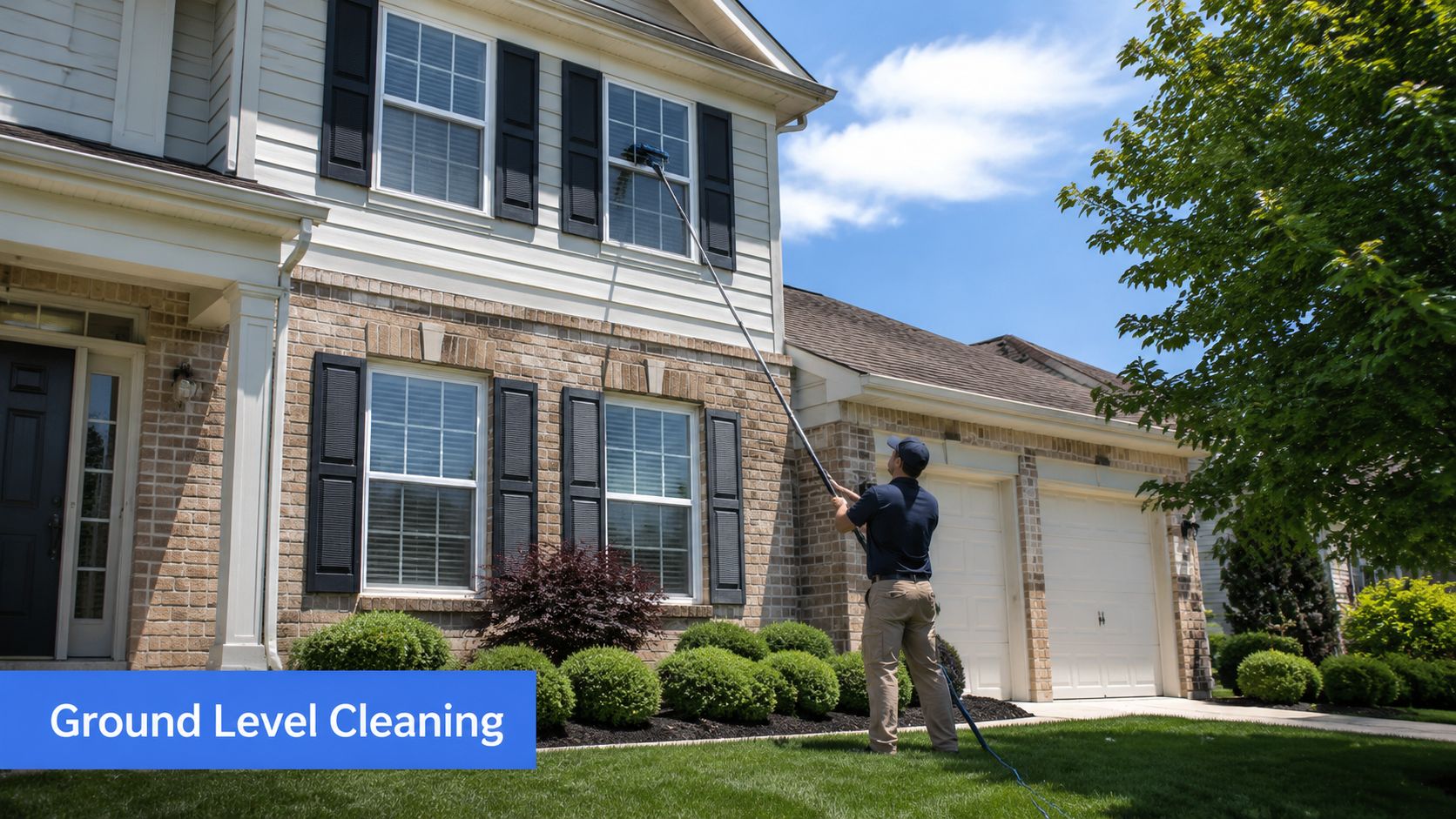
There are two ways pros do this. One uses a traditional pole with a scrubber and squeegee. The other uses a pure-water system with a water-fed brush. Both have a place. The right choice depends on the glass, the access, and how much finish quality you can produce from below.
This is the classic ground method. You apply solution with a scrubber or sponge head, agitate the dirt, switch to a squeegee head, and remove the water in controlled passes. Then you detail any remaining edges if you can safely reach them.
The workflow is simple, but the execution isn't:
A lot of homeowners struggle because they extend the pole farther than they can manage. The farther the glass is from your hands, the more small wrist mistakes become visible streaks.
For more practical reach strategies, this guide to reach window cleaning helps show where pole work is realistic and where it stops being efficient.
Pure-water cleaning is often the professional answer for second-floor exteriors. The system filters minerals out of the water so the rinse can dry clear on the glass. Instead of scrubbing, squeegeeing, and detailing every pane by hand from a distance, you brush the surface and rinse thoroughly.
That changes the job in a good way on a lot of homes:
Pure water isn't perfect for every condition. Heavily soiled first-time cleans, greasy residue, and poorly maintained windows may need more agitation or closer work. But for regular maintenance on accessible exteriors, it's hard to beat.
Here's a look at pole work in action:
Use this simple comparison:
| Situation | Better fit |
|---|---|
| You want direct control over each pass | Squeegee pole |
| You need safer exterior maintenance from the ground | Pure-water pole |
| The glass has stubborn residue and needs close technique | Squeegee, if access is safe |
| The windows are part of a regular maintenance schedule | Pure water |
If the pole starts feeling heavy, shaky, or hard to guide, that's your signal. The setup is no longer working for you.
A second-story window can look straightforward from the driveway. Then you set a ladder, climb a few rungs with wet hands and a tool belt, and realize the job has changed. The main question is not whether you can reach the glass. It is whether you can work it safely, keep proper body position, and get back down without forcing the setup.
That is the part many DIY guides skip. Window cleaning on a ladder is not just ladder use. It is ladder use while your eyes track soap, edges, blade angle, frame dirt, and footing at the same time. A homeowner who is comfortable changing a light bulb from a ladder may still be a poor candidate for second-story glass.
IPC notes that UK annual statistics show about 30 workers suffer serious accidents each year in this sector, a reminder that high-level window work is a specialized trade shaped by safety demands (IBISWorld industry overview citing IPC safety context).
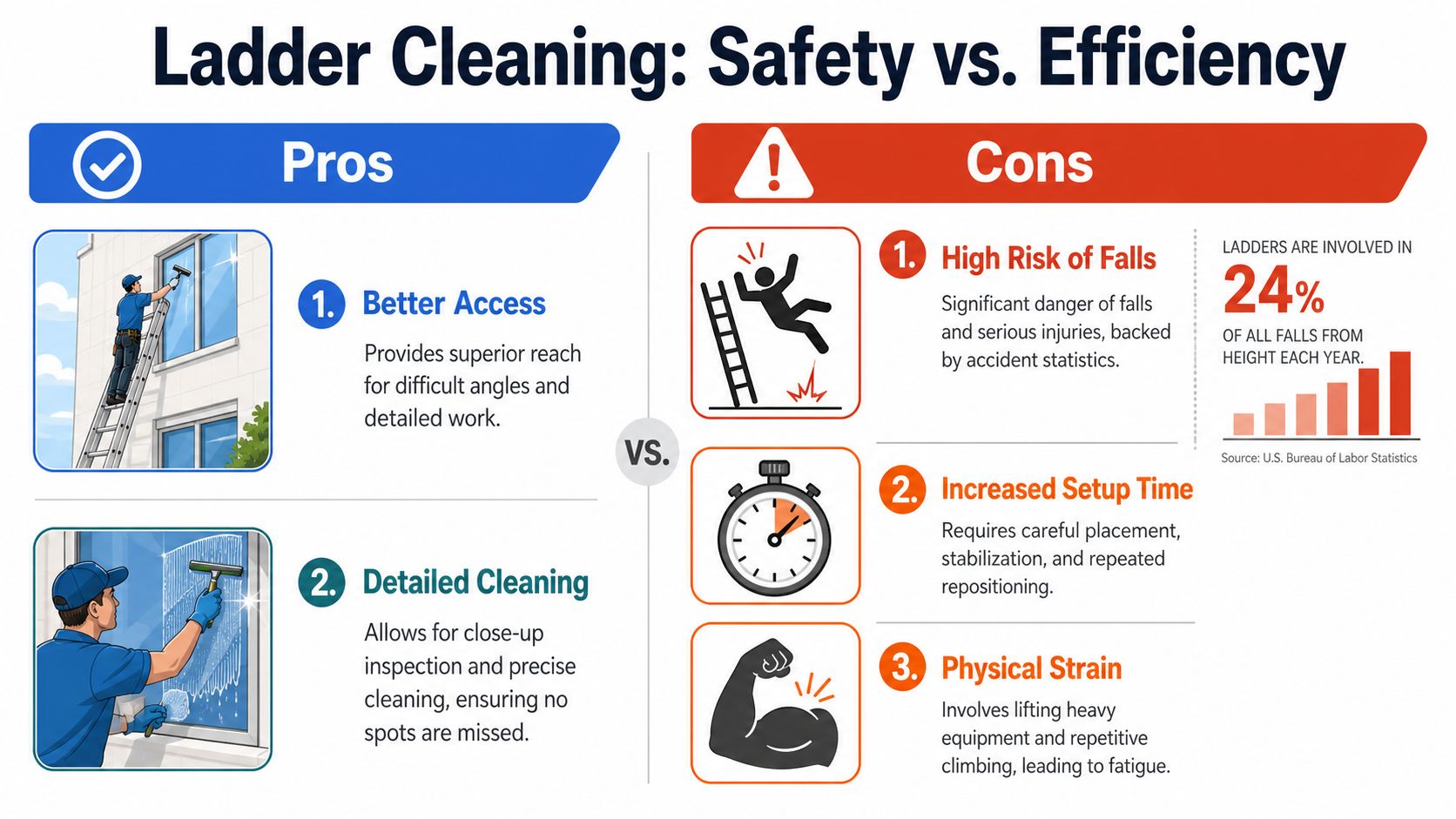
Some houses rule out ladder cleaning before you even unload the tools. Shrubs that push the ladder feet off line, sloped ground, loose gravel, stairwells, roof transitions, and overhead power lines all raise the risk fast. Wind does the same. A setup that feels stable at ground level can feel completely different once you are high enough to work the top sash.
Use a simple test. If the job requires leaning sideways, reaching past one shoulder, or twisting your hips to finish the edge, the ladder position is wrong. If there is no safe place to reposition the ladder and stay centered on the pane, close-up hand work is the wrong method for that window.
I have seen plenty of homeowners make the same mistake. They judge the climb, not the work. The climb may be manageable. The cleaning motion is what gets them in trouble.
Before climbing, check these points every time:
If your gutters need work too, treat that as a separate decision. Review these gutter cleaning tips before combining tasks. Fatigue and rushing are common after the window work is done, and that is when people start making poor choices.
Safe access gives you something pole work cannot. Direct control. You can see contamination at the corners, spot a torn screen tab, feel hardened debris under the mop, and correct the pass immediately. That said, close work only pays off if your body position stays solid and your strokes stay simple.
A good ladder squeegee routine looks like this:
Wet the pane fully
The glass needs an even film. Dry spots make the rubber skip.
Scrub the top edge and corners first
That is where bug marks, oxidized frame residue, and packed dirt usually sit.
Work with short, controlled pulls
On a ladder, shorter strokes are usually smarter than big showy movements.
Overlap each pass slightly
Small overlaps prevent thin lines between pulls.
Wipe the rubber often
One speck of grit can leave a line all the way down the pane.
Touch the edges lightly with microfiber
The cloth should pick up leftover moisture, not do the whole job over again.
Straight pulls are often the better choice for homeowners because they are easier to control on a ladder. Fanning can be faster in trained hands, but it asks more of your wrist angle, balance, and pressure control. If you are fighting the blade while trying to stay centered between the rails, the technique is too advanced for the setup.
That is the larger decision here. The best method is not the one that looks most professional. It is the one you can perform without stretching, hesitating, or improvising halfway through the pane. On second-story windows, professionalism means clean glass and safe choices at the same time.
Second-story glass fools people. It can look clean from the ground, then show every streak once the sun shifts or you come upstairs and see it at eye level.
That usually comes down to judgment more than effort. Homeowners often pick one method, one soap mix, and one pace for the whole house. Upper windows rarely reward that. A shaded side, a hot west-facing pane, and a window above a dusty screen frame all need slightly different handling.
Maintaining clean Auckland windows starts with the same rule I use anywhere else. Match the method to the conditions, not to what looked easy in a video.
A practical guide from Purilly on washing second-story windows recommends working on a cloudy day, keeping the blade clean, and not letting solution sit on the glass too long in sun or wind. That lines up with what happens in the field. Most streaks come from solution drying too fast, residue left by an overly strong mix, or dirt getting dragged back across the pane.
Here are the usual causes:
One point gets missed in a lot of DIY guides. Some streaks are not a cleaning mistake. They are a method mismatch. If the pane is drying before you finish a pass with a pole, the answer may be to change sides of the house, shorten the work area, or stop and come back under better conditions.
Most fixes are simple, but they only work if you diagnose the right problem first.
| Problem | Better approach |
|---|---|
| Soap haze | Use less soap and change out dirty solution sooner |
| Drying too fast | Clean that side early, work in shade, or break the pane into smaller sections |
| Edge drips | Wipe frames, top edges, and sills before the final glass pass |
| Random streak lines | Check the rubber for grit, nicks, or hardened edges |
| Spots after drying | Rinse better or use purified water if your tap water leaves minerals |
Hot, bright climates expose weak technique fast. Solution can dry before a slow pass is finished. In that case, speed alone is not the fix. The better choice may be a smaller applicator, a lighter mix, or waiting until the glass is out of direct sun.
The pattern I see most often is forcing one approach onto every second-story window. That is how homeowners end up overworking the glass, leaning too far from a ladder, or trying to polish out residue with a towel.
A few repeat offenders cause most of the trouble:
Starting with the pane and ignoring the frame
Loose dirt above the glass will run down into your finished work.
Using more pressure to chase a streak
Pressure does not fix bad rubber, dirty water, or dried soap.
Overwetting the window
Extra solution creates more runoff, more edge detail, and more chances for spotting.
Trying to correct everything from one position
If you cannot reach the corner cleanly from where you are, change position or change methods.
Continuing after conditions turn against you
Wind, heat, glare, and fatigue make upper-window work worse in a hurry.
The cleanest result usually comes from restraint. Use less soap than you think. Make fewer correction passes. Stop when the setup stops making sense.
That is part of professional judgment too. Clean glass matters, but choosing not to push a bad setup matters just as much.
You get halfway through a second-story job, the pole is flexing, one window sits above a sloped bed full of shrubs, and the only way to fix the last corner looks like a ladder move you should not make. That is the point where the decision has already been made. The job has moved past reasonable DIY.
A professional earns the fee by knowing where that line is before setup starts.
Residential window cleaning prices vary by region, window count, access, and how much detailing the house needs. Upper-story work usually costs more because access takes longer, risk goes up, and the cleaner may need different tools for different elevations. Recent U.S. pricing guides also note that second- and third-story windows often carry added cost over first-story work, whether the company prices by visit or by pane (Angi window cleaning cost guide).
That extra cost is not just for labor. It covers safer setup, better control on upper glass, screen handling, edge detailing, and the judgment to stop using one method when another is the safer choice.
Hire the work out if the house asks for more than basic reach and rinse.
Common examples include windows over hardscape, steep grades, delicate landscaping, or rooflines that force awkward ladder placement. The same goes for dormers, entry glass above stairs, divided panes that need detail work, or any window where you cannot tell, from the ground, how you would recover if the first approach fails.
Skill matters here. So does honesty.
If your only plan is "I'll figure it out once the ladder is up," call a professional instead. Good window cleaning is not just getting the glass wet and pulling a squeegee across it. It is choosing a method that still works when the window is high, the footing is imperfect, and the margin for error is small.
For a homeowner view from another market, Maintaining clean Auckland windows makes the same basic point. The primary decision is usually about access, exposure, and consistency, not effort.
Use three filters before you start:
That third question matters more than homeowners expect. A lot of bad ladder decisions happen after the first streak, missed edge, or stuck screen. Frustration pushes people into one more stretch, one more step, one more pass from a poor position.
That is where professionals are different. We do not just clean windows. We assess access, pick the least risky method that will still produce a good result, and change the plan when the setup says we should.
If your answers are uncertain, hire the job out. That is a sound call, especially in hot, dusty, or windy conditions where upper windows get harder to clean well and harder to clean safely.
If you'd rather have the job handled safely and done right the first time, Professional Window Cleaning serves homes and businesses across Arizona, Colorado, and Nevada with the two methods professionals trust: expert squeegee work and pure-water cleaning. If your second-story windows need attention and you'd like an experienced crew to take the risk off your hands, reach out and schedule a quote.
Read our blog posts regularly and keep learning.