Care and Maintenance
Residential Window Cleaning Phoenix: What to Know
Residential window cleaning phoenix - Looking for expert residential window cleaning in Phoenix? Get streak-free results and local tips that keep your home


You wash the window on a hot afternoon, step back, and it looks clean. By the time the glass catches full sun, the spots show up again. White dots, dull haze, and hard crust along the edges are classic hard water stains, and in Arizona, Nevada, and Colorado they build fast because mineral-heavy water dries quickly and leaves the deposits behind.
I've been dealing with this for more than 26 years, and the same mistake comes up over and over. Homeowners treat these marks like ordinary dirt. They are dealing with mineral buildup bonded to the glass.
That difference matters.
Hard water stains removal works best when the method matches the severity of the stain. Light spotting can often be cleaned up with basic acidic cleaners and the right towel work. Moderate buildup usually needs stronger products and better technique. Severe staining can cross into surface damage, where polishing gets limited results and replacement sometimes becomes the honest answer.
If you want a simple breakdown of how water spots form in the first place, this explanation of what causes boat water spots lines up with what we see on residential glass. The surface changes, but the mineral problem is the same.
The goal is not to scrub harder. The goal is to tell the difference between removable deposits and glass that has already been etched, then use the least aggressive method that will work.
Hard water contains a high concentration of dissolved minerals, mainly calcium and magnesium. It's classified as hard at 121 to 180 mg/L of calcium carbonate and very hard above 180 mg/L, according to Lysol's explanation of hard water. When that water evaporates, those minerals stay behind on the glass.
That's what creates the chalky white spots, hazy film, and crusted drip lines people keep trying to wash off with ordinary glass cleaner.
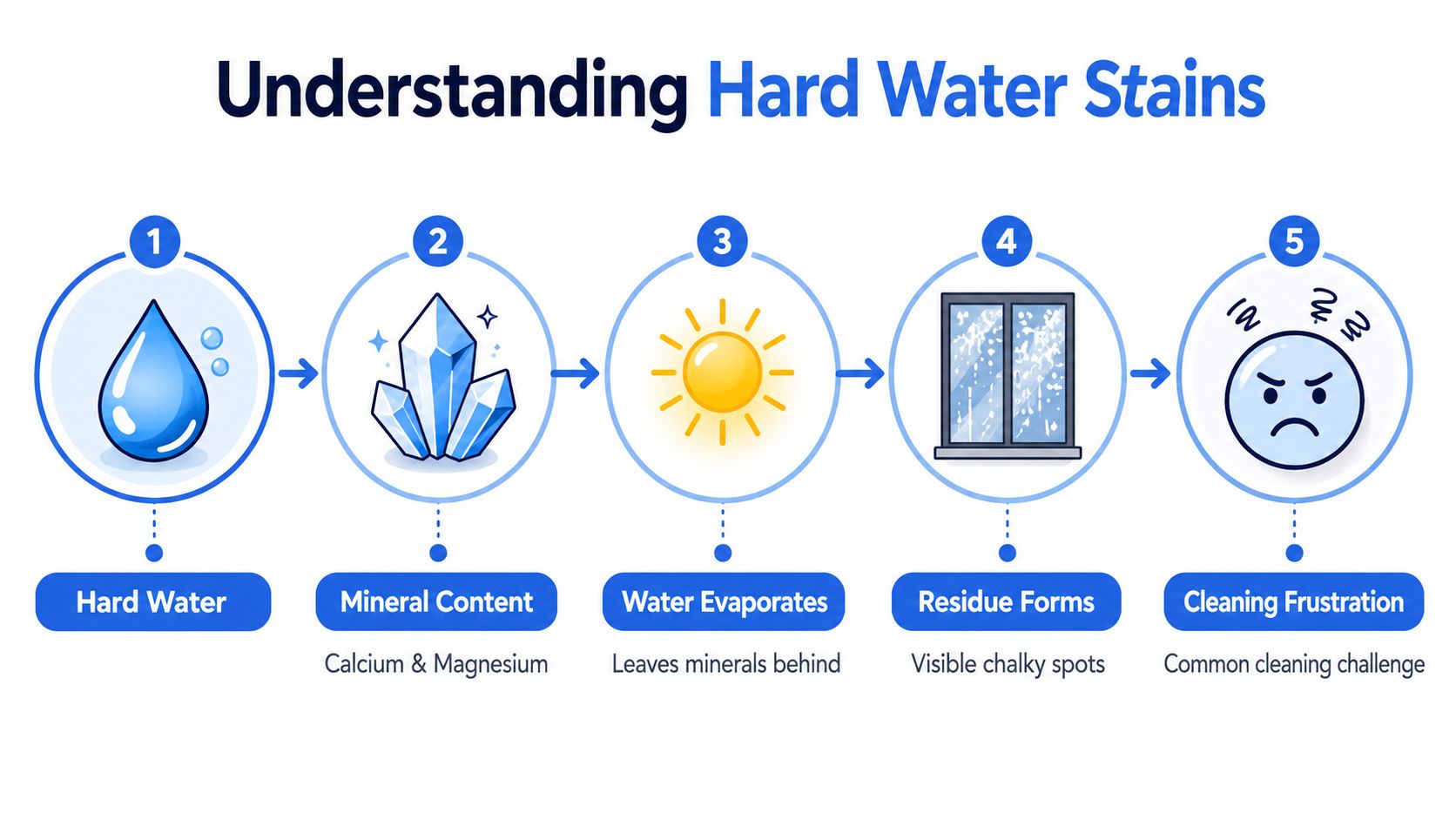
Arizona, Nevada, and Colorado homeowners see this more often because mineral-heavy water and fast evaporation work together. Sprinklers hit the glass. Hose water dries in the sun. Shower steam settles, then disappears. The residue doesn't.
A basic wash won't solve that because you're not removing dust anymore. You're trying to dissolve a mineral deposit.
Practical rule: If a spot comes back right after normal cleaning, it usually isn't dirt. It's mineral residue bonded to the surface.
Fresh stains usually look like scattered dots or a light haze. Older stains build into thicker patches or rings. The longer they sit, the more stubborn they become, and eventually the deposit can leave behind physical damage in the glass itself.
That's why the chemistry matters. Acidic cleaners work because they react with the alkaline mineral buildup and break it down. White vinegar is the usual first step because it can dissolve calcium carbonate without being overly aggressive on most finishes.
If you've ever looked into what causes boat water spots, the same principle applies. Mineral-rich water dries, leaves deposits behind, and repeated exposure makes removal more difficult over time.
Hard water stains aren't a sign that you cleaned badly. They're the result of a specific mineral process. Once you understand that, the fix gets a lot more straightforward.
When the stain is fresh and still sitting on the surface, start simple. The best first move is a vinegar solution, applied with patience instead of brute force.
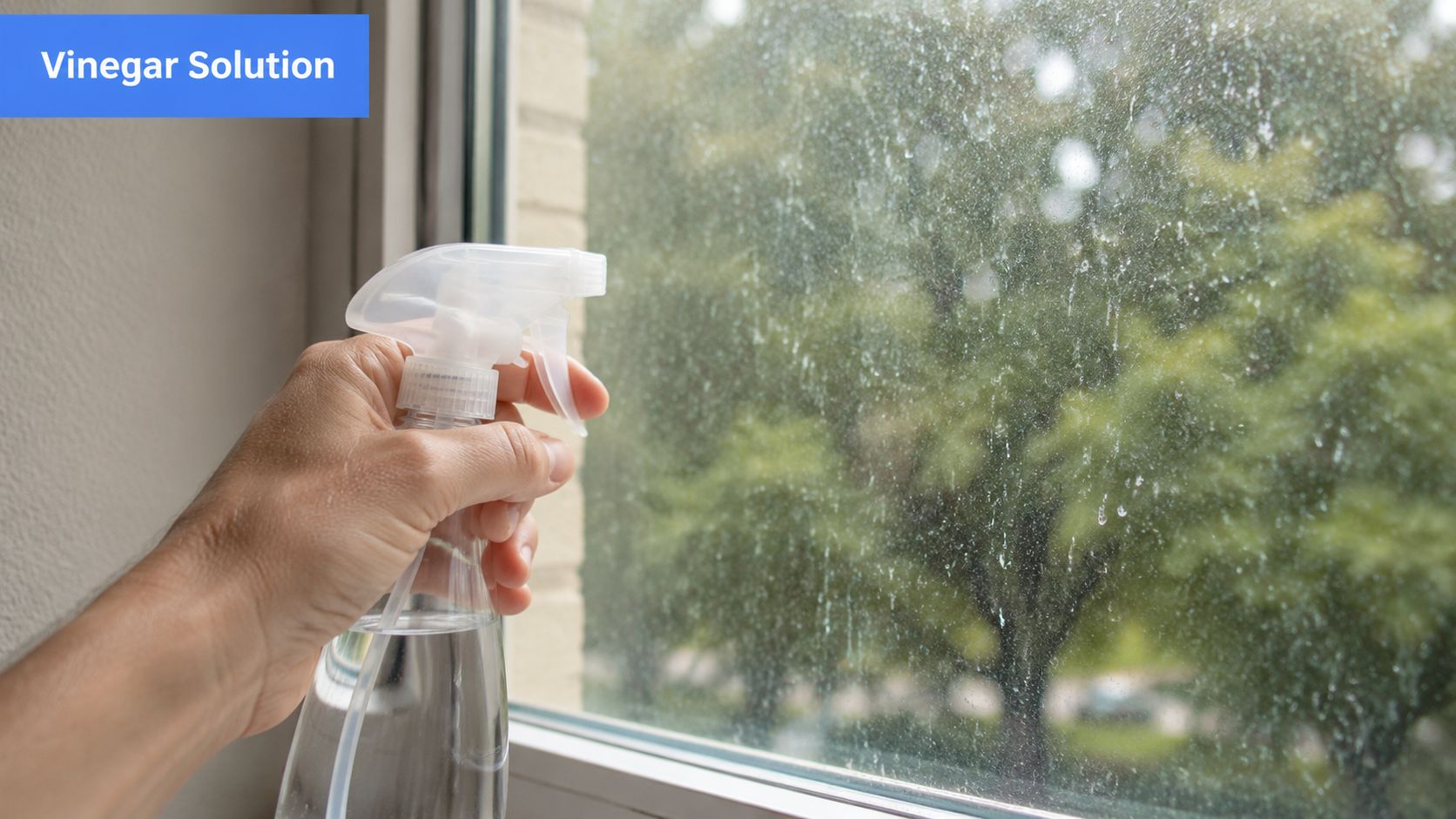
For light mineral spotting, a 50/50 mix of white vinegar and water is a practical starting point. Spray it onto the stained glass until the surface is evenly wet, but not dripping all over the frame.
The key isn't the spray bottle. The key is contact time.
According to Good Housekeeping's hard water stain guidance, vinegar should sit on the glass for at least 5 to 10 minutes to begin dissolving light deposits. For slightly tougher spots, 15 to 30 minutes is the standard dwell time.
If you spray vinegar on and wipe it off right away, you usually haven't given the acid enough time to do the job.
Use this order:
If the stain is on a vertical pane and the vinegar keeps running off, press a vinegar-soaked cloth against the glass so the solution stays in contact with the deposit longer.
A few tool choices make a big difference.
Here's a visual walkthrough of the basic approach:
A lot of DIY jobs fail at the rinse stage. People dissolve part of the mineral stain, then rinse with the same hard water that caused the problem in the first place.
If you can, use distilled water for the final rinse and dry the glass completely with a clean microfiber. That last wipe is what separates a clean pane from a streaky one.
A light stain should respond to this method. If it fades but doesn't clear, that tells you something important. The deposit is past the easy stage, and it's time to step up from kitchen-shelf cleaning to a product designed specifically for mineral removal.
Moderate stains live in the middle ground. Vinegar softens them, but doesn't finish them. They aren't thick enough to look like scale on a shower valve, yet they're bonded tightly enough that basic household cleaning leaves a haze behind.
Many people make the wrong move at this stage. They assume the answer is the harshest cleaner on the shelf. On glass, that's often how you trade a stain problem for a scratch problem.
Moderate hard water staining usually shows up like this:
In places like Denver, exterior glass often gets a mix of mineral spotting and ordinary grime. That combination fools people into thinking one more wash will solve it. It won't. Once the dirt is gone, the mineral pattern is still there.
Look for products built for mineral-dissolving or non-abrasive polishing work on glass. Labels matter here. A cleaner made for soap scum or tile isn't automatically safe for window glass.
A smart choice usually has one of these characteristics:
| Product type | Good use | Main caution |
|---|---|---|
| Mild acidic cleaner | Breaking down bonded mineral film | Keep it off sensitive surrounding finishes |
| Glass polishing compound | Working on stubborn haze without heavy scratching risk | Test first on a small area |
| Specialty hard water remover | Targeted stain removal on glass and fixtures | Follow dwell and wipe directions carefully |
The wrong products fail for predictable reasons.
Moderate stains need control, not aggression. The best cleaner is the one that removes minerals without changing the surface of the glass.
Before using any commercial remover, ask three questions.
Does it say it's appropriate for glass?
Does it rely on mineral removal rather than brute abrasion?
Can you test it in an inconspicuous spot before doing the whole pane?
If the answer to any of those is no, keep shopping.
Moderate stains are often recoverable with the right chemistry and careful technique. But once the buildup becomes dense, layered, or partly etched into the surface, store-bought cleaner alone usually isn't enough.
Severe hard water damage is where the job stops being routine. At this stage, you're not wiping off spots. You're working on buildup that may have baked into the surface or already started to etch the glass.
That's why technique matters as much as product choice.
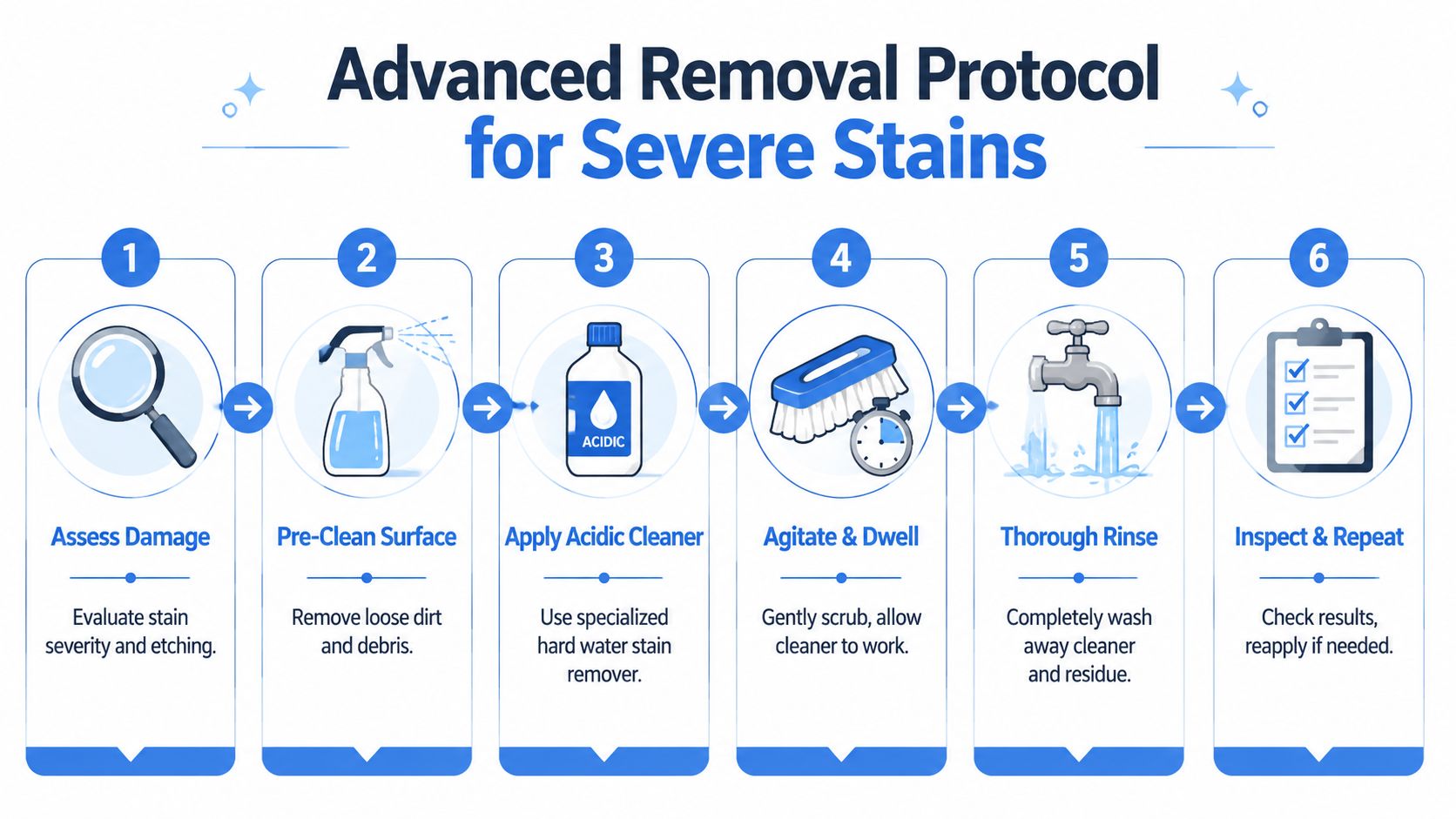
A severe stain calls for a structured approach, not guesswork. A professional five-stage method outlined in this hard water stain removal demonstration involves initial cleaning, applying a mineral-dissolving polish, working it in with light circular pressure, rinsing thoroughly, and buffing with a clean microfiber. The same source warns that pressure should stay at 2 to 4 lbs max, and going beyond that risks permanent glass abrasion.
That pressure limit matters more than is often realized. Severe stains tempt people to lean in harder. That's exactly how glass gets damaged.
Use a damp microfiber and a specialized mineral-dissolving polish. Work a small area at a time. Keep the motion circular and controlled.
For stubborn residue, some pros will use #0000 steel wool with extreme lightness and plenty of lubrication. This is not a general DIY recommendation. It's a precision move, and if the glass already has defects or debris on the surface, you can make things worse fast.
A practical workflow looks like this:
Severe stain removal is part chemistry, part touch. The wrong pressure can do permanent damage long before the stain disappears.
Severe hard water damage often gets confused with etching. They can look similar, but they aren't the same. Mineral deposits can often be dissolved or polished off. Etching is actual surface damage.
That's why repeat passes should be deliberate. If the deposit is shrinking, continue carefully. If the white mark is gone but the glass still looks dull or textured, you may be looking at etched glass rather than remaining buildup.
For stronger acid-based approaches, it helps to understand where products fit and where they don't. A useful reference is this overview of a phosphoric acid cleaner, especially for understanding why acid selection and surface compatibility matter.
What works on glass doesn't automatically work on nearby stone, trim, or specialty finishes. Acid can damage certain materials, and severe buildup around edges often touches more than one surface. Tape off what needs protection, and don't let runoff decide for you.
When a stain has gone from visible deposit to true glass damage, the goal changes. You're no longer removing contamination. You're deciding whether polishing can improve the appearance enough, or whether the glass needs professional restoration or replacement.
You finish cleaning the glass, it looks clear for a week, then the same white spots show up in the same places. In Arizona, Nevada, and parts of Colorado, that usually means the water source never changed. The stain keeps returning because the minerals keep landing on the glass and drying there.
Prevention starts with pattern recognition. Check where the spotting begins. On desert homes, it is often irrigation overspray, hose runoff, pool splash, misting systems, or condensation that sits too long on shaded panes. On shower glass, it is the daily film left behind when hard water evaporates. If you fix the water path, maintenance gets much easier.
Light staining responds well to simple habits done consistently.
For bath glass, the same maintenance routine applies. This guide to shower door maintenance for homeowners covers the daily habits that make a real difference.
In Phoenix, Las Vegas, Scottsdale, Henderson, and many Front Range areas of Colorado, the water can be hard enough that wiping alone turns into a constant chore. That is when a tiered approach makes sense.
For mild spotting, routine drying and a basic glass-safe protectant are usually enough.
For moderate repeat spotting, a hydrophobic sealant helps water bead up and release more cleanly. It does not stop minerals from existing, but it gives them less time to dry tight against the surface. The trade-off is maintenance. Sealants wear down, especially on shower glass and sun-baked west-facing windows, so they need to be reapplied.
For persistent whole-house spotting, the long-term fix may be upstream. A water softener or better control of irrigation spray can cut the problem at the source. That costs more up front, but it often saves labor and frustration over time.
Professional maintenance works better when the rinse water is not adding fresh minerals back onto the glass. That is the idea behind pure water window cleaning systems. Remove the minerals from the water, and the final rinse dries with far fewer spots.
That does not replace good prevention at home. It shows why untreated hard water keeps recreating the same problem.
Good prevention saves the glass, not just your time. It also makes it easier to tell whether you are dealing with fresh mineral buildup or older damage that cleaning will not reverse.
A lot of hard water calls in Arizona, Nevada, and Colorado follow the same pattern. The glass gets scrubbed over and over, the white crust finally loosens, and the window still looks cloudy in the same exact area. At that point, the problem is often no longer loose mineral buildup. It is etched or worn glass.
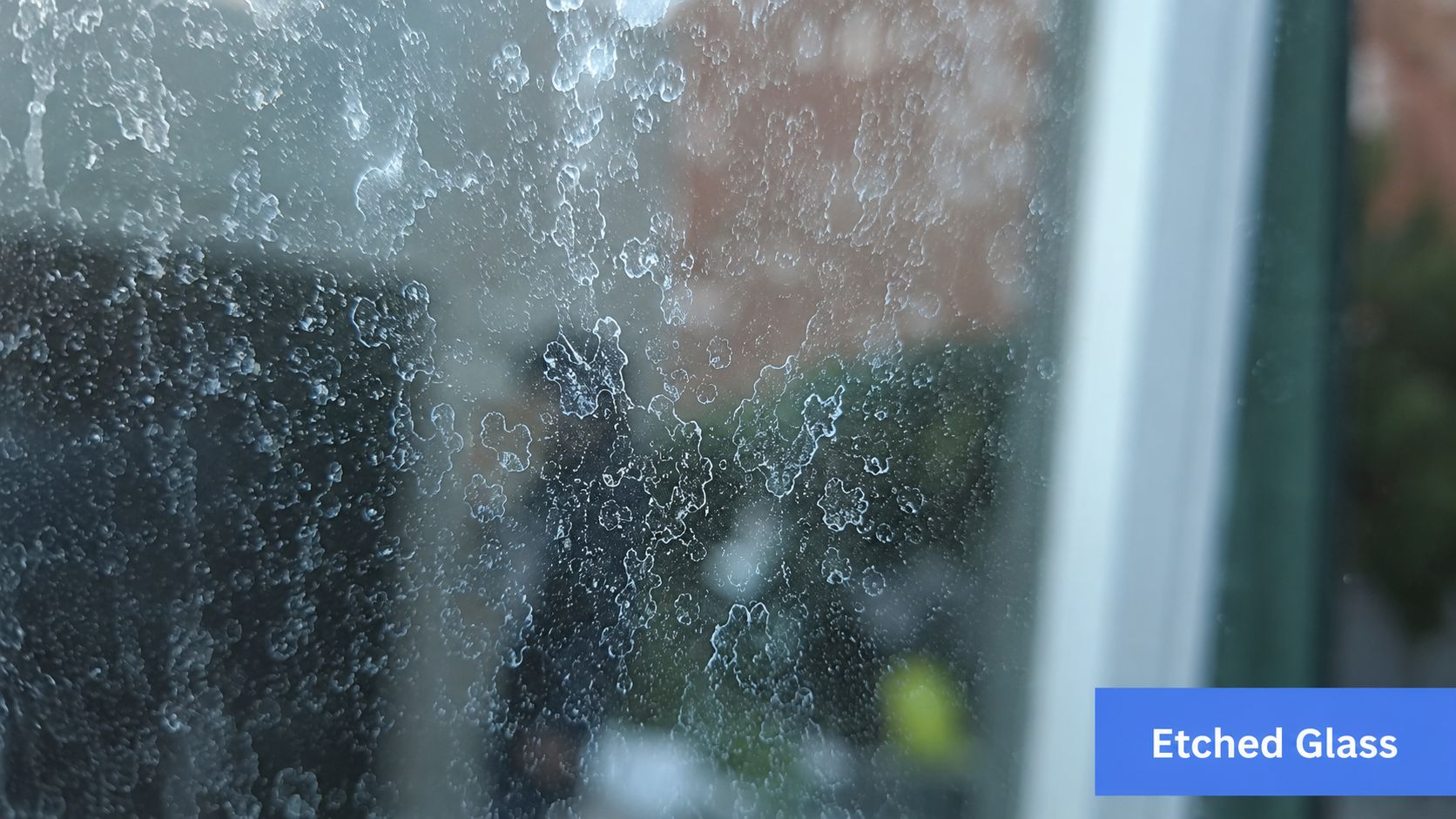
Light and moderate stains usually respond to the right chemical, the right pad, and patience. Severe stains are different. In desert markets, sprinkler overspray, reclaimed water, intense sun, and long dry cycles can bake minerals onto glass so hard that cleaning turns into surface correction, and sometimes the damage is permanent.
A simple field check helps. If the spot still feels raised or rough, some deposit may still be removable. If it feels smooth but keeps looking dull, milky, or scarred, you are likely dealing with etching, surface wear, or residue trapped in damaged glass.
That distinction matters because aggressive DIY work often makes the finish worse. I have seen homeowners use razor blades, abrasive pads, and strong acids on tempered glass, then call after the stain is partly gone and the scratching is not.
Professional window cleaners work with two core cleaning systems. One is mop-and-squeegee work. The other is purified water cleaning. Window Cleaning Warehouse's explanation of pure water cleaning gives a solid overview of how pure water systems remove minerals from the rinse so the glass dries cleaner.
That matters more in Phoenix, Scottsdale, Las Vegas, and along the Front Range than many people realize. Hard water creates the stain, and mineral-heavy rinse water can keep feeding the same cycle during maintenance. Pure water does not repair etched glass, but it does help prevent fresh spotting after the heavy buildup has been addressed.
Value lies not just in stronger tools or better access equipment. It is diagnosis.
An experienced technician checks the glass type, how long the deposits have been sitting, whether the spotting came from irrigation or runoff, and whether the panel is a cleaning job, a restoration attempt, or a replacement conversation. Those are three very different outcomes with three very different price points.
Pros also know the trade-offs. Mechanical polishing can improve some damaged glass, but it takes skill and it is not appropriate for every pane. Stronger chemistry can speed up removal, but used carelessly it can stain frames, damage nearby finishes, or create its own haze. High exterior glass adds another layer. A second-story shower transom or a sun-baked entry wall is not the place to test internet advice with a ladder and a scratch pad.
Professional Window Cleaning has been cleaning windows for over 26 years, and the hardest jobs usually come down to one question. Is this stain still on the glass, or is it already in the glass?
If your windows still look cloudy after repeated cleaning, the issue may be mineral buildup, etching, or both. Professional Window Cleaning has served homes and businesses since 1999 and knows when a stain can be removed, when the glass can be improved, and when it's time to stop guessing. Reach out for expert help with stubborn hard water staining, routine window washing, or spot-free cleaning on everything from residential glass to high-rise properties.
Read our blog posts regularly and keep learning.