Care and Maintenance
Water Fed Pole Window Cleaning Brush: A Complete Guide
Learn how a water fed pole window cleaning brush works, the best brush types, pole compatibility, and pro tips for streak-free, ground-level window cleaning.


About one high-rise window cleaner was killed per year in the United States in a widely cited 2010 to 2014 benchmark, according to this high-rise safety overview. That number is lower than earlier eras, but it's still enough to settle the argument about whether training is optional. It isn't.
High-rise work isn't an extension of ground-level window washing. It's suspended access, fall protection, rescue readiness, site control, equipment inspection, and constant judgment calls about weather, anchor points, communication, and public safety below. If a company treats it like “window cleaning, just higher,” that company is taking shortcuts in the one area where shortcuts fail hardest.
For companies that want to win trust from property managers, building owners, and insurers, high rise window cleaning training is a business system as much as a field skill. It protects crews, protects pedestrians, protects contracts, and protects your reputation when a client asks the most important question in this trade: “How do you know your team is qualified to be up there?”
One death a year is enough to expose the cost of casual training in suspended access work. That benchmark was established earlier in the article. The business lesson is straightforward. If a company cannot show how it trains, evaluates, and documents its high-rise crews, it is not ready to sell this service to serious property managers.
Formal training exists because high-rise window cleaning combines two jobs at once. It is glass cleaning, and it is controlled work at height. A technician has to inspect personal protective equipment, confirm anchor suitability, set up descent systems correctly, protect the public below, and respond to changing roof and weather conditions without improvising. Companies that rely on informal shadowing leave too much to memory, habit, and luck.
That failure shows up fast in operations. One foreman rigs a drop one way. Another skips a pre-task check because the route looks simple. A new hire copies whichever version he saw last. By the time management notices the inconsistency, the company already has exposure on safety, insurance, and client confidence.
Building managers in Denver, Las Vegas, and similar urban markets are not just hiring for clean glass. They are hiring for predictable execution, site control, and documented safety practices that hold up under review from ownership groups, risk managers, and insurers. If your team cannot produce training records, equipment inspection logs, rescue planning, and supervisor sign-off, the sales conversation gets short.
That matters for recruiting too. Anyone exploring high-rise window washing jobs should expect a defined training path, not a trial-by-exposure approach on a live façade. Good companies make the progression clear. New workers start with ground support, hazard recognition, equipment checks, and controlled practice before they touch production work at height.
A practical rule applies here. If the task involves suspension, descent control, roof transfer, or rescue support, formal instruction comes first.
Owners sometimes treat training as overhead. In this trade, poor training is what gets expensive. It leads to damaged equipment, delayed routes, failed audits, rework, incident investigations, and lost renewals when a client decides your operation feels disorganized.
Well-run companies use training to standardize decisions across crews and sites:
That consistency is what clients buy. On a high-rise account, clean results are expected. What separates one contractor from another is whether the operation looks controlled from proposal to closeout.
Training design also affects retention and compliance in the field. Crews remember procedures they practice, discuss, and repeat under supervision. They ignore procedures that live only in a binder. That is why resources on effective training strategies for engagement are useful to operations leaders building programs that workers will follow on the wall and on the roof.
The companies that keep high-rise contracts for years do not treat training as a one-time class. They build it into hiring, scheduling, supervision, audits, and promotion. That is how a contractor becomes easier to trust, easier to insure, and harder to replace.
The first thing to understand is that high rise window cleaning training is not one class. Current guidance typically separates basic safety, rope access, equipment-specific certification, rescue and first aid, and supervisory training, as outlined in this training overview. That multi-module structure matches real jobsite conditions. A worker may start on roof prep, shift to suspended access, then support an emergency response or ground-zone control issue on the same project.
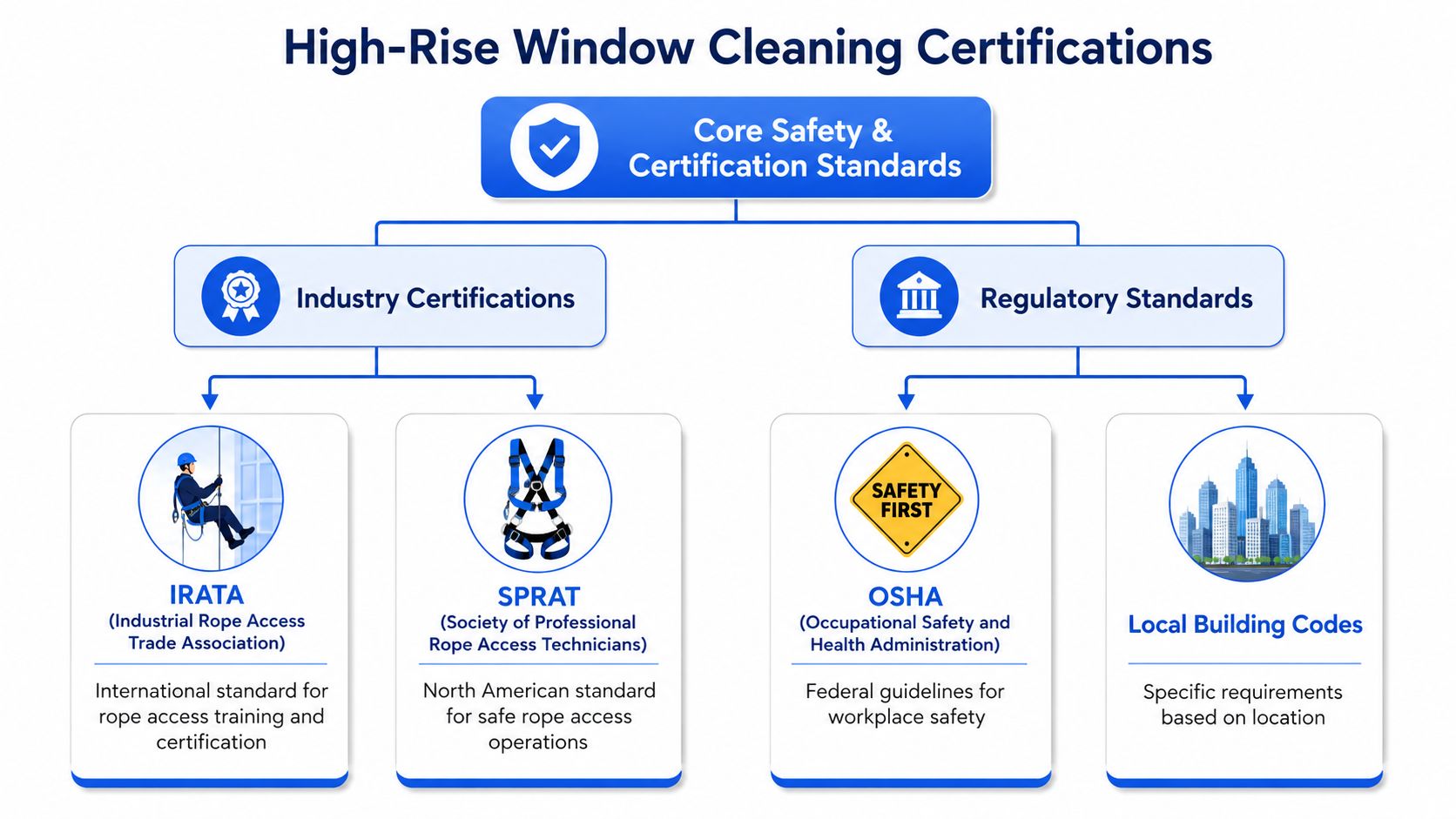
Most buyers hear OSHA, SPRAT, and IRATA and assume they're interchangeable. They aren't.
The practical question isn't which acronym sounds best. It's which credential fits the work you do, where you do it, and what your clients require.
If you're hiring a contractor in a market with complex buildings and demanding client expectations, including Phoenix, ask for specifics, not general assurances.
A useful screening list looks like this:
A certificate without site-specific competence is incomplete. The credential gets a worker in the door. The system behind it keeps the job under control.
For companies hiring or developing technicians, the same logic applies. If you want a clearer picture of the role itself, high-rise window washing jobs are a good reminder that the work demands more than comfort with heights.
One reason standards matter more now is that hiring, site approval, and insurance decisions increasingly depend on documented training and risk controls. Companies that can show recognized credentials, defined procedures, and supervisory accountability are easier for clients to approve.
That's also why risk transfer can't be separated from training. If you manage crews or buy subcontracted labor, a practical reference like this Coverage Axis resource for window washing contractors helps frame the insurance side of contractor selection. Good insurance doesn't replace training. It supports a business that already takes training seriously.
The technical benchmark in this trade is straightforward: a worker must be competent in fall protection and rescue. High-rise guidance consistently stresses the need for certified anchor points or suspension systems, harnesses, tool lanyards, pre-use inspection of gear, and stop-work decisions during high wind, thunderstorms, or heavy rain, as explained in this high-rise safety guide.
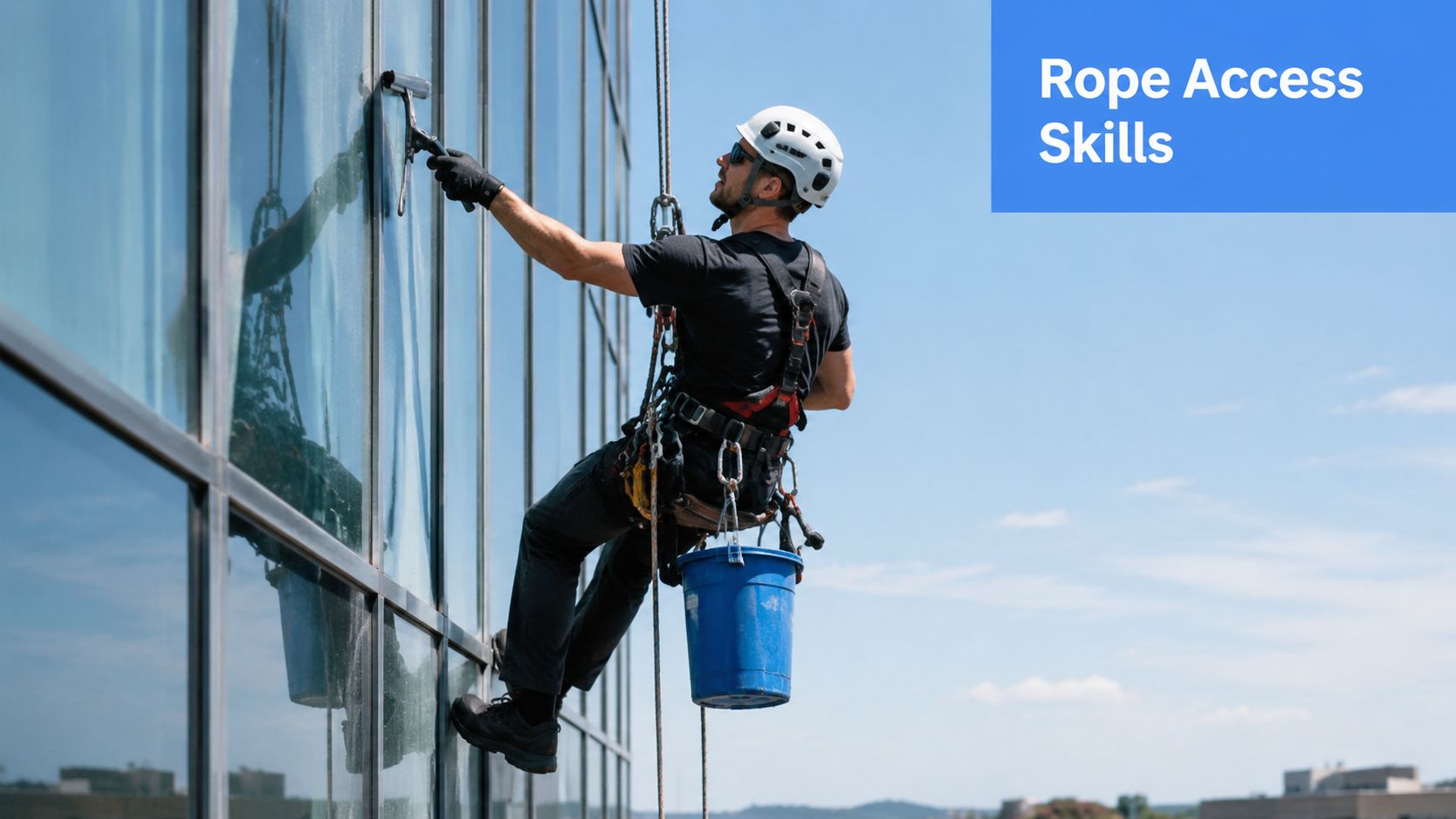
A worker who can descend isn't necessarily a worker who can clean safely, protect the public below, and respond when something goes wrong. That's where equipment proficiency separates a trained technician from someone who only knows the basics.
On a real façade, the sequence matters. Before any cleaning starts, the crew needs to confirm anchor integrity, inspect ropes and harnesses, verify communication, establish the drop zone below, and tether every tool that could fall.
Then the worker has to perform the actual cleaning while suspended. In our trade, professionals rely on only two cleaning methods: the squeegee and the pure-water system. At height, both methods require adaptation.
What doesn't work is treating access and cleaning as separate disciplines. A technician has to do both at once.
Most preventable problems show up in setup. A twisted harness, worn rope, poor anchor selection, untethered scraper, or weak ground-to-roof communication can turn a routine drop into a shutdown.
Key habits worth enforcing every day:
A practical equipment reference also helps newer supervisors connect gear names to field use. This guide to high-rise window washing equipment is useful for that purpose.
Later in training, it helps to watch movement, rigging, and body positioning in action:
The best crews don't just clean glass well. They rig cleanly, communicate clearly, and leave nothing unsecured.
A short course gets a new hire into the pipeline. It does not make that person field-ready. Initial instruction gives a trainee the basics, then the company has to build skill, judgment, and consistency through supervised work over time, as outlined in this high-rise training summary.
From an operations standpoint, the mistake is usually the same. A contractor sends someone to a rope course, files the certificate, and treats the problem as solved. That approach creates exposure for the company, not just the worker. If your crew cannot show a repeatable training path, you will feel it in incident reviews, insurance conversations, site approvals, and client confidence, especially in tighter commercial markets like Denver and Las Vegas.
The strongest training program follows a sequence. Start with classroom instruction and controlled drills. Add closely supervised field exposure. Increase responsibility only after the worker shows consistent habits under real job conditions.
That sequence matters because cleaning suspended from ropes is production work under risk. A trainee has to learn how to set up, move efficiently, protect the public area below, work around building features, and stay usable for the rest of the shift. Those are company standards, not personal preferences.
| Phase | Duration | Key Modules | Outcome |
|---|---|---|---|
| Foundation training | First course period | Basic safety, knots and rope handling, harness fitting, anchor awareness, descent systems, tool tethering, emergency basics | Trainee understands core systems and can perform supervised drills |
| Controlled practice | Early post-course period | Repetition on setup, pre-use inspection, communication, bosun's chair or suspended-system familiarity, cleaning tool control | Trainee can assist safely under close oversight |
| Supervised field work | Extended development period | Live-site preparation, descent planning, glass cleaning in suspension, weather judgment, drop-zone control, rescue participation | Trainee develops usable field competence |
| Advanced responsibility | After documented consistency | Site-specific planning, crew coordination, documentation, mentoring newer workers | Technician is ready for greater autonomy or lead support |
A useful course plan covers more than descent technique. It has to match the way your company operates.
Include these modules:
For a company owner or operations manager, one trade-off comes up fast. Longer training blocks cost more up front and pull people out of production. Weak training costs more later through rework, slower crews, client complaints, and avoidable safety failures. The cheaper option on paper is often the more expensive one in the field.
Training fails when it teaches movement without judgment. A technician needs both.
The course plan has to be documented well enough to stand up to client review. Keep records of completed modules, equipment familiarization, supervised hours, rescue drills, incident debriefs, and mentor sign-offs. If a property manager, insurer, or general contractor asks how your crew was prepared, your answer should come from records, not memory.
Clear documentation also improves crew management. It tells supervisors what the trainee has done, what still needs work, and when that person is ready for less oversight. That is how a company turns entry-level instruction into a dependable field standard.
Choosing a provider is less about marketing and more about fit. Leading programs align with IRATA, SPRAT, and OSHA 1910, and the right choice depends on region, building type, and employer risk profile, especially when insurance and site approval are part of the decision, as explained in this provider-focused overview.
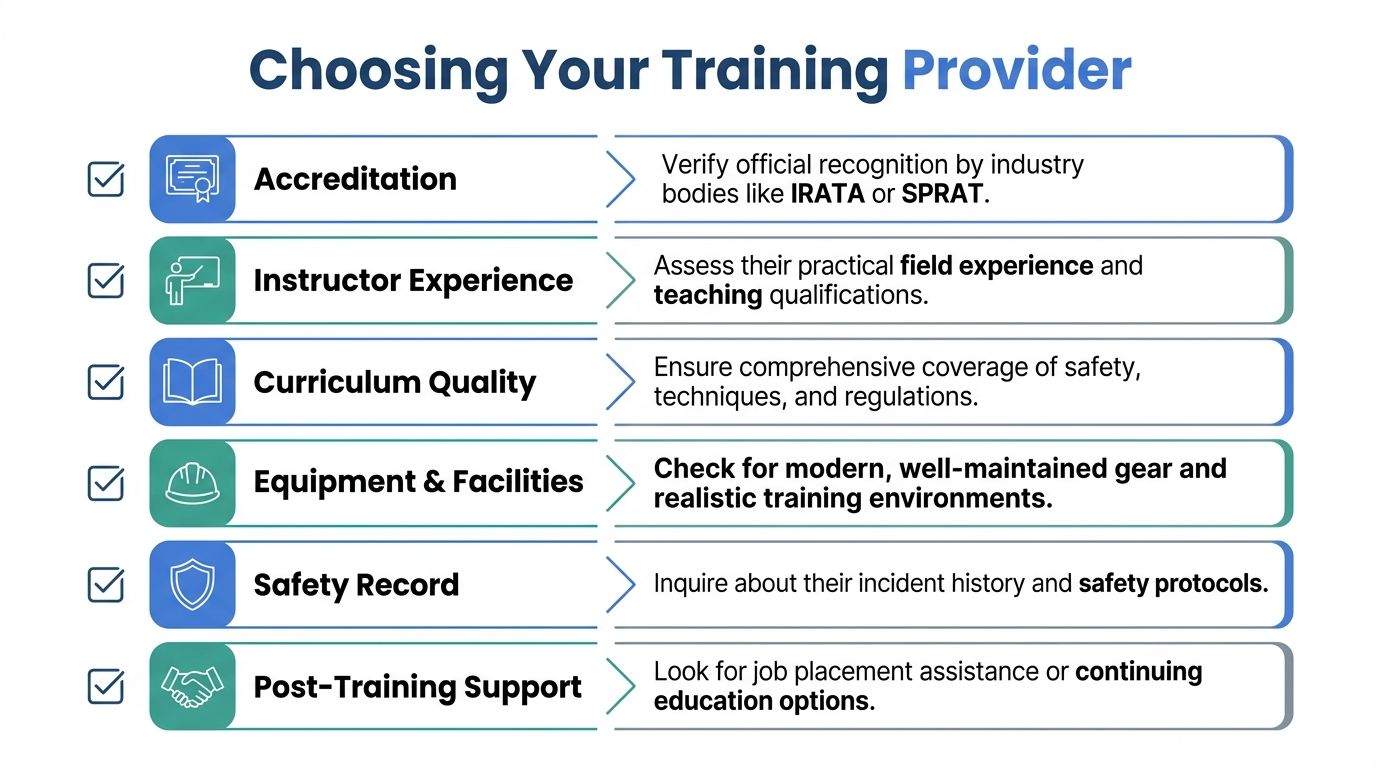
A provider may be reputable and still not be the best fit for your company. A contractor serving older mid-rise properties has different training needs than one bidding high-visibility towers with strict site-access rules.
A serious provider should be able to answer these without vague language:
In competitive markets such as Las Vegas, credentials do more than satisfy internal policy. They affect client perception. Property managers and premium commercial accounts often want to see that a contractor chose a training path that fits their site expectations.
That's why companies should avoid blanket thinking like “any rope certificate is fine.” Sometimes a shorter industry course may suit limited work under tight supervision. Sometimes a full rope-access credential is the better move because the building, the client, or the risk profile demands it.
A provider deserves extra scrutiny if they:
The best provider for your business is the one that trains your crew for the jobs you perform, not the one with the slickest brochure.
Certification gives a worker a starting point. Mentorship turns that worker into someone you'd trust on a difficult drop.
That gap matters because high-rise work changes from building to building. Roof layout, anchor placement, wind patterns, façade details, tenant access, public exposure below, and communication logistics all shift. A classroom can teach principles. A mentor teaches how those principles hold up on a live site.
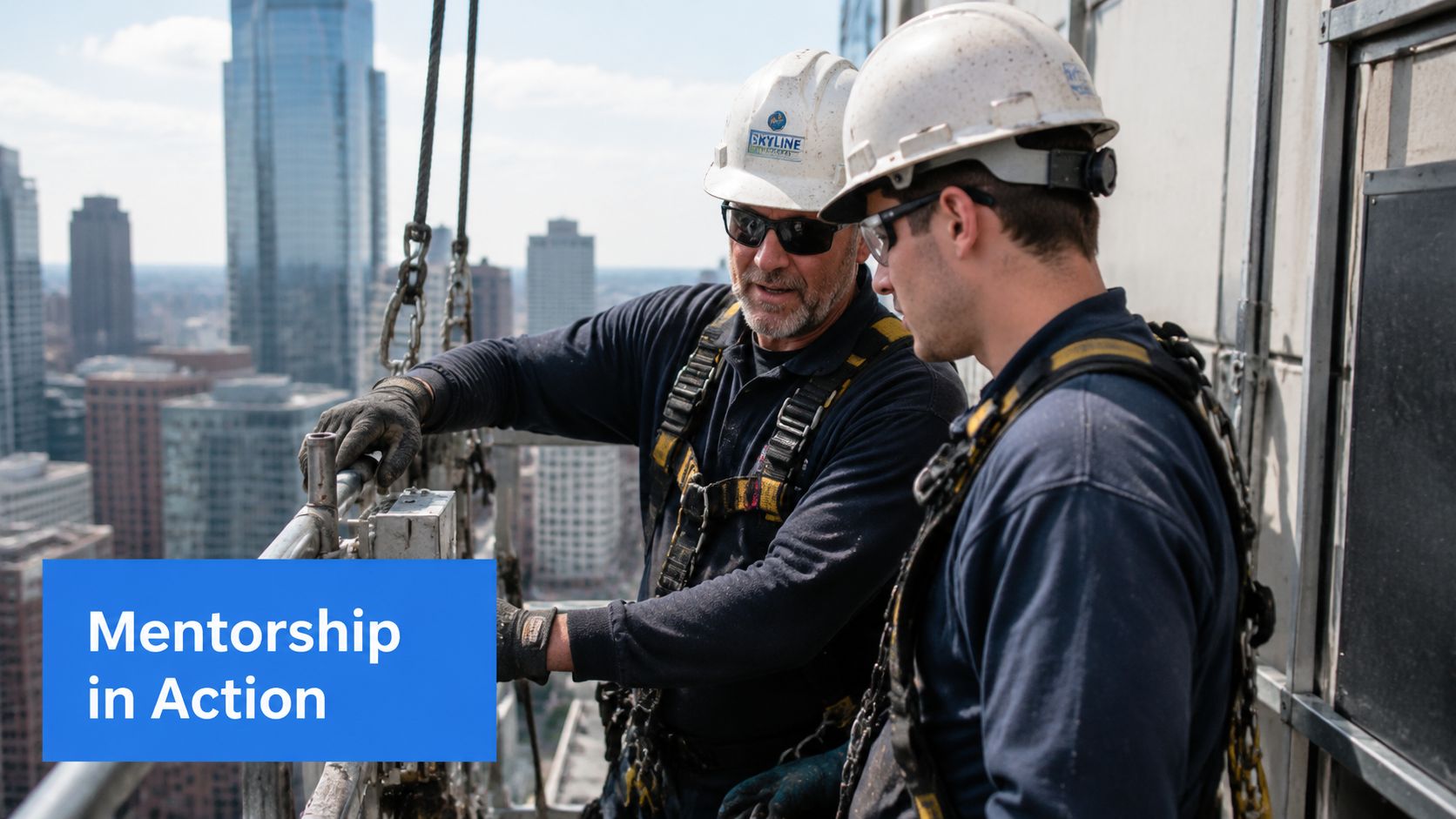
A strong coaching program is structured. It doesn't mean telling a trainee to “shadow the lead guy” for a while.
The mentor should be responsible for three things:
Site translation
The mentor shows how formal training applies to a specific roof, specific access route, and specific cleaning scope.
Controlled progression
The trainee starts with setup support, inspection checks, and limited suspended tasks before taking on more responsibility.
Behavior correction
The mentor stops bad habits early. Rushed clipping, weak communication, sloppy tool control, and poor body position are easier to fix in the first weeks than after they become routine.
New technicians don't need more confidence. They need supervised repetition until their judgment matches their certification.
The cleanest rollout is gradual. Let a new technician earn autonomy in layers.
This approach gives supervisors a better read on whether the worker can handle pressure, not just drills.
Companies often talk about safety culture in abstract terms. In practice, safety culture shows up in small moments. A trainee pauses to question an anchor. A lead stops the job because communication isn't clean. A supervisor calls weather before the crew talks themselves into continuing.
That's where experience compounds. Firms with long operating histories know that repeated coaching creates better outcomes than one-time instruction. The lesson applies whether you're staffing jobs in Scottsdale or any other market with demanding clients and varied buildings.
The business payoff is simple. Better mentorship leads to steadier crews, cleaner execution, stronger client trust, and fewer surprises on site.
If you need a high-rise team that treats training, safety, and execution like business-critical systems, Professional Window Cleaning brings more than 26 years of experience across residential, commercial, and high-rise work. Whether you manage a tower, condo property, dealership, stadium, or medical campus, their crews serve markets across Arizona, Colorado, and Nevada with the professionalism building owners expect when suspended work is involved.
Read our blog posts regularly and keep learning.