Care and Maintenance
How to Clean Building Windows Safely in 2026
Learn how to clean building windows with professional squeegee and pure-water methods. Step-by-step guide covering safety, tools, and maintenance.


You're standing at a high-floor office desk, looking through broad panes of glass at a city skyline. The view feels effortless, but the window system is doing demanding work. It has to manage wind, temperature, pressure, water, sunlight, structural movement, and safe access for the people who maintain it.
That's why high rise windows aren't oversized residential windows. Their glass, frames, seals, anchors, and cleaning systems function more like a building's outer skin. A small maintenance issue can affect appearance, tenant comfort, energy performance, and the long-term condition of the façade.

Building owners and property managers also need to understand the access problem. Cleaning a low-floor window may require a ladder or an interior step. Cleaning a tall façade can require a suspended platform, rope access, carefully inspected anchors, trained technicians, and weather-aware planning. The distinction is explained further in this guide to what is considered a high-rise building.
A tenant may notice only two things about a high-rise window: whether the view is clear and whether the room feels comfortable. A property manager sees a longer list. They see fingerprints at the entrance, mineral deposits on exterior glass, damaged seals, difficult access points, and the effect that a neglected façade can have on a building's image.
Clean glass shapes the first impression of an office, condominium, hotel, medical facility, or showroom. It lets daylight reach deeper into occupied spaces and keeps the building looking cared for from the street. Dirty or hazy windows can make a well-maintained property appear older than it is, especially when the façade contains large areas of reflective glazing.
High rise windows sit within the building envelope, the boundary separating occupied space from outdoor conditions. The system must keep wind and rain outside while helping the interior remain stable and comfortable. Frames transfer loads to the structure, seals limit air and water movement, and insulated glass helps moderate heat flow.
That makes maintenance more than a cosmetic task. A cleaner can identify visible concerns such as cracked glass, failed seals, loose gaskets, corrosion, or staining that deserves further inspection. Cleaning doesn't replace façade engineering or repair work, but it gives owners a regular opportunity to observe the exterior closely.
Practical insight: Treat clean windows as part of asset care, not as an isolated appearance service.
At elevation, access becomes a central design question. The building may have a suspended maintenance unit, roof-mounted davits, dedicated anchors, or façade sections that require specialized rope access. Older buildings may need temporary equipment because they weren't designed around modern maintenance systems.
Safety history explains the caution. Industry reporting citing OSHA-tracked data recorded 88 window-cleaning accidents over a 15-year period, with 62 fatalities, meaning roughly 70.5% of those recorded incidents ended in death as reported by HealthDay. More recent U.S. reporting recorded seven window-washer deaths from January 2022 through December 2023, with nearly all linked to falls from heights, according to the same source.
Owners don't need to manage the work themselves, but they do need to understand why competent planning, documented equipment inspections, and qualified crews matter. The following sections build that understanding from the window's basic anatomy to hiring decisions.
Height is the obvious starting point, but it isn't the only factor that makes a window a high rise window. A façade becomes a high-rise maintenance challenge when ordinary ground-level access no longer works and the building's glass system must meet demanding structural, safety, and code requirements.
Local definitions vary, so owners should consult the applicable building code rather than rely on a single universal threshold. In practical terms, a window system is treated as high rise when its location, exposure, and access require specialized planning.
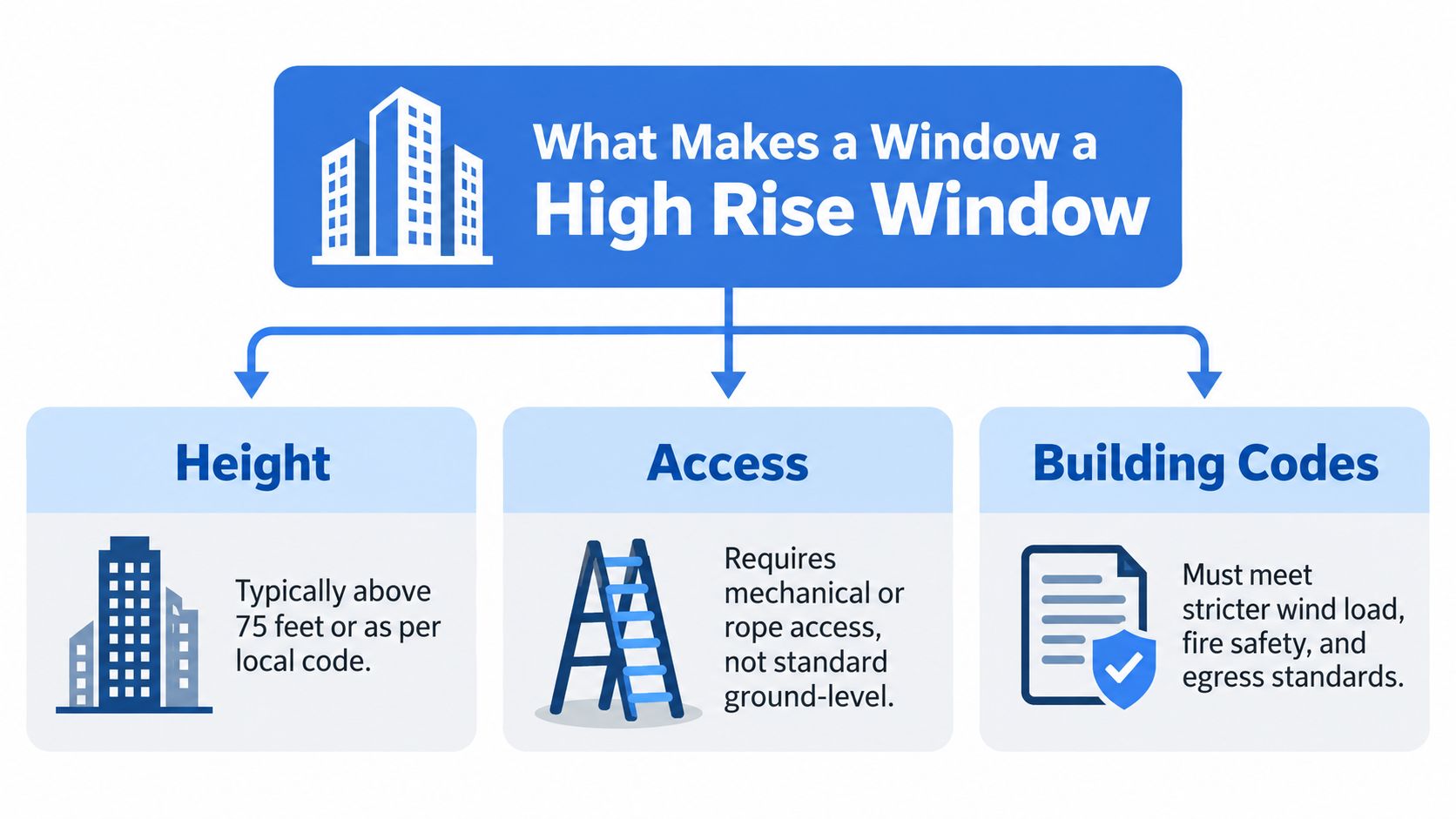
A window several floors above grade faces different conditions from one at a sheltered ground-floor opening. Wind pressure can rise with exposure, equipment may need to operate from the roof, and rescue planning becomes part of the work method. Even a shorter structure can require specialized access if the façade is set above a podium, slopes over an entrance, or contains hard-to-reach architectural features.
The key question is simple: Can trained workers reach, clean, inspect, and leave the window without ordinary ladders or interior access? If not, the property needs a high-rise maintenance approach.
Think of the window as a building's skin rather than a sheet of glass. The visible lite is only one component. A typical system may include:
Building codes influence glass selection, wind resistance, fire performance, safety glazing, and emergency egress. The design also determines whether a crew can use a suspended platform, rope descent, telescopic pole, or interior method.
Owners should keep façade drawings, equipment records, anchor documentation, and repair history together. That information helps a cleaning contractor understand the building before anyone approaches the glass, and it helps engineers diagnose problems when a window shows distortion, leakage, or movement.
The materials chosen for high rise windows affect more than the building's appearance. They influence weight, thermal movement, water management, structural response, replacement difficulty, and the way a cleaning crew reaches each pane.
Aluminum frames are common in commercial towers because they're relatively light, formable, and compatible with curtain wall construction. Their weakness is that metal conducts heat, so designers often use thermal breaks and insulated components to reduce the path for heat transfer. Steel can provide strength and a distinctive narrow profile, while composite materials may combine structural performance with improved thermal behavior. The right choice depends on the façade design, climate, loads, and project requirements.
Glass selection creates another set of trade-offs. Insulated glass units use separated panes and a sealed cavity to support thermal performance. Laminated glass holds together more effectively when damaged and can serve safety, security, or acoustic goals. Low-emissivity coatings help manage radiant heat, but cleaners must use appropriate procedures to avoid scratching or damaging coated surfaces.
A curtain wall hangs from the building structure and forms a continuous exterior grid. It often creates the clean, uninterrupted glass appearance associated with modern towers, but its many vertical and horizontal joints require careful water management and inspection.
A window wall generally sits between floor slabs. It can create a strong glass presence while using a different support arrangement from a curtain wall. Replacement access, slab-edge details, and perimeter seals become especially important.
A punched opening places individual windows into masonry, concrete, or another solid wall. The appearance is more compartmentalized, but individual units may be easier to identify and replace. Access can still be difficult if the openings are scattered across the façade.
| System Type | Best For | Maintenance Consideration |
|---|---|---|
| Curtain wall | Continuous glass façades and modern towers | Inspect mullions, pressure plates, gaskets, joints, and access equipment |
| Window wall | Floor-by-floor glazing between structural slabs | Watch perimeter seals, slab-edge interfaces, and replacement logistics |
| Punched opening | Masonry or concrete façades with individual windows | Track unit condition, surrounding wall joints, and localized access |
A cleaning plan should account for coated glass, exposed gaskets, frame drainage paths, and the possibility of trapped grit. Aggressive scraping or unsuitable pads can damage a coating or leave scratches that are more visible from inside than outside.
Owners should ask whether the contractor has worked with the actual façade type, not merely with “commercial glass.” A professional site assessment should identify glass coatings, access equipment, water-sensitive areas, and any existing defects before routine work begins.
High rise windows experience forces that are easy to miss from inside the building. The glass may look motionless, yet the system is responding to changes in atmospheric pressure, wind suction, solar exposure, temperature, and structural movement.
Elevation creates a particularly important issue for insulated glass in mountain cities. Atmospheric pressure drops by about 1 psi for every 2,000 feet, or 610 meters, of elevation gain, according to BuildingGreen's discussion of high-elevation window problems. If an insulated unit was manufactured at sea level and installed at a much higher elevation, the pressure difference can bow the glass outward.
For a 2-foot by 4-foot unit, that pressure difference can create roughly 1,150 pounds, or 5,120 newtons, of additional force on each lite, as described by the same source. The result may include visible distortion, seal failure, or breakage in severe cases. Changes in the interpane cavity geometry can also reduce thermal performance, which is why Denver properties and other mountain-city projects need elevation-aware glazing specifications.
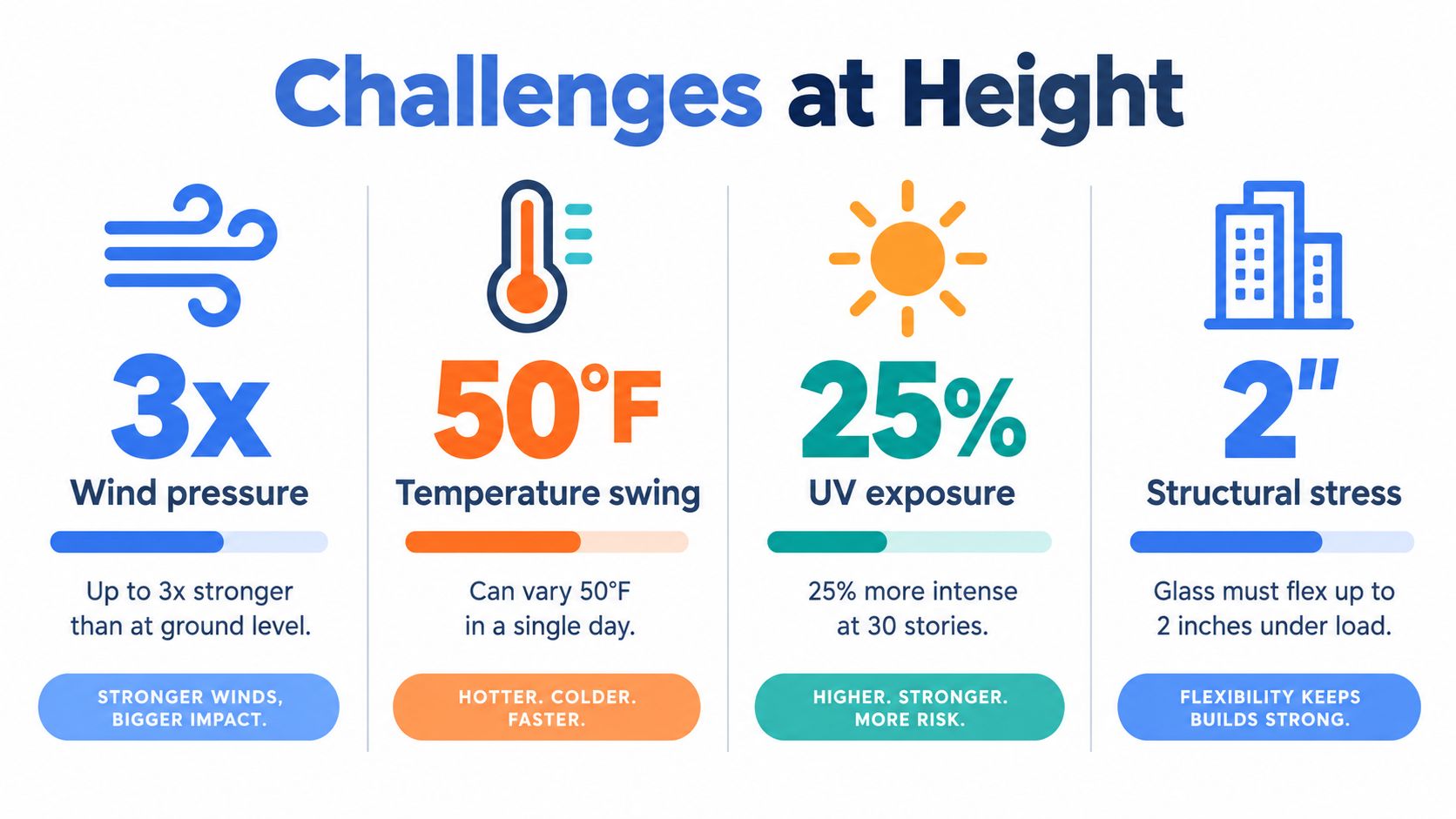
Windward façades receive positive pressure, while side and leeward façades can experience outward suction. Guidance for commercial high-rise design notes that pressures commonly exceed 3.5 kPa, can reach 5.0 kPa on upper floors, and may exceed 6.0 kPa on hurricane-exposed towers according to this engineering guide to glass thickness and wind loads.
That distinction matters because suction can govern serviceability and failure risk. Engineers size the glass, mullions, anchors, and sealant bite for both directions. A visible rattle, cracked seal, or recurring water leak deserves attention because the symptom may indicate movement within the larger façade system.
Bird safety isn't only a skyscraper issue. Official guidance from the U.S. Fish and Wildlife Service on bird-window collisions says less than 1% of window collisions occur at high-rise buildings, while most collisions happen lower down around the tree-canopy zone.
The practical lesson is to study the site rather than treat every elevation identically. External patterns work best when spaced at 2 by 2 inches or a similar pattern rule, and bird-safe glass can support both bird protection and energy goals, according to the same guidance. Lower façades near landscaping, courtyards, and connected vegetation may deserve more attention than the highest floors.
Professional window cleaning uses only two methods: the squeegee method and the pure-water system. Access equipment may differ, but the cleaning method itself falls into one of these two categories.
The squeegee method uses a cleaning solution, a washer or scrubber, and a squeegee to remove soil and water from the glass. At height, a technician may work from a rope descent system, bosun chair, suspended scaffold, or mechanical platform, depending on the building's design and approved access plan.
The pure-water method uses filtered water delivered through a brush on a pole. The water dries without leaving spots, which makes it a no-squeegee alternative as described in this overview of high-rise window cleaning equipment.
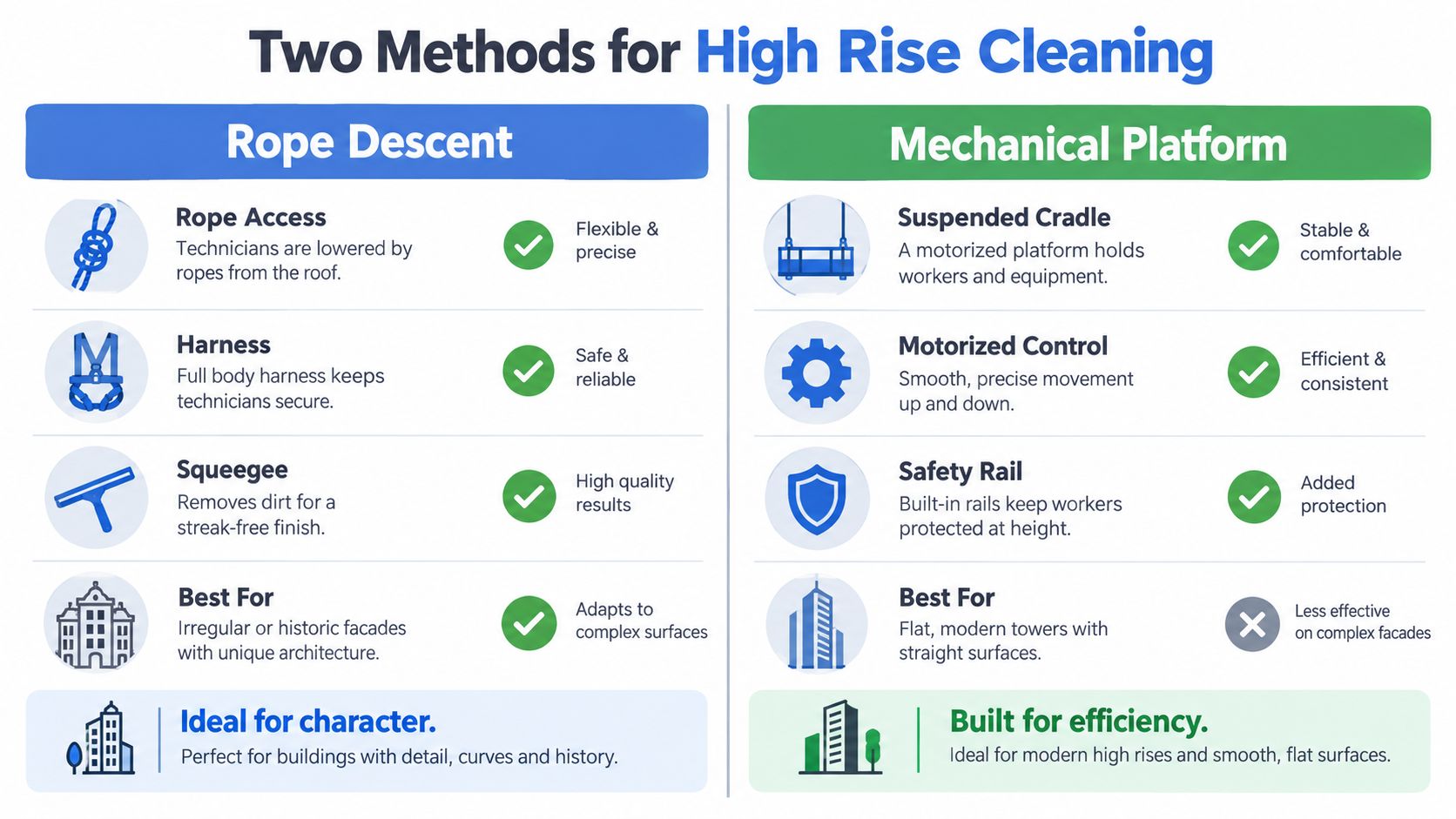
Squeegee cleaning remains useful when a worker needs close control of the glass, frame edges, or stubborn soil. It can suit irregular façades, historic details, and areas where a pole can't reach the surface correctly. The access system, not the squeegee itself, determines how the technician reaches the elevation.
Pure-water cleaning keeps the operator on the ground when the pole can reach the glass. Neutral industry information says these systems can clean windows up to about five stories, or roughly 90 feet, from the ground, when paired with the proper pole setup according to Unger's pure-water system information. That can reduce ladder-fall exposure, but it doesn't make every façade suitable. Wind, setbacks, architecture, water supply, and pole control still matter.
The safest access method is the one that reaches the glass while exposing workers to the least unnecessary height.
Professional Window Cleaning has been cleaning windows for over 26 years and provides window cleaning services in Las Vegas, Phoenix, Denver, and Scottsdale. For an owner, experience matters because the crew must match the cleaning method to the façade rather than force one technique onto every building.
High-rise window maintenance became heavily regulated because a mistake can injure a worker, a tenant, a pedestrian, or someone operating below the work area. Owners don't need to memorize every rule, but they should know what responsible planning looks like before approving a proposal.
OSHA-related guidance for rope-descent work says anchor points must be inspected and certified annually and must support 5,000 pounds in any direction the rope may pull, with worker training and equipment inspection also required as summarized in this OSHA-related high-rise cleaning guide. Those requirements make the building's anchor documentation an essential part of contractor onboarding.
The U.K. Health and Safety Executive says work-at-height window cleaning must be properly planned, supervised, and performed by competent people. It also advises employers to avoid work at height where reasonably practicable by using telescopic water-fed poles or cleaning windows from inside in its window-cleaning safety guidance.
That principle gives owners a useful review sequence:
Insurance isn't a substitute for safe work, but it helps owners understand how liability is managed. A property manager comparing vendors can review this resource on cleaning service liability insurance from Duncan & Associates Insurance Brokers alongside certificates of insurance and contract terms.
The strongest contractor relationship is transparent. If a crew can't explain how it will reach a particular elevation, inspect its equipment, respond to a sudden wind change, or recover a worker during an emergency, the proposal isn't ready for approval.
A suitable high-rise cleaning partner should begin with a site assessment, not a generic price. The provider needs to review the façade, glass type, access equipment, ground conditions, tenant activity, water requirements, and known defects before recommending a method.
Compare proposals against the same practical questions:
Price still matters, but the lowest bid may omit difficult elevations, frame detailing, safety setup, or the time needed for careful work. A clear proposal makes those differences visible.
Owners should also plan cleaning around the building's exposure and use. A busy entrance, restaurant frontage, condominium lobby, or showroom may need attention on a different schedule from sheltered upper-floor glazing. Keep records of dates, observed defects, access problems, and areas that repeatedly collect soil. Those records help the next contractor work efficiently and help the owner spot changes in the façade.
For a deeper look at the specialized service itself, review high-rise window washing from Professional Window Cleaning. The right partner protects more than curb appeal. It helps preserve safe access, clear views, informed maintenance decisions, and confidence in the building envelope.
Professional Window Cleaning provides squeegee and pure-water window cleaning for commercial properties, high-rise buildings, condominiums, and other demanding facilities. Visit Professional Window Cleaning to discuss your façade, access requirements, and a practical cleaning plan.
Read our blog posts regularly and keep learning.