Care and Maintenance
How to Prevent Hard Water Stains on Windows
Learn how to prevent hard water stains on windows with proven tips for homeowners and property managers in Las Vegas, Phoenix, Denver, and beyond.


A typical single-family home takes 2 to 4 hours for exterior-only service and 3 to 5 hours for cleaning inside and out. Commercial and high-rise jobs can range from half a day to several weeks, depending mainly on access, safety setup, and cleaning scope.
You may be asking because a crew is scheduled to arrive while your day is already full. You're watching the clock, wondering whether the appointment will finish before school pickup, a tenant meeting, or the next contractor arrives. The honest answer to how long window cleaning takes starts with more than the number of windows. The method used, the condition of the glass, access to each pane, and whether screens, tracks, sills, and frames are included can change the schedule substantially.
Professional Window Cleaning has been cleaning windows for over 26 years, and the most useful estimate is always the one that reflects the actual property rather than a generic promise. The ranges below will help you understand what happens on the day, where the time goes, and which details you should mention before booking.
A crew may arrive while you are preparing breakfast, heading to school pickup, or opening an office. You will see ladders, hoses, buckets, poles, and safety equipment come off the truck before the first pane is washed. Plan for a time block rather than an exact finish minute. The schedule depends on what is included, not only on the building's size.
For a single-family home, exterior-only work commonly takes 2 to 4 hours, while inside-and-out service generally takes 3 to 5 hours. Those ranges assume ordinary access and a defined scope. A first visit with heavy soil, screens, tracks, frames, or difficult windows takes longer. Published residential window cleaning time estimates also show shorter visits for smaller properties and longer visits for larger ones.
Commercial work follows the same principle. A small office may take 1 to 3 hours, while a storefront may take 30 minutes to 2 hours. Entrances, customers, deliveries, and occupied rooms can slow the crew even when the glass area seems modest.
High-rise work uses a different schedule. A project can last from half a day to several weeks because crews may need suspended platforms, rope-access systems, inspections, changing work zones, and suitable weather. One high-rise timeline reports that cleaning a standard 50-floor skyscraper can take 30 to 40 days (high-rise window-cleaning timelines).
The quoted duration covers the work around the glass as well as the cleaning itself:
| Property Type | Typical Duration | Crew Size |
|---|---|---|
| Single-family home, exterior only | 2 to 4 hours | Varies by job |
| Single-family home, inside and out | 3 to 5 hours | Varies by job |
| Small office | 1 to 3 hours | Varies by job |
| Storefront | 30 minutes to 2 hours | Varies by job |
| High-rise building | Half a day to several weeks | Varies by access and scope |
These ranges describe production conditions, not a promise for every property. A clear, regularly maintained home may finish near the shorter end. Scraping, detailed edge work, restoration, extra setup, or the wrong method for the surface can extend the visit. The two professional methods therefore affect both the result and the time on site.
There are only two methods professional window cleaners use: the squeegee method and the pure-water system. The right choice depends on the surface, the access, and whether the glass is on the inside or outside.
The traditional squeegee method uses soap and water applied by hand. The cleaner agitates the glass, pulls the solution away with a rubber blade, and details the edges with a cloth. It's similar to washing a car carefully on a Saturday morning. The technician controls the amount of solution, pressure, and detailing on every pane, which makes this approach especially useful for interior glass, spot treatment, and frames that need close attention.
Pure-water cleaning starts with tap water that passes through filtration, deionization, reverse osmosis, or a combination of purification stages. The process removes dissolved minerals such as calcium and magnesium, so the water can dry without leaving mineral residue on the glass (pure-water window-cleaning equipment). A pump sends the purified water through a hose to a telescopic pole. A soft brush loosens dirt, the water rinses it away, and the glass air-dries without a squeegee (water-fed pole operation).
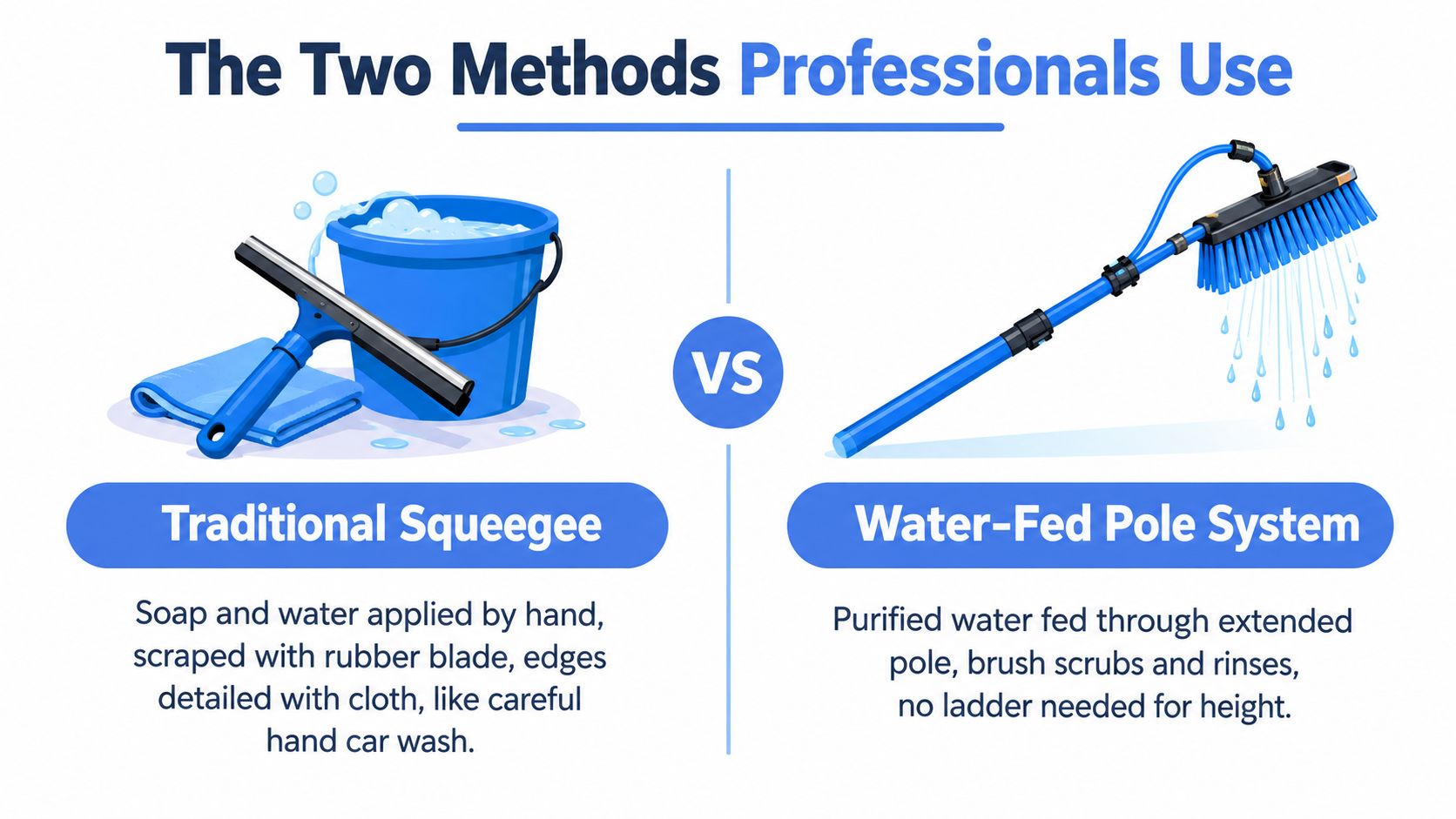
Squeegee work tends to take longer per pane because the cleaner washes, pulls, and details each section by hand. In return, the technician gets close control over interior glass and difficult spots. Pure-water equipment can cover exterior glass efficiently from the ground, but it generally can't clean the inside face of a window, so many full-service appointments use both methods.
A water-fed pole can reach roughly 55 feet, or about five stories, from the ground in suitable conditions (pure-water reach and access guidance). That can remove ladder moves from an exterior job, although the system still depends on clear access and suitable glass.
Practical rule: Ask which method will be used on each side of the glass. The answer often predicts the job length better than the window count alone.
For homeowners using household products between professional visits, it also helps to understand safe product selection and handling. This guide to best ammonia glass cleaner practices provides useful context, while a deeper explanation of professional equipment is available in this window washing system guide.
Home size gives you a starting point, but window count and cleaning scope make the estimate more useful. A condo with a few accessible windows can finish quickly, while a house with the same number of openings may take longer if it has divided panes, upper-story access problems, or neglected tracks.
The following ranges combine practical residential benchmarks with published field estimates (residential production and timing guidance).
| Home Size | Window Count | Exterior Only | Inside & Out | First-Time Deep Clean |
|---|---|---|---|---|
| Small home or condo | Up to 10 | 1 to 2 hours | 2 to 3 hours | Often longer than routine service |
| Average single-family home | 15 to 25 | 2 to 3 hours | 3 to 4 hours | Often longer than routine service |
| Larger home | 25 to 40 | 3 to 4 hours | 4 to 5 hours | Often longer than routine service |
| Estate or multi-story property | 40-plus | 4 to 6 hours | 6 to 8 hours | Often longer than routine service |
A routine visit usually moves quickly because the glass has less bonded dirt and the frames need less recovery work. A first-time deep clean can take substantially longer when panes have pollen film, construction dust, mineral residue, or long-neglected grime. Published guidance notes that first-time or heavy-clean appointments can take 20% to 30% longer than maintenance visits (first-clean and maintenance timing).
That difference matters even within the same home tier. An average home with 15 to 25 windows may fit the ordinary inside-and-out range during maintenance, but a neglected first visit can move toward the upper end or beyond it. Glass condition, access, pane design, and the number of passes required determine where the job lands.
Glass-only service is not the same appointment as glass plus screens, tracks, sills, and frames. For an average home, adding those areas typically pushes the visit up by 30 to 60 minutes, depending on their condition and how many windows need attention.
Screens may need removal, washing, drying, and careful replacement. Tracks can hold grit, dead insects, and compacted dust that can't be removed by wiping the glass alone. If you're also coordinating another home-maintenance visit, a guide to furnace cleaning time illustrates the same planning principle: the service label alone doesn't reveal the labor involved. The exact scope does.
A second-floor window over a crowded patio can take longer than a ground-floor pane with an open path, even when both homes have the same window count. Accessibility controls the setup: ladder moves, equipment placement, gate access, and the time needed to protect landscaping or furniture.
Before requesting an estimate, trace the route to each exterior window. Check whether gates will be open, shrubs block the sill, or vehicles occupy the work area. A pure-water pole can reduce ladder use in suitable conditions, but the operator still needs a clear, safe route and enough room to work.
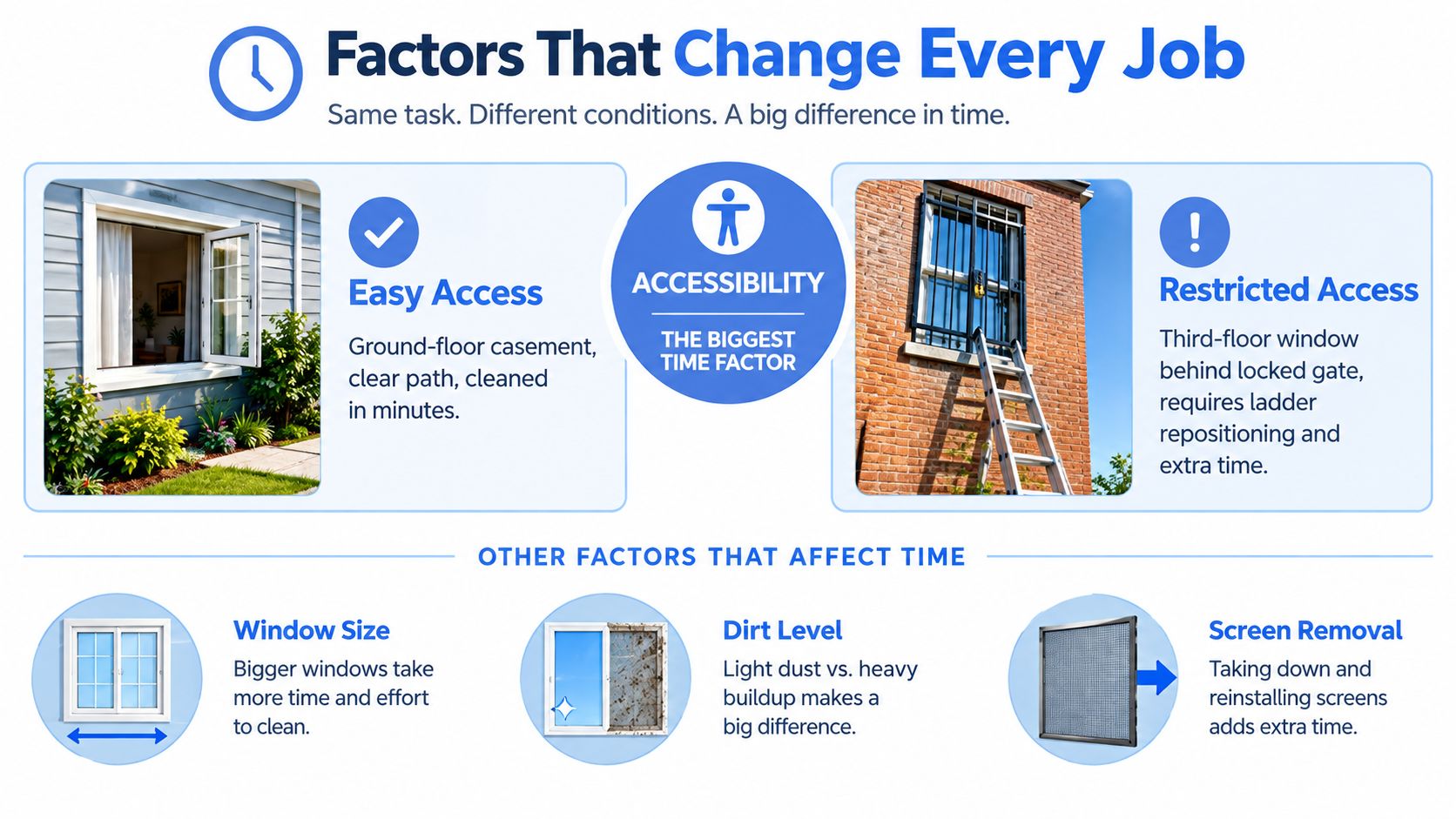
Construction dust, baked-on grime, and pollen film may require scraping, agitation, and a second pass. A first-time deep clean can take 20% to 30% longer than a maintenance visit, according to independent window-cleaning guidance (deep-clean timing factors).
Hard-water spots require a different process. Mineral deposits may need restoration treatment or an acidic wash instead of ordinary soap and water. Extensive spotting can add 30 to 60 minutes per elevation. The cleaner should inspect the glass first, because removable mineral residue and permanent etching need different expectations.
Household dust can also soil frames and screens faster. Guidance on cutting dust with better HVAC provides broader cleaning context, although it does not replace window cleaning.
The service scope changes the appointment more than the window count alone. Glass-only work is a different job from glass plus screens, tracks, sills, and frames. Removing, washing, drying, and rehanging screens takes handling time. Tracks require vacuuming and wiping inside narrow channels, and that work can add about an hour on a typical 20-window home when included.
Frame material changes the pace as well. Wood sashes require careful detailing around paint and finished surfaces. Vinyl and aluminum usually tolerate faster scrubbing, though heavy soil or damage can slow either one.
Decide before the crew arrives whether you want clear glass only or cleaning across the full window assembly. That single choice gives the estimate a clearer starting point.
A two-story shop and a two-story office can require very different appointments. The deciding detail is often access, along with what the service includes. Ground-level glass may be reachable from inside or with a water-fed pole. Upper floors may need a swing stage, suspended platform, aerial lift, or rope-access system.
A small storefront usually takes 30 minutes to 2 hours, while a small office may take 1 to 3 hours. Low-rise exterior work can take 4 to 8 hours, and a typical three-story office building may be completed in about half a day (commercial building timing). These shorter jobs generally have straightforward access, moderate soil, and little interruption from customers, vehicles, or tenants.
Commercial production is often estimated by dividing window area by an hourly productivity rate. One planning tool uses about 1,200 square feet of window area per hour as a conservative benchmark for a professional cleaner and describes an average standard commercial session as around 4 hours (commercial production-rate planning). That figure is a planning reference, not a promise. Healthcare facilities may take longer because access and operating requirements demand slower, more controlled work.
| Building Type | Typical Size | Estimated Time | Main Driver |
|---|---|---|---|
| Storefront | Small glass frontage | 30 minutes to 2 hours | Entry access and foot traffic |
| Small office | Modest window count | 1 to 3 hours | Interior coordination |
| Low-rise office | Several elevations | 4 to 8 hours | Access and setup |
| Three-story office | Typical multi-level office | About half a day | Elevation changes |
| Twenty-story building | High-rise façade | 2 to 3 days | Equipment staging and safety |
| Fifty-floor skyscraper | Full high-rise façade | 30 to 40 days | Geometry and access systems |
A 20-story building may require 2 to 3 days, while a standard 50-floor skyscraper may require 30 to 40 days for a thorough clean. High-rise guidance explains that façade geometry, access systems across multiple elevations, and the cleaning scope can extend a project from one day to several weeks (high-rise access and duration guidance).
The wiping itself is only one part of the schedule. Safety rigging, permits, traffic control, tenant coordination, and equipment inspections can determine when work is possible. Rope-access gear, aerial platforms, and suspended systems must be moved, checked, and staged at each elevation. Weather can reduce the usable work window, and overnight scheduling may be needed around occupied offices or busy streets.
You can shorten the visit by removing obstacles before the crew arrives. Move patio furniture away from windows, open side gates, clear interior access to windows, and trim or move anything that blocks ground-floor glass. These small preparations prevent the crew from spending cleaning time repositioning objects.
Park the company vehicle where it can reach the work area with its hose and equipment. If a shared driveway or narrow access lane will require ladder placement, tell neighbours in advance. A clear working zone matters even more when the crew plans to use a water-fed pole, since the hose must run safely from the purification equipment to the operator.
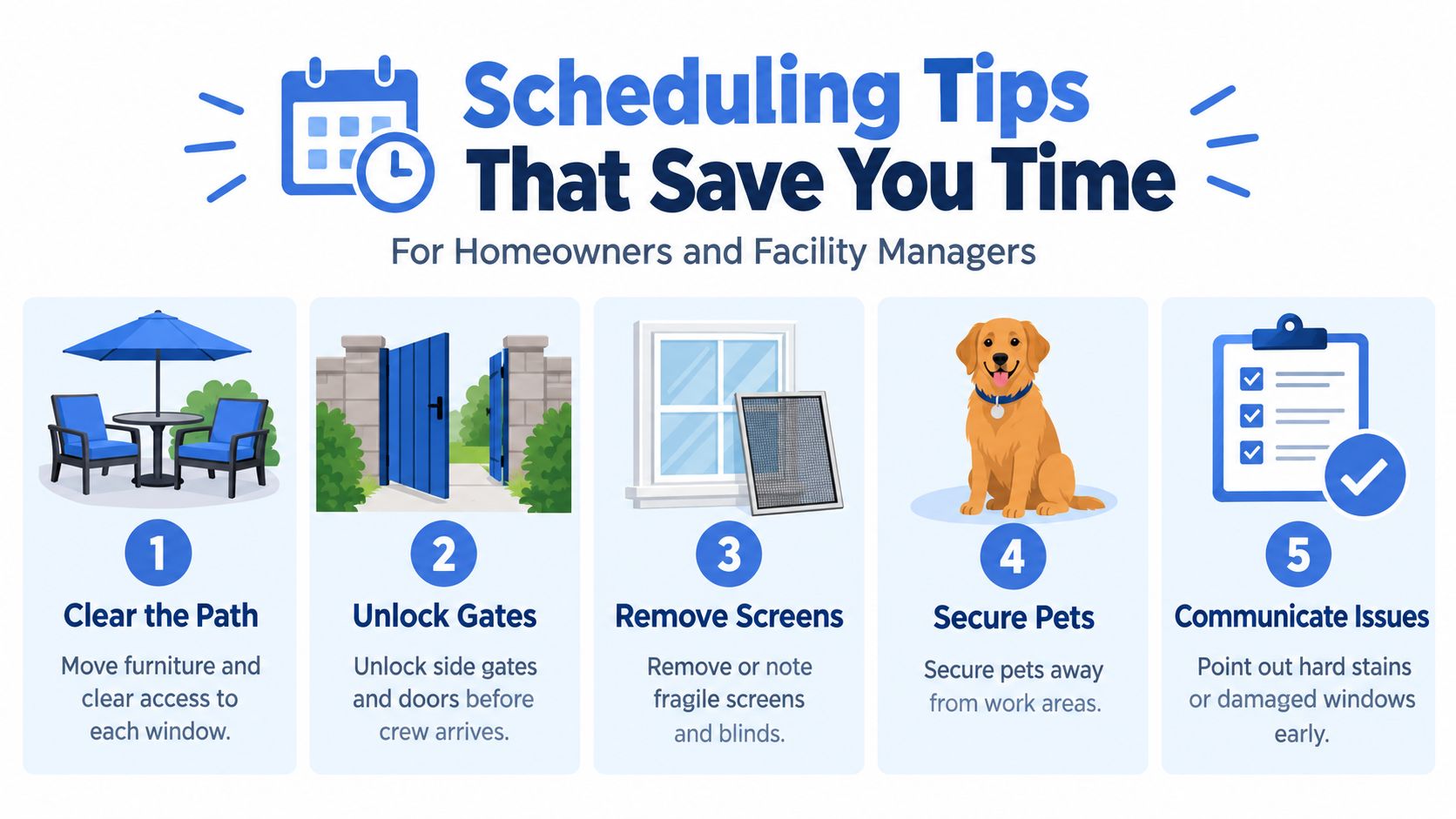
Run a quick pre-walk shortly before the appointment. Note windows the crew should skip, such as cracked panes, broken seals, pet-access rooms, or areas where blinds can't be moved. Pointing out those details early prevents the technician from stopping mid-job to determine what is and isn't included.
Consolidate related requests into one visit whenever possible. If you want interior and exterior glass, screens, tracks, sills, and frames addressed, say so when booking. Splitting those requests across separate appointments creates another setup and travel period.
Spring and late autumn can offer more scheduling flexibility than the busiest summer period. Booking after pollen season can also reduce the chance that newly rinsed screens immediately collect another layer of airborne debris.
A reliable time estimate separates what you control from what the cleaning company must assess. You control the requested scope, access preparations, and whether screens or tracks are included. The technician controls the method selection, equipment plan, crew arrangement, and the safe sequence for reaching difficult glass.
The most dependable way to narrow the estimate is an on-site walkthrough. A good estimator checks the window count, pane configuration, glazing type, access points, soil level, and the condition of screens, tracks, sills, and frames. They can also identify whether a pane needs ordinary cleaning or a separate restoration treatment.
Phone quotes and square-foot estimates can be useful starting points, but they're educated guesses when the company hasn't seen the property. A window count doesn't reveal whether a third-floor pane sits behind a locked gate, whether a screen is fragile, or whether mineral buildup requires additional passes.
Ask the contractor:
A window cleaning price calculator can help you organize the details before requesting a quote, but it can't replace an on-site assessment. The fastest path to an accurate time estimate is a short property survey that lets the cleaner see the actual access conditions.
Professional Window Cleaning provides residential, commercial, and high-rise window cleaning, using the right combination of squeegee and pure-water methods for your glass and access conditions. Visit Professional Window Cleaning to request service and arrange a property-specific estimate, so you can plan the appointment around a realistic time window.
Read our blog posts regularly and keep learning.