Care and Maintenance
Window Cleaner for Tinted Windows: Safe Methods
Find the best window cleaner for tinted windows and learn safe cleaning methods that protect film, prevent streaks, and extend tint life.


Most advice about cleaning double glass windows starts with the wrong assumption: every cloudy patch must be dirt. That mistake leads homeowners toward stronger chemicals, razor blades, and excessive scrubbing, even when the underlying problem is trapped moisture inside a failed sealed unit. The safe approach is simpler. Clean the surfaces you can reach, protect the seals and coatings, and diagnose internal fogging before you try to wash it away.
Double-glazed windows involve two separate cleaning surfaces, not one open cavity that can be scrubbed from both sides. The interior-facing pane and exterior-facing pane are accessible. The sealed space between them isn't. For double-glass windows, the practical rule is to clean only the two exposed outer surfaces, because the insulated space between panes is sealed and inaccessible. Fog, residue, or debris inside that space usually signals seal failure rather than ordinary dirt, as explained in this overview of double-pane window construction.

That distinction changes the entire job. You aren't trying to reach the middle of the insulated glass unit. You're removing dust, fingerprints, pollen, mineral residue, and environmental grime from the surfaces designed to be cleaned. The perimeter seal deserves more care than the center of the glass because forcing liquid, tools, or pressure toward the edge can damage the component that keeps the unit insulated.
Use a mild glass cleaner, clean water, and a soft cloth, sponge, or appropriate squeegee. Avoid aggressive scraping unless the glass manufacturer specifically allows it. A coated or self-cleaning pane can have restrictions that ordinary clear glass doesn't, and a tool that seems harmless on one window can scratch or degrade another.
Start by identifying which surface is dirty. If the mark disappears when you wipe the room-facing side, it's surface contamination. If it remains after you clean both accessible sides and appears visually suspended between the panes, stop treating it as a cleaning problem.
Practical rule: Protect the edge, clean the reachable glass, and never try to separate or penetrate a sealed double-pane unit.
Professional work relies on two methods only. The first is the squeegee method, which applies cleaning solution and removes it with a rubber blade. The second is a pure-water system, which uses filtered water that can dry without leaving mineral residue. Microfiber cloths still have an important role, but they're hand tools for detailing and drying, not a separate professional window-cleaning method.
The right method depends on the window's access, the water quality, the amount of soil, and whether the pane has a coating. Professionals don't need a shelf full of tricks. They use either a controlled squeegee process or a pure-water system, then select compatible brushes, cloths, poles, and detailing tools around that method.
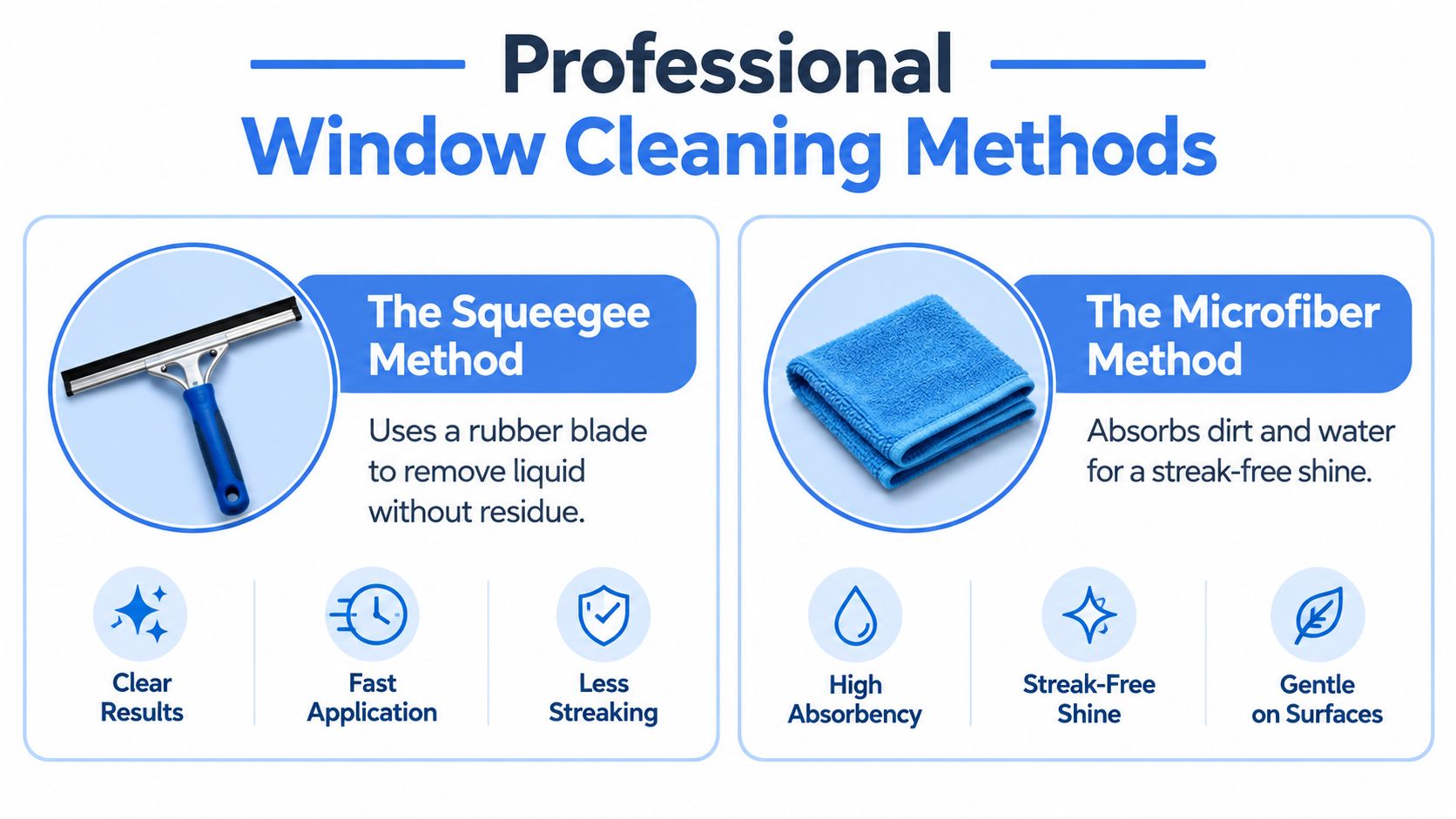
A scrubber or mop carries the cleaning solution across the pane and loosens the soil. The rubber-bladed squeegee then removes the dirty water before it dries. Keep the upper edge leading and use overlapping passes or controlled fanning strokes. That movement gives the blade a continuous wet path and reduces the lines left behind by isolated wipes, consistent with professional squeegee technique guidance.
This method gives excellent control on interior glass, smaller residential panes, and windows with heavier fingerprints or buildup. It also lets the cleaner see exactly where dirty water is moving. The trade-off is that technique matters. A worn rubber blade, too much solution, a dry pane, or a poor angle can leave streaks.
Microfiber cloths fit into this method for edges, corners, frames, and final touch-ups. They shouldn't replace rinsing and proper water removal when the pane is heavily soiled. A cloth that picks up dirty water can redistribute it if it's saturated.
A pure-water system filters ordinary tap water through reverse osmosis and/or deionization. Those stages remove dissolved minerals such as calcium and magnesium. The mineral-free water loosens surface soil and can dry spot-free without squeegeeing because it leaves no mineral residue, as described in this explanation of professional pure-water cleaning.
This approach is especially useful for exterior glass, high windows, and frames that can be safely rinsed. It reduces the need to carry dirty solution down the pane and works well where hard-water spotting would otherwise be a constant problem. It isn't a license to flood every window. The cleaner still needs to control runoff, keep water away from vulnerable openings, and confirm that the glass and frame are suitable for the process.
| Situation | More practical choice |
|---|---|
| Interior residential glass | Squeegee method |
| Heavy fingerprints or greasy soil | Squeegee method |
| Exterior windows with safe rinse access | Pure-water system |
| Hard-water environment | Pure-water system or soft/deionized final rinse |
| Coated or self-cleaning glass | Follow the manufacturer's approved method |
The choice isn't about finding a clever shortcut. It's about removing soil while leaving no residue and putting as little stress as possible on the seal, coating, and frame.
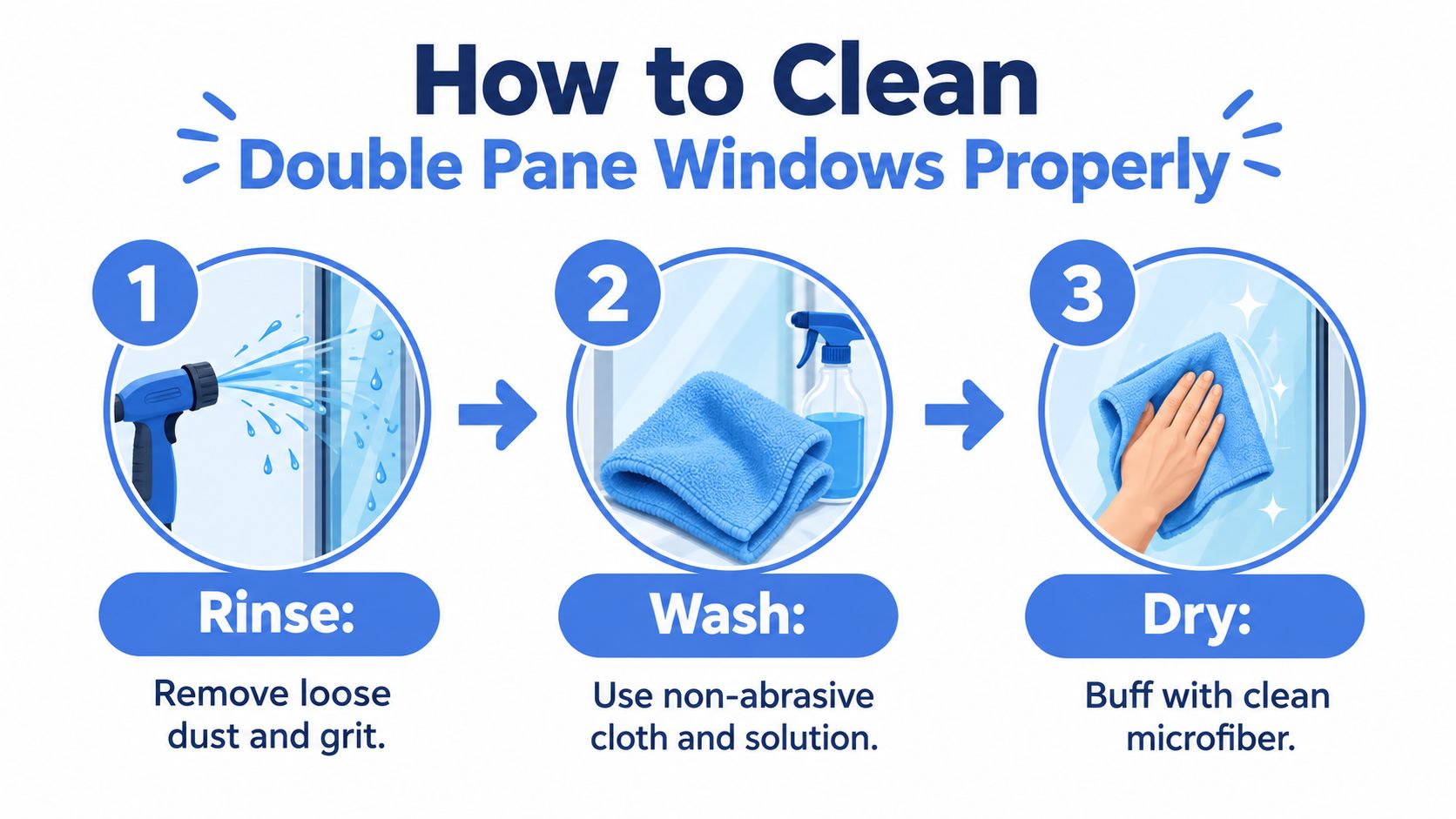
Good results come from wetting first, washing second, and drying immediately. Dry dusting a gritty pane drags particles across the surface. A hot pane dries solution before you can remove it. A soaked frame can send water toward tracks, seals, and drainage paths.
Open or tilt the window only as far as the hardware allows, and make sure the pane is stable. Vacuum loose debris from the frame, sill, and tracks before applying liquid. That small preparation prevents muddy grit from turning into a slurry and helps keep debris away from the drainage openings, a detail emphasized in this double-glazing cleaning guide.
Choose shade or the coolest workable part of the day. Direct sun heats the glass and shortens your working time. On a hot exterior pane, even a mild solution can flash-dry into marks before the squeegee reaches it.
Flood or thoroughly rinse the surface first. The purpose isn't to soak the frame. It's to suspend and carry away loose dust and grit before the scrubber or cloth makes contact. Use enough water to wet the pane evenly, then wash with a soft, non-abrasive sponge or scrubber and a mild solution.
Work from the upper edge toward the bottom. Use light-to-medium pressure, particularly near the perimeter and on coated glass. Smooth overlapping strokes are more effective than repeatedly attacking one spot with force.
Keep the solution on the glass rather than pushing it into the seal or frame. If the window is a tilt-in style, clean the upper and lower sections in a controlled sequence, supporting the sash and watching where runoff collects. For hard-to-reach windows, don't lean or improvise with unstable access equipment. A professional service such as professional window cleaning for offices can handle access and water-control concerns in commercial settings.
After washing, rinse with clean water. Then choose the finish according to the pane and water conditions:
Dry the pane and nearby frame promptly. Don't let rinse water evaporate on the glass. A clean result depends less on a premium spray than on removing dirty and mineral-laden water before it dries.
The glass is often tougher than the materials around it. The perimeter seal, edge area, frame finish, and coatings are where an overenthusiastic cleaning job creates lasting trouble.

Don't use razors, metal blades, abrasive powders, scouring pads, or sharp objects near the glass edge or coating. Don't use a pressure washer on double-glazed windows. High pressure can drive water into places that should remain dry and can disturb seals, gaskets, trim, or drainage paths.
Manufacturer and industry guidance also warns that coated or self-cleaning glass may prohibit both metal blades and rubber squeegees. The restriction depends on the coating, so identify the product before choosing a tool. This glass-care guidance for coated surfaces explains why a tool approved for ordinary glass may be unsuitable for treated glass.
The edge is not a target for extra force. If a mark sits beside the seal, soften and lift it with an approved non-abrasive method, or leave it for a technician.
Vacuum frames and tracks before washing. Clear visible debris from weep holes without poking aggressively into the frame. Those openings need to drain water, and blocked drainage can contribute to moisture accumulation around the window.
Use a controlled amount of solution and keep the cloth or scrubber damp rather than dripping. Repeatedly forcing wet tools into gaskets doesn't clean the sealed cavity. It only increases the chance of moisture intrusion at the frame.
For additional edge-care detail, window seal cleaning guidance is useful when the buildup is concentrated around gaskets and tracks. If you're comparing regional safety advice, this resource on Dublin window cleaning advice is also a good reminder that pressure washing is the wrong tool for delicate window assemblies.
Clean in shade, begin at the top, move downward, use light-to-medium pressure, and rinse and dry without delay. That sequence prevents residue from baking onto the surface and keeps the cleaning process away from the parts most likely to fail.
Surface dirt usually has a clear location. You can see it on the room side or outside face, and it disappears when that surface is cleaned. Fogging between panes behaves differently. It remains after both accessible surfaces are wiped and may change with outdoor temperature or humidity.
Sealed double-pane windows can't be cleaned from the outside because the insulated cavity isn't open to a cloth, spray, or squeegee. Moisture, haze, or residue suspended between the panes usually means the perimeter seal has failed. Cleaning the exterior won't restore that seal, and trying to drill, pry, or inject a product into the unit can create further damage.
Look at the location first. If condensation is on the room-facing surface, indoor humidity, weak ventilation, and temperature differences may be contributing. If it appears on the exterior surface, it can be a weather-related condition. If it sits between the panes and can't be wiped from either side, treat it as an insulated-glass-unit problem.
Condensation is a moisture-management issue as much as a window-cleaning issue. Run bathroom and kitchen exhaust fans, improve airflow, avoid blocking warm air from reaching the glass, and keep weep holes clear. Dry the sill after cleaning instead of leaving a wet ledge against the frame.
A failed seal generally calls for replacement of the insulated glass unit rather than more scrubbing. The frame may remain usable, but the sealed glass assembly has to be assessed by someone who can distinguish a repairable frame issue from a failed unit. See this practical guide to double-pane window fog before attempting a home fix.
Double glass stays clearer when you remove loose soil before it bonds to the pane, use mild solutions, and dry every surface before residue can remain. Soft water or deionized water helps in hard-water areas, while gentle microfiber detailing keeps corners and edges clean without aggressive pressure.
Check the tracks, frames, gaskets, and drainage openings during routine cleaning. Call for an evaluation when internal fog remains after both surfaces are clean, when a coating's care instructions are unclear, or when a window is too high or awkward to reach safely.
Professional Window Cleaning has been cleaning windows for over 26 years and serves residential, commercial, and high-rise properties in Las Vegas, Phoenix, Denver, and Scottsdale, among other locations.
If your double glass windows need careful surface cleaning, frame and track attention, or a clear assessment of fogging that won't wipe away, visit Professional Window Cleaning to request service. Their team can match the cleaning method to the glass, access conditions, and moisture problem instead of treating every cloudy window as ordinary dirt.
Read our blog posts regularly and keep learning.