Care and Maintenance
Window Squeegee Rubbers: A Complete Reference Guide
Window squeegee rubbers explained — types, sizes, materials, how to measure, replace, and pick the right rubber for clean, streak-free glass every time.


You're probably looking at a property and asking a simple question that turns messy fast. Is this building low-rise, mid-rise, or high-rise, and why does that label matter for day-to-day operations?
For a property manager, the answer affects more than leasing language or design review. It changes how you plan access, budget façade care, schedule inspections, and handle recurring work like exterior window cleaning. A building that feels “not that tall” from the sidewalk can still require a very different maintenance approach once crews have to reach upper floors safely and consistently.
A mid rise building sits in the practical middle ground of urban real estate. It's tall enough to create meaningful density, mixed-use frontage, and more units on a smaller site, but it usually still operates on a more compact scale than a tower.
That matters because this building type isn't niche. It has become a core part of city growth. In Australia, medium-rise apartment commencements increased by 95.1% between 2004–05 and 2018–19, showing how important this form has become in major population centers, according to the Australian Bureau of Statistics analysis of apartment building heights.
If you manage one of these properties, you're dealing with a building type that often tries to do several jobs at once. It may need to feel residential, fit into a walkable street, satisfy design rules, provide daylight to units, and still stay maintainable over time.
Practical rule: If your building is tall enough that routine window work needs more planning than a ladder and a bucket, you're already thinking like a mid-rise manager.
There's another reason the label matters. Mid-rise properties often have more complicated tenant movement and vendor access than smaller buildings. Deliveries, resident entry, loading, and contractor coordination all become more structured. If you're tightening operations, a system for secure gate and building entry can help reduce friction when maintenance teams, cleaning crews, and residents all need controlled access to the same property.
Professional Window Cleaning has been cleaning windows for over 26 years!
That kind of experience matters most on buildings in the middle. A small storefront is straightforward. A true high-rise has obvious access demands. Mid-rise buildings are where owners often underestimate what recurring exterior care requires.
Mid-rise architecture is easiest to understand if you stop looking for one magic number. In practice, this category is shaped by four things working together: height, street relationship, code limits, and building form.
A property manager feels those four factors in day-to-day operations. The architect may see massing and proportion. You see where a lift can park, which windows sit above setbacks, and how long exterior work will disrupt residents and storefronts.
Many design standards describe a mid-rise building as falling somewhere between low-rise and tower development, often around 4 to 14 storeys. Toronto's guidance is a useful example because it does not treat height as an isolated number. It ties building height to the width of the street beside it, which often produces mid-rise forms in the 5 to 14 storey range, as described in Toronto's mid-rise building design guidelines.
That street-width rule matters operationally. A broader right-of-way can support a taller building mass. A taller mass usually means more glass, more corners, and more upper elevations that cannot be handled with simple ground tools.
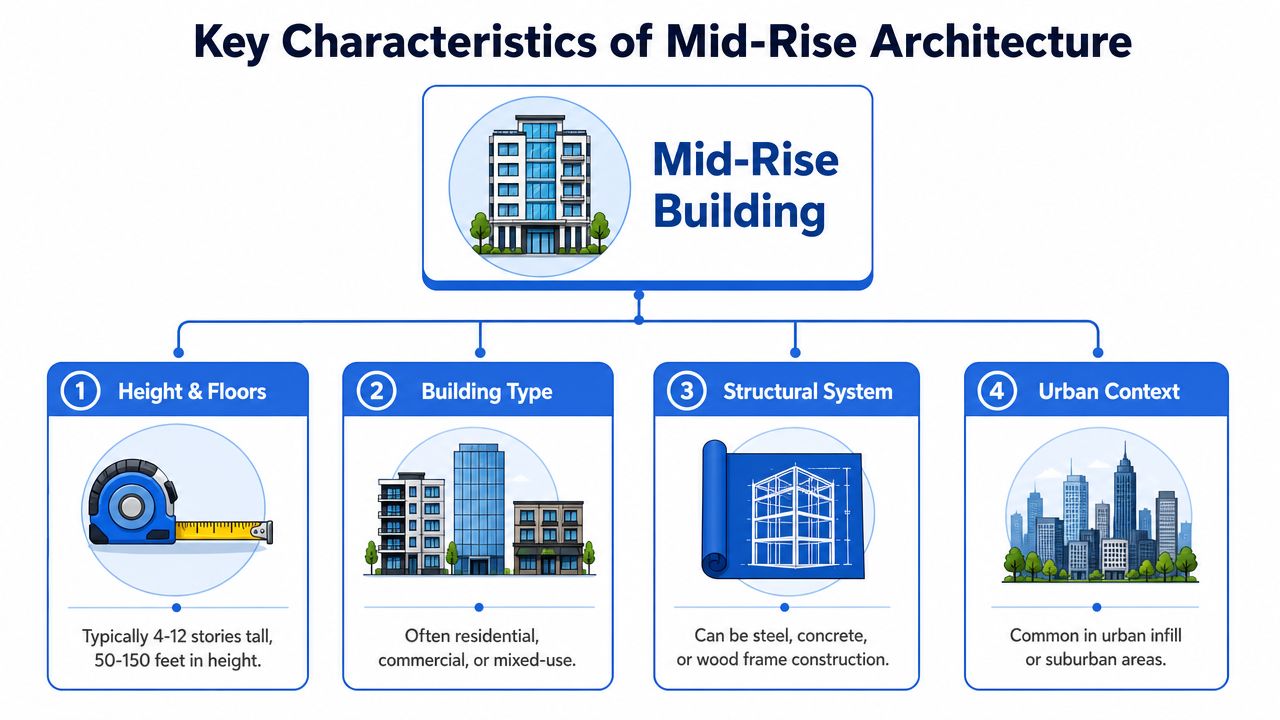
Floor count alone does not tell you how the building will perform in real use. Two buildings with the same number of storeys can create very different maintenance demands if one sits tight to the sidewalk, has deep setbacks, or includes projecting balconies and retail canopies.
That is why new managers often get tripped up. They expect a clean category line. Mid-rise buildings work more like the middle gears on a truck. They are beyond the simplicity of a small low-rise, but they may still fall short of the full systems and routines expected in a tower.
For exterior maintenance, this middle condition is where planning starts to matter a lot more. Window cleaning may still be possible from the ground on some elevations. Other sections may need lifts, roof access planning, pedestrian control, or tighter coordination with tenants and parked vehicles.
A building may be called mid-rise for several different reasons:
The last point is the one property managers tend to learn firsthand.
From the curb, a mid-rise can look manageable. From the maintenance log, it often acts more complicated than it appears. Upper windows may be broken up by recesses, shade structures, terraces, parapets, and uneven rooflines. Each of those design moves changes access. In other words, the drawing on paper becomes labor hours, equipment choices, and safety procedures on site.
That blueprint-to-upkeep connection is what makes mid-rise architecture its own category. It is not only about how tall the building stands. It is also about how that height, shape, and street fit affect recurring work on the façade, especially window cleaning.
When you're budgeting maintenance, comparisons help more than definitions. A low-rise, mid-rise, and high-rise may all have glass. They don't create the same work.
One long-term market shift shows why the category matters. A cited market analysis says mid-rise apartments grew from 6% of new apartment construction in 1990 to 41% of what was under construction by the time of the report, reflecting a major move toward medium-density development in mature housing markets, as noted in this industry summary on why mid-rises are on the rise.
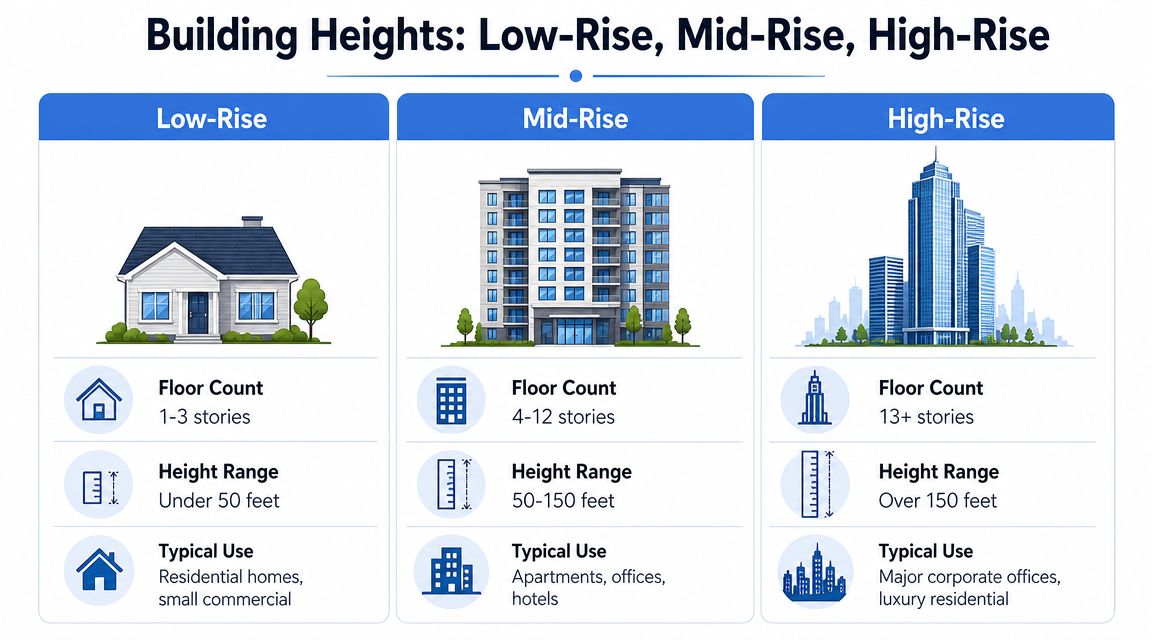
| Building type | Typical feel | Access reality | Window cleaning impact |
|---|---|---|---|
| Low-rise | Smaller footprint, simpler elevations | Ground ladders and short-reach tools often work | Fast setup, fewer access constraints |
| Mid-rise | Denser, often mixed-use, more façade articulation | Ground tools may work on some areas, but lifts or rope planning may be needed on others | More site planning, more coordination with tenants and vehicles |
| High-rise | Tower form, large vertical envelope | Specialized access is routine | Access strategy becomes a central part of maintenance cost |
The middle category is where managers often get surprised. A low-rise usually has obvious limitations and simple cleaning plans. A high-rise usually gets treated like a specialty property from day one. A mid-rise can be deceptively complex because part of the building may be easy while another elevation is not.
If you manage a mid-rise building, compare it to other structures using these questions:
For a deeper look at where that upper category begins, this article on what is considered a high-rise building gives useful context.
A mid-rise building often carries tower-like maintenance challenges without tower-level visibility in the budget.
That's why owners should classify the property by operational demands, not by marketing language alone.
Once you know you're managing a mid-rise building, the next question is simpler and more useful. What exactly are crews cleaning?
The answer usually starts with the façade system. Mid-rise properties often mix materials more than people expect. You may have brick at lower levels, panelized sections above, storefront glazing at grade, and residential windows stacked above that.
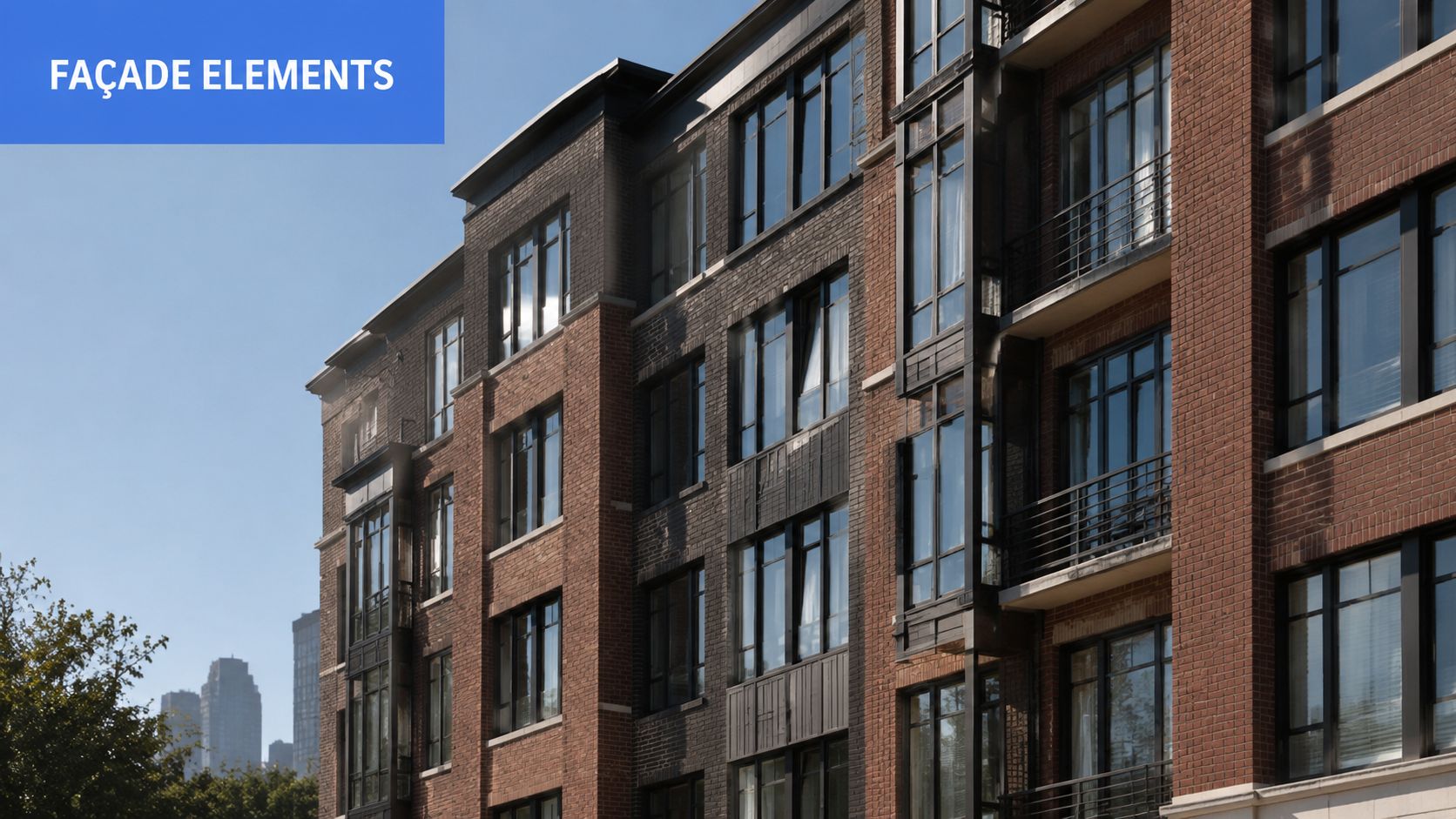
Here's what property managers usually run into:
The windows themselves matter just as much as the wall around them.
These are individual windows set into a more solid wall, often brick or panel cladding. They're common on apartments and mixed-use mid-rises. Cleaning is more repetitive, but access can be awkward because crews have to work around projections, sills, and changing façade planes.
These run horizontally in longer bands. They appear on some office and institutional properties. The glass is more continuous, so the cleaning pattern is efficient, but streaks become easier to spot because the eye reads the band as one long line.
These create a more modern look with more glass coverage. They can brighten interiors and improve views, but they increase visible maintenance demand. Dirt, drips, pollen, and mineral deposits don't have much visual competition on broad glass surfaces.
If the architect gave the building more glass for light and views, the manager inherited more visible maintenance.
Before you call a contractor, walk the site and note:
A smart maintenance plan starts with the envelope you have, not the one shown in a brochure rendering.
You approve a window cleaning visit for a six-story property, and the first question from the contractor is not about soap or tools. It is about access. Can they work from the ground, or will they need a lift for part of the façade? That is how mid-rise cleaning usually works in practice. The cleaning method matters, but the building's shape and reach points usually decide the plan.
At the crew level, exterior window cleaning comes down to two core methods: squeegee cleaning and pure-water cleaning. Everything else is a variation in how workers reach the glass safely and efficiently.
Squeegee work is the close-detail option. A technician wets the glass, agitates the dirt with a scrubber, removes the water with a professional squeegee, and wipes the edges clean. It is slower than pole work, but it gives the crew more control.
That control matters where occupants see glass from a few feet away.
This method fits best when:
For a property manager, the easy rule is this: if the glass sits at eye level, near an entrance, or beside a leasing or retail space, squeegee work usually gives the finish people expect. It is also useful on problem areas where bug debris, grease, adhesive residue, or hard-water spotting need extra attention.
Pure-water cleaning works more like rinsing with laboratory-clean water. The system filters minerals out of the water, sends it through a pole and brush, and lets the glass dry without the spotting that untreated water would leave behind.
On the right building, it is efficient and predictable.
This method is often useful when:
Mid-rise properties often benefit from pure-water systems on upper exterior windows that repeat floor after floor. If one elevation is flat, open, and reachable from grade, crews can cover a lot of glass without bringing large equipment onto the site. That can reduce setup time and simplify pedestrian control.
A new manager will often ask, “Should this be cleaned with a squeegee or pure water?” The better first question is, “How will the crew safely reach the glass?” Access is often the main challenge.
As noted earlier, the code line between mid-rise and high-rise matters because taller occupied floors can change what equipment is practical and what planning is required. For many mid-rise properties, though, the day-to-day decision is less about labels and more about obstacles on the ground and interruptions in the façade. A clean vertical wall is simple. A wall with balconies, canopies, setbacks, planters, and tight drive aisles is a different job entirely.
For mid-rise properties, access usually falls into a few patterns:
This is often the simplest setup when the building allows it. Crews work from grade with pure-water poles and avoid heavier equipment. It works well on straightforward elevations, but canopies, deep recesses, parked cars, and landscaping can block the brush from reaching the glass at the right angle.
Boom lifts and similar equipment are common when windows sit above practical pole range or when the glass needs hand detailing. A lift works like bringing the technician to the window instead of extending the tool to the window. That sounds simple, but it adds site planning. The crew needs room to stage, pavement that can handle the equipment, and a path that does not interfere with residents, deliveries, or storefront traffic.
Some mid-rise buildings need rope-based access on selected sections, especially near the taller end of the category or on elevations where lifts cannot reach cleanly. Courtyards, upper setbacks, and irregular rooflines can create those conditions. It is common for one side of the building to be lift-friendly while another side requires a different approach.
That mixed-access pattern is normal on mid-rise properties. One building can have three cleaning setups in the same service cycle.
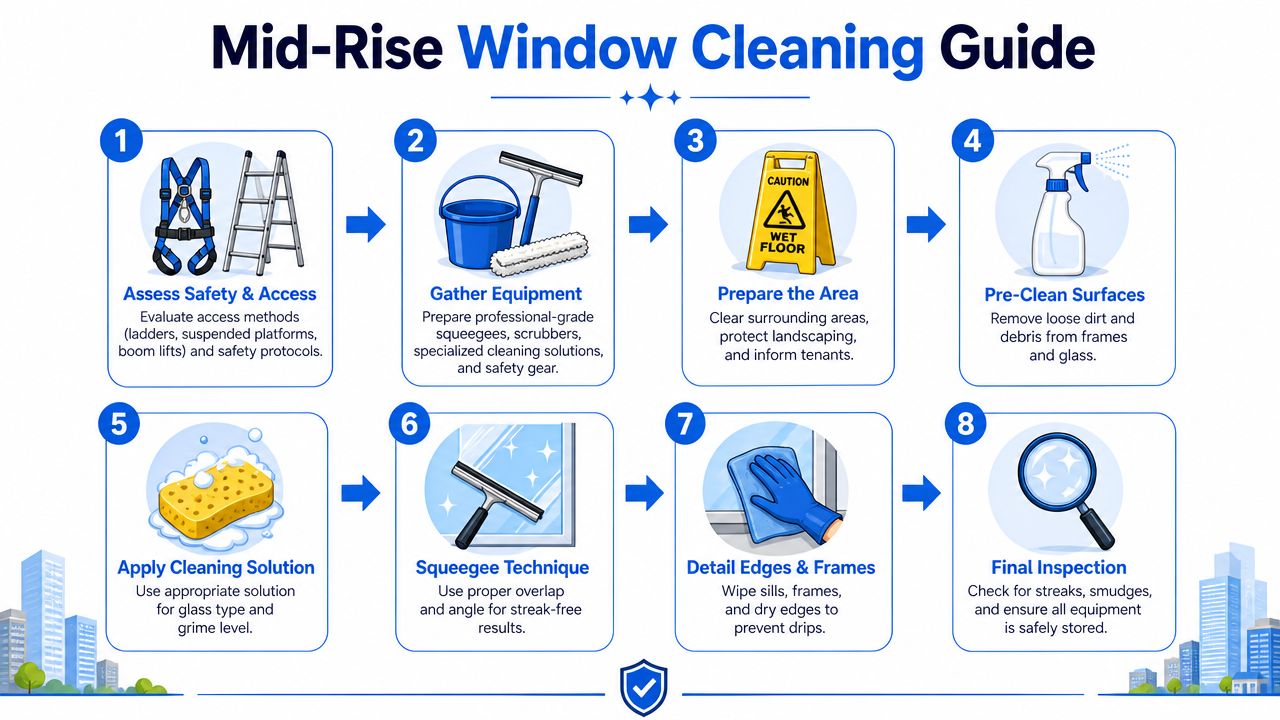
A quick visual helps if you're evaluating process and access options:
There is no single cleaning schedule that fits every mid-rise. The right interval depends on what people see first, how quickly the glass shows soil, and how difficult each elevation is to access.
Use these decision points:
A practical schedule starts with visibility and complaints, then gets adjusted around access efficiency. If a lift is already on site for one difficult elevation, it often makes sense to bundle nearby work into the same visit.
If you're comparing vendors, ask them to separate the cleaning method from the access plan. Those are different decisions. A crew might use squeegees on entry glass, pure water on reachable upper windows, and lift access for selected elevations during the same service cycle.
Professional Window Cleaning is one provider that handles residential, commercial, and high-rise window washing, which matters if your property portfolio includes more than one building type.
A mid-rise window cleaning bid can look simple on paper and still fail on site. The crew arrives, finds tight access on one side, heavy foot traffic on another, and glass that needs a different method than the proposal assumed. For a property manager, that usually means delays, tenant complaints, or a change order that should have been avoided during hiring.
That is why contractor selection for a mid-rise should be treated like an operations decision. You are hiring someone to work on an occupied building with real constraints, not just to wash glass. In Phoenix, Las Vegas, and Denver, climate adds another layer. Dust, hard water, wind, snow, and freeze-thaw exposure all affect how the work is planned and when it should be scheduled.
A good screening process looks a lot like the process used for other recurring trades. This guide to hiring contractors for rental properties is a useful reference because it focuses on the habits that make a vendor dependable over time: clear communication, careful screening, and consistency from visit to visit.
Start with the questions that connect directly to your building.
One practical test helps a lot. Ask the contractor to walk the site and talk through the job in the order they would perform it. That conversation often tells you more than a polished proposal. A vendor who understands mid-rise work will notice staging limits, pedestrian flow, shaded areas that dry slowly, and façades that collect runoff.
Mid-rise buildings work like a machine with several connected parts. The glass, the façade, the access points, and the tenant schedule all affect the final result. If one bidder prices the job as if every window can be reached the same way, the quote may be low for the wrong reason.
Ask each bidder to explain:
If you are building an annual maintenance budget, this article on window cleaning service costs can help you frame the pricing discussion before proposals come in.
Professional Window Cleaning is one company that serves Arizona, Nevada, and Colorado, which can be useful if you manage properties across more than one of these markets. The best fit, though, is the contractor who can explain your building clearly, price the work accurately, and carry out the plan without creating problems for tenants or staff.
Read our blog posts regularly and keep learning.