
Care and Maintenance
Window Squeegee Rubbers: A Complete Reference Guide
Window squeegee rubbers explained — types, sizes, materials, how to measure, replace, and pick the right rubber for clean, streak-free glass every time.


You walk into the bathroom or kitchen, look up, and see beads of water on the ceiling. Sometimes it's just a faint sheen. Sometimes it's full droplets, a stain, or paint starting to lift. Most homeowners assume the roof is leaking.
Sometimes it is. Often it isn't.
Condensation on ceiling surfaces is one of the most misunderstood moisture problems in a house. It's easy to mistake for a plumbing leak or roof failure because the end result looks the same. Water is where it shouldn't be. The underlying cause, though, is often a mix of indoor humidity, cold surfaces, weak ventilation, and small building-envelope failures that let warm moist air reach the wrong place.
That matters because the right fix depends on the right diagnosis. If you treat condensation like a roof leak, you can spend money in the wrong place and still have the same wet ceiling next week.
You finish a hot shower, come back 20 minutes later, and the ceiling is beaded with water. In a kitchen, it often shows up after a long simmer on the stove. In both cases, the ceiling can look like it leaked, even when no pipe or roof fault is present.
A ceiling gets wet when warm, moisture-heavy air hits a surface that is colder than the air around it. The water was already in the room as vapor. The ceiling became the place where that vapor turned back into liquid.
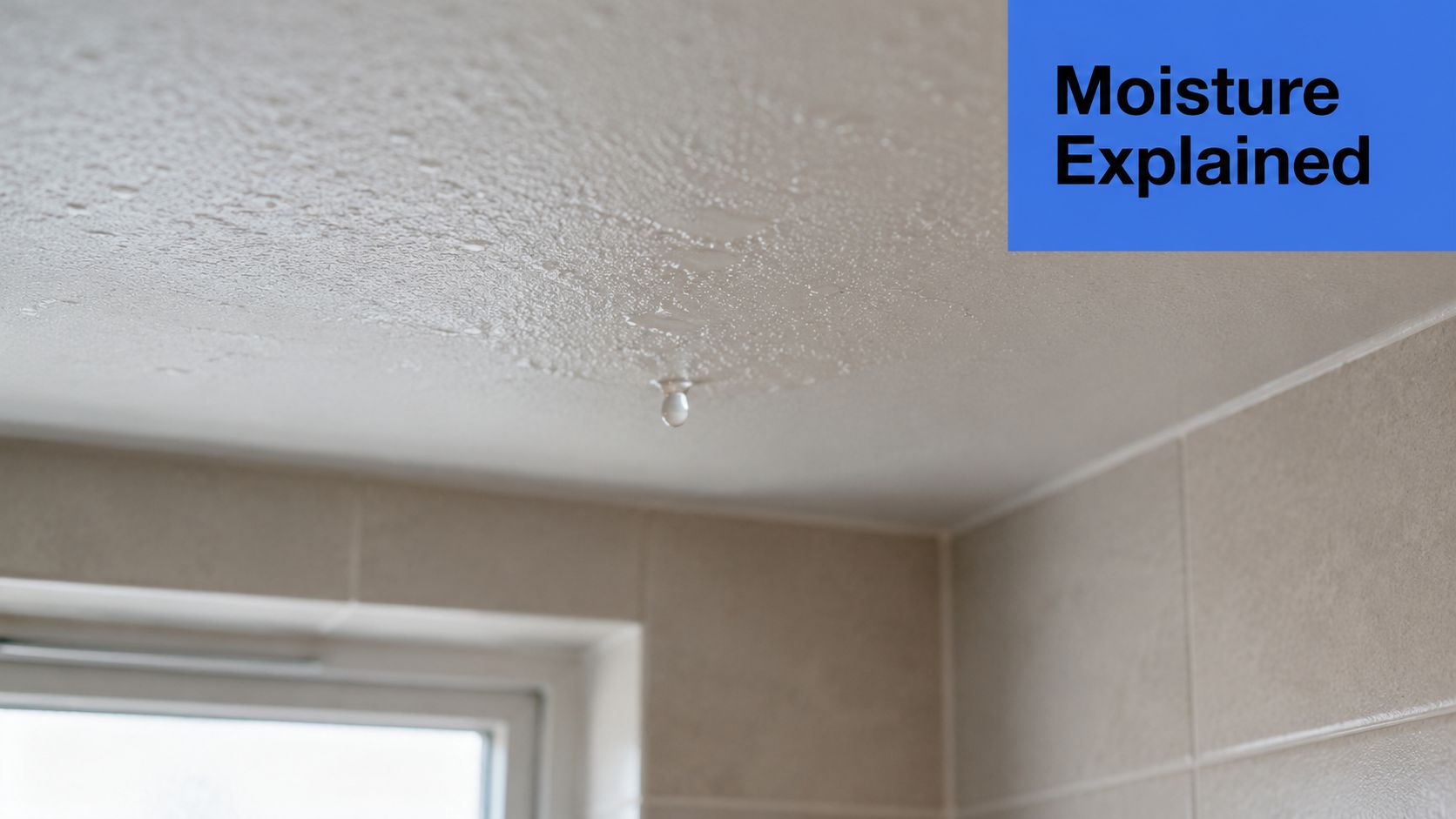
Daily life adds a surprising amount of humidity indoors. Showers, baths, cooking, drying clothes, and breathing all load the air with water vapor. That vapor rises and spreads. If it reaches a cool ceiling, especially one under an uninsulated loft, near an exterior corner, or around an air leak, droplets form.
The key term is dew point. It is the temperature at which air can no longer hold all its moisture. Once part of the ceiling drops below that temperature, water appears on the surface.
In practice, I look at three things first. How much moisture the room generates. How quickly that moisture is removed. How cold the ceiling gets compared with the rest of the room.
Bathrooms and kitchens produce fast spikes in humidity, and they often have the weakest extraction. A fan that is dirty, undersized, or venting poorly will let damp air linger. If windows are rarely opened, or the room has old glazing and cold frames, moisture stays trapped longer and more of it lands on nearby surfaces.
That is where the wider building envelope comes in. Ceiling condensation is often tied to window condition, not just what is happening overhead. Cold window glass, failed seals, draughts around frames, blocked trickle vents, and poor guttering outside can all point to a house that is not shedding moisture or controlling temperature well. If rainwater is overflowing near walls or soffits, it is worth checking whether neglected drainage is contributing to damp conditions around the structure. A local guide to gutter cleaning in Colorado Springs shows the kind of exterior maintenance that helps protect those vulnerable edges.
A few patterns usually point toward condensation:
If the ceiling is actively dripping, drywall is sagging, or a stain changes quickly, treat it as a possible leak until proven otherwise. Start with a practical guide on what to do about a ceiling leak, then check whether the underlying problem is moisture generation, poor extraction, cold surfaces, or a combination of all three. The right fix depends on the right diagnosis.
The first job is to stop guessing. Ceiling moisture has a pattern, and once you know what to look for, the source usually narrows down fast.
Learn to identify if the water on your ceiling is condensation or a more serious leak.

A true roof leak usually follows weather. Condensation usually follows indoor conditions. If the ceiling gets wet after a shower, after cooking, or after a cold night with no storm, that's a strong clue.
Then look at where the moisture forms:
| What you see | What it usually suggests |
|---|---|
| Broad film or droplets across part of the ceiling | Condensation |
| Localized stain under one path | Leak is more likely |
| Moisture around vents, lights, or ceiling penetrations | Air leakage and condensation |
| Repeated dampness in bathroom or kitchen ceiling | Poor extraction |
Wipe the area dry. If it comes back quickly during normal occupancy, that points toward an indoor moisture problem.
Many homeowners look at the stain and stop there. The actual issue is often above, behind, or passing through the ceiling plane.
Historical building science points to thermal bridging and poor insulation as major causes in upper ceilings and attic edges, where warm indoor air reaches colder outer surfaces and condenses. Gaps around windows and doors can add to the problem by letting moist air move into cavities and nearby ceiling areas, and poorly sealed exhaust ducts can dump moisture directly at ceiling level, as noted in this overview of common ceiling condensation causes.
One issue gets missed all the time. Unsealed recessed LED can lights. They can act like little leakage points in the ceiling. The verified guidance explains that these fixtures can let humid attic air “puff” into cold roof cavities and reduce insulation depth behind the fixture, creating a thermal bridge where the surface drops below the dew point, even in homes that seem well insulated. That's covered in this technical explanation of recessed light condensation problems.
If the wet spot forms in a neat circle around a recessed light, don't assume the roof is leaking above it. Check the fixture sealing and insulation first.
Bathroom fans and kitchen exhaust only help if they move moisture outside. If ductwork leaks, disconnects, or vents into the attic, you're feeding moisture into the exact space where condensation starts. If you suspect that, this guide on how to repair leaky ductwork is useful for understanding what proper correction involves.
Exterior water management also matters. Overflowing gutters can saturate adjacent assemblies and confuse the diagnosis, especially near upper walls and soffits. If that part of the house has been neglected, this article on gutter cleaning in Colorado Springs is a practical reference for what to inspect.
Not all condensation on ceiling problems happen in winter. In hot, humid climates, over-cooling can create the opposite problem. Building science guidance notes that indoor temperatures below 65°F in summer can create condensation on the backside of drywall in humid regions, and that homeowners often mistake it for a roof issue. That's discussed in this building science review of summer over-cooling condensation.
This matters in places like Phoenix, where aggressive air-conditioning can create moisture trouble that doesn't look logical until you understand the temperature difference.
Ceiling moisture isn't just ugly. Left alone, it turns into a health problem and a building problem.
Paint starts bubbling. Drywall stains. Joints soften. Repeated wetting can weaken the paper face of drywall and leave a ceiling looking permanently tired even after it dries. In attics and upper cavities, prolonged moisture can also affect timber and sheathing.
The cosmetic damage is usually the first thing people notice. It's rarely the most important part.
Persistent condensation creates a good environment for black spot mould. That's one reason these patches often start in bathroom ceilings, around window heads, and in colder corners where dampness hangs around.
Government and industry guidance summarized in the earlier building-envelope material notes that black spot mould is a direct consequence of persistent ceiling condensation and should be removed by washing surfaces with disinfectant after regular wiping prevents moisture from lingering on nearby finishes. Once mould gets established, a quick repaint won't solve it. You have to remove the moisture source first.
Wet ceilings are a symptom. Mould is the result of leaving that symptom in place too long.
A house rarely keeps a moisture problem confined to one surface. If warm moist air is condensing on a ceiling, windows often show the same stress. You may see misting on glass, dampness at frames, or mould around the window reveal.
That connection matters because condensation is really about the building envelope working poorly as a system. The ceiling, attic, vents, seals, ducts, and windows all play a part. If one area is failing, another area often isn't far behind.
You come upstairs in the morning, the ceiling paint looks dull, the bathroom mirror is still wet, and the bedroom windows have moisture at the edges. That pattern matters. Ceiling condensation is rarely just a ceiling problem. It usually means the house is holding too much moisture, losing heat at weak points, or failing to move damp air out fast enough.

The best prevention plan starts with control, then moves to correction. First, stop active moisture from sitting on finishes. Then fix the room conditions and building-envelope weak spots that let the problem keep returning.
If the ceiling is wet now, deal with the water first.
A simple fan check helps. Hold a sheet of toilet paper against the bathroom extractor grille. If the fan cannot hold it in place, airflow may be weak, the duct may be blocked, or the fan may be undersized for the room.
Here's a useful visual overview of moisture control and ventilation in practice.
“Lower the humidity” sounds sensible, but it does not help much unless you measure it. Use a hygrometer and watch what happens after showers, cooking, laundry drying, and overnight with doors shut.
If readings stay high for long periods, the room is producing more moisture than the fan, background ventilation, and heating pattern can handle. That is when people waste money on cosmetic fixes and wonder why stains return.
Lasting improvement usually comes from several smaller corrections working together.
Background ventilation matters, especially in winter when rooms stay closed. Trickle vents in window frames help keep air moving without leaving the sash wide open. They are not a substitute for extractor fans, but they do reduce stagnant, humid air around window heads, reveals, and ceiling corners.
If your glass mists up often, read this guide on how to prevent window condensation. Window condensation is often the early warning sign that the same moisture load is reaching the ceiling and colder parts of the envelope.
Bathroom and kitchen extract fans should discharge outdoors. If a fan dumps moist air into a loft or roof void, the house has not solved anything. It has only moved the moisture to a colder place.
Insulation helps, but only if moist indoor air is not slipping past the ceiling line. I see this often around downlights, loft hatches, fan housings, pipe penetrations, and poorly sealed junctions at the top of walls.
Warm air escapes through those gaps, hits colder surfaces above, and drops its moisture there. More insulation on its own can reduce heat loss, but it will not stop air leakage. Sealing the bypasses and then checking insulation coverage is the better order.
Cold rooms condense moisture faster than evenly heated ones. The aim is not tropical heat. The aim is to avoid leaving upper rooms, corners, and ceiling perimeters much colder than the rest of the house.
This becomes more noticeable around older windows, thin reveals, and loft edges where surface temperatures fall first. As noted earlier in the article, colder internal surfaces are where mould and condensation tend to take hold.
Some moisture sources are easy to miss. Drying clothes indoors, shutting off fans too early, keeping internal doors closed after showers, and blocking vents with blinds or furniture all add up.
Small changes help, but they only work if the house can also release that moisture. That is the trade-off. Better heat retention, tighter windows, and improved draught proofing make homes more comfortable, but they also make ventilation discipline more important.
Do not assume every wet patch is condensation. If staining is localized, returns after dry weather, or appears near flashings, chimneys, or roof junctions, check for an external water route as well. Paletz Roofing and Inspections is one example of the kind of roof-focused reference that reminds homeowners to separate internal humidity problems from true leak paths.
A good prevention plan treats the house as one system. Ceilings, fans, loft insulation, window vents, seals, and roof details all affect where moisture ends up. If you fix only the visible patch, the next weak point usually shows up somewhere else.
Some condensation problems are simple. Others aren't. The hard part is knowing when you've crossed from routine moisture control into a building defect, ventilation fault, or repair job that needs trained eyes.

DIY measures are reasonable when the issue is light, recent, and clearly tied to a room like a bathroom. They're not enough when you have repeated staining, visible mould spreading beyond a small patch, damaged drywall, or signs that moisture is entering concealed spaces.
Bring in a professional when you notice things like:
Homeowners often separate “window issues” from “ceiling issues.” In practice, they're connected. Windows are part of the same pressure, temperature, and moisture system.
Poorly sealed windows, blocked trickle vents, and neglected frames can contribute to stale air, weak airflow, and local cold spots. When that happens, indoor humidity doesn't leave the house efficiently. It settles on the coolest surfaces first. Sometimes that's the glass. Sometimes it's the upper corner of a room. Sometimes it's the ceiling above the shower.
That's why a holistic inspection matters. You don't want one contractor looking only at the stain, another looking only at the attic, and nobody noticing the indoor moisture pattern or the condition of the windows.
A dry ceiling starts with a healthy envelope. The roof, insulation, air sealing, ducts, and windows all have to cooperate.
If you also suspect a roof problem, use a local roofer or inspector who understands the difference between rain entry and interior moisture behavior. Even a simple visual reference from Paletz Roofing and Inspections can help homeowners understand how easy it is to confuse the two when water marks show up overhead.
A good exterior maintenance professional can spot patterns homeowners miss. Water staining around window heads, blocked drainage paths, dirty frames that hide mould, failed seals, and neglected upper elevations all tell part of the story.
That's also where experience matters. Professional Window Cleaning has been cleaning windows for over 26 years. On homes and buildings with persistent moisture issues, that kind of field experience helps because technicians see how windows, frames, vents, and upper exterior details behave across seasons.
There's another practical point here. In professional window cleaning, there are only 2 methods used by trained crews. The traditional squeegee system and the pure-water system. Industry standards recognize those as the only two methods that produce consistently reliable, streak-free results for residential and commercial properties, as outlined in this explanation of professional window washing methods.
Those methods matter because each has a job:
| Method | Best use |
|---|---|
| Squeegee system | Faster route work, interiors, detailed grids, and close hand-finished work |
| Pure-water system | Higher exterior windows, larger properties, and chemical-free cleaning |
Verified trade guidance also notes that water-fed pole systems are recommended for windows above safe ladder height, large commercial properties, and eco-friendly cleaning needs, while squeegees remain better for intricate grids and interior detailing. On pure-water setups, the water must be filtered to a TDS reading below 0.07, and if source water reads above 150, reverse osmosis is required before deionization, according to this trade explanation of traditional versus pure-water window cleaning and this practical comparison of when to use each method. For squeegee work, pros overlap strokes by approximately one inch and wipe the blade between passes to avoid streaks, as described in this guide to professional squeegee technique.
That isn't just window-cleaning trivia. It's a sign of professional discipline. The same companies that understand safe access, upper-level exterior conditions, and detailed visual inspection often spot the clues that connect window health to broader moisture trouble.
For homeowners in Las Vegas, NV and Scottsdale, AZ, that whole-house view is especially useful because climate swings, strong cooling demands, and sealed-up interiors can all complicate condensation patterns.
The short version is this. If the problem is small, recent, and clearly tied to indoor habits, start with humidity control, ventilation, and cleaning. If the moisture keeps returning, starts staining materials, or shows up alongside window condensation and attic warning signs, stop treating it as a minor nuisance. Get the house looked at as a system.
If you want experienced eyes on the exterior side of that system, Professional Window Cleaning is a smart place to start. Their team has been in business since 1999, and their work on residential, commercial, and high-rise properties gives them a practical view of how windows, upper elevations, and building maintenance affect the health of the whole property.
Read our blog posts regularly and keep learning.