
Care and Maintenance
Home Window Cleaning Services: What to Expect in 2026
Learn what professional home window cleaning services include, how pricing works, and how to choose a trusted local provider in 2026.


You're sitting beside a bright window, feeling heat on your arm while the room's cooling system runs harder. The glass looks perfectly ordinary, yet it's allowing solar energy, glare, and ultraviolet exposure into the space. Solar protection window films can change that balance without replacing the entire window, but the right choice depends on the glass, climate, orientation, and how the surface will be maintained.
After more than two decades of cleaning filmed and unfilmed glass, the practical lesson is clear. A film that performs well on one building can be the wrong product for another. Product labels matter, but installation quality, cleaning technique, and realistic energy expectations matter just as much.
Solar protection window films are thin, bonded layers installed on glass to manage incoming sunlight. A typical architectural film uses a polyester base with adhesive, color or optical layers, and a protective coating. Once installed correctly, the film becomes part of the window assembly rather than a loose covering.
The film can reflect and absorb selected portions of solar energy before that energy reaches the interior. The best products separate heat control from visible brightness, allowing useful daylight and outward visibility while reducing uncomfortable hot spots. They also provide UV protection, which helps limit the long-term fading of furnishings, flooring, displays, and artwork.
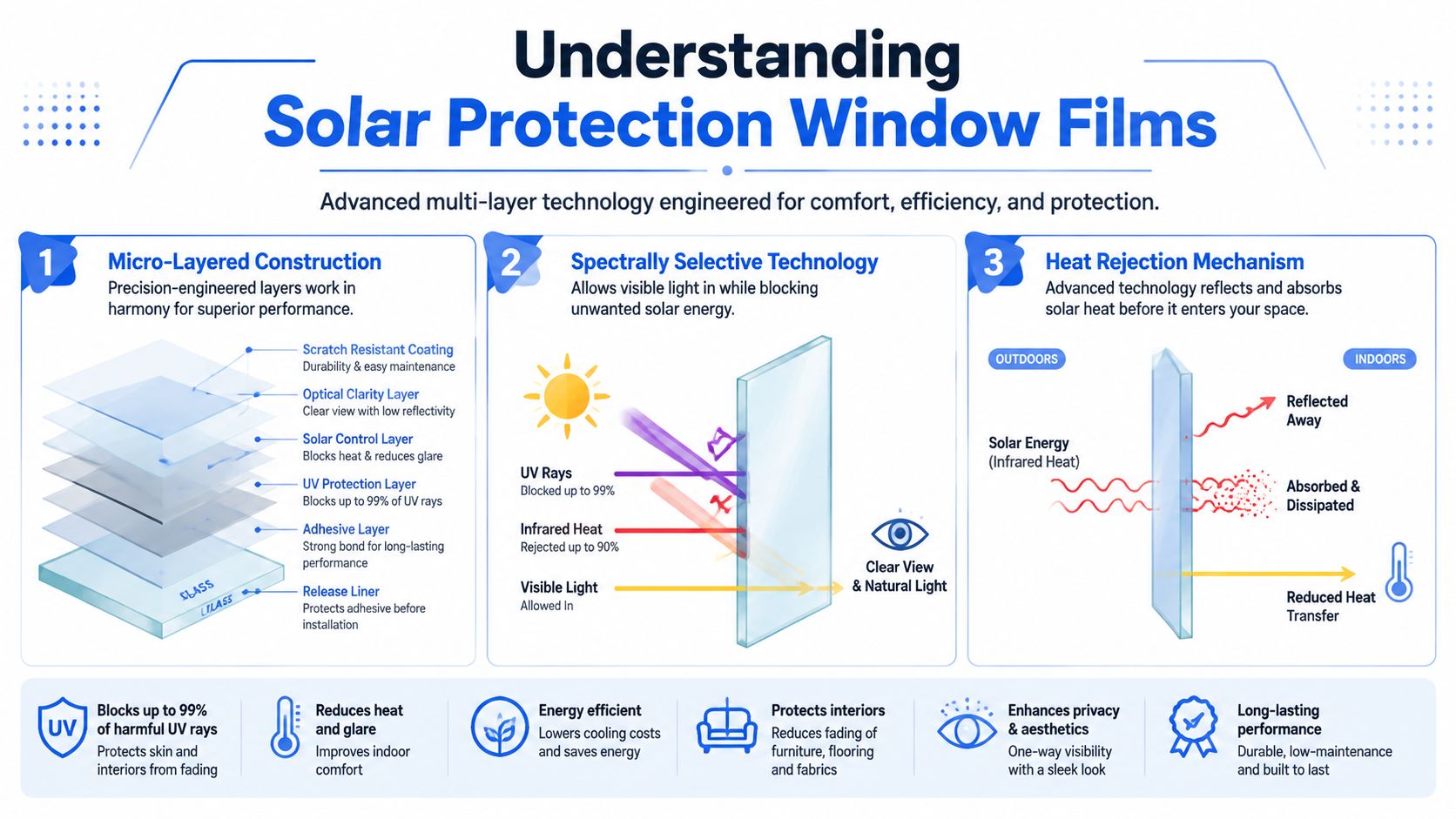
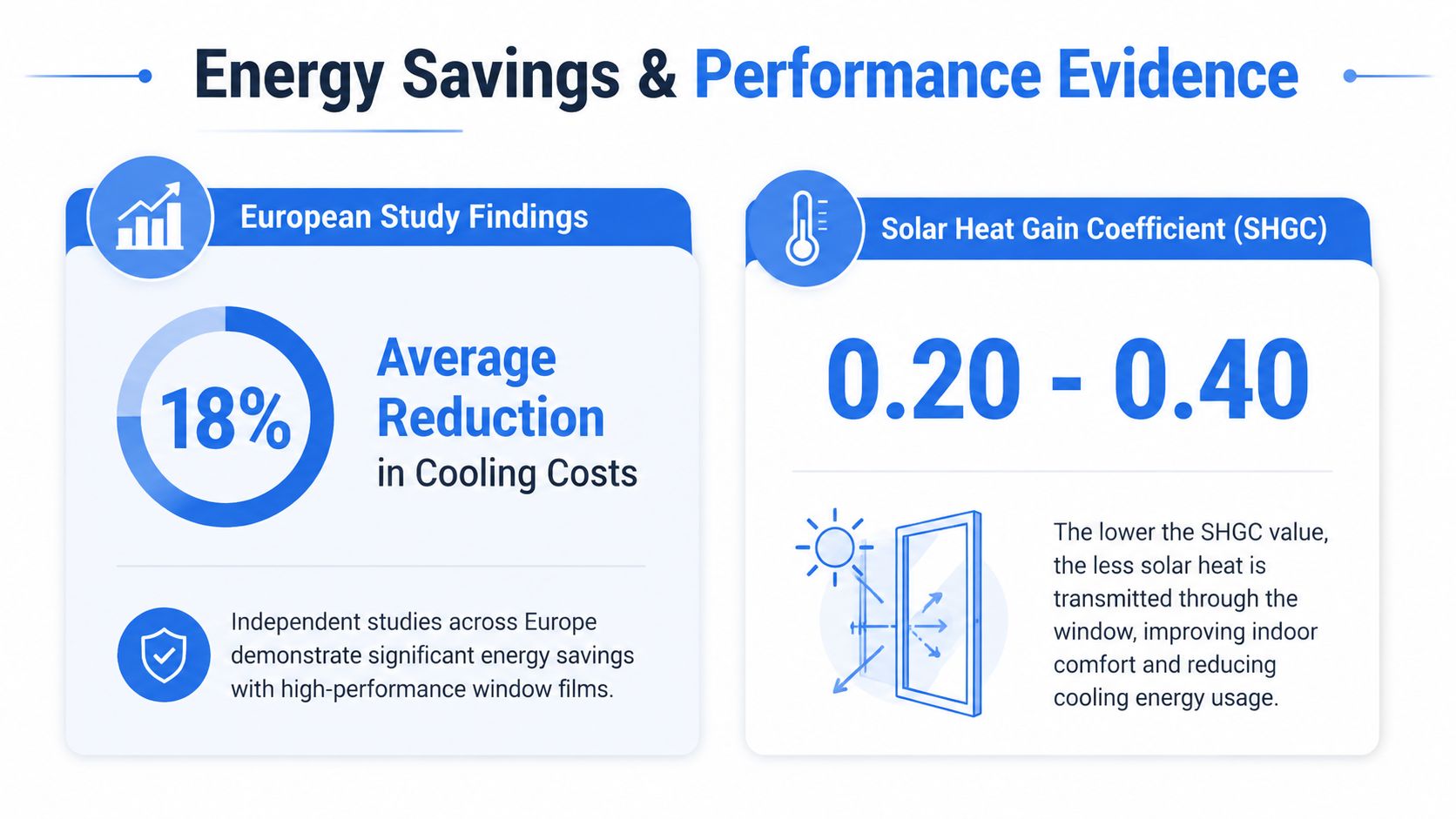
The key question isn't whether a film looks dark. It's how the complete glass-and-film assembly handles the solar spectrum. Solar Heat Gain Coefficient, or SHGC, measures how much solar heat enters through the combined window system. Lower SHGC values mean less solar heat passes indoors, while visible transmittance, or VT, describes how much daylight remains. The National Fenestration Rating Council's consumer guidance explains why the SHGC and VT balance deserves attention during selection.
A film may be useful in a west-facing office, a sunroom, a retail storefront, or a high-rise condominium, but each application has different priorities. A darker appearance may reduce glare, while a lighter spectrally selective product may preserve the view better. For smaller decorative or privacy projects, these bathroom window film ideas can also help homeowners think about how glass treatments affect light and privacy.
Practical rule: Choose the film by measured performance on your actual glass, not by shade alone.
Film categories overlap in appearance, but their construction produces different results. Dyed films use color to reduce brightness and solar transmission. They're often selected for a subtle tinted appearance and can provide glare relief, but they generally don't offer the same optical precision or long-term color stability as advanced ceramic and spectrally selective products.
Reflective films use metallic or highly reflective layers to send more solar energy back toward the exterior. They can suit commercial façades where daytime privacy and strong solar control matter, although the mirrored appearance may be unsuitable for homes, historic buildings, or properties with strict design requirements.
Ceramic films use nonmetallic particles to control infrared energy while maintaining a clearer appearance. They're attractive where signal compatibility, neutral aesthetics, and durability matter. Spectrally selective films take the concept further by targeting portions of the solar spectrum with a deliberate balance between heat rejection and daylight.
| Film Type | Heat Rejection | Visibility | Durability |
|---|---|---|---|
| Dyed | Moderate, primarily through absorption and reduced light transmission | Often darker, with a tinted appearance | Generally more vulnerable to visible color change over time |
| Reflective | Strong solar control through reflection | Can create a mirror-like exterior and affect daytime privacy | Durable when correctly specified, but appearance and glass compatibility require review |
| Ceramic | Strong infrared control with a neutral appearance | Usually clearer than heavily reflective products | Good resistance to fading and signal interference |
| Spectrally selective | Designed to reject selected solar wavelengths while preserving daylight | High optical clarity is often the main advantage | Depends on product construction, placement, and installation quality |
The numbers on a technical sheet help separate marketing language from useful comparisons. A technical sheet for a premium solar-control product reports assemblies around SHGC 0.28 to 0.43 and visible light transmission from 12% to 45%, depending on the glass and film combination. Those ranges come from the 3M Night Vision technical data sheet, and they demonstrate an important point. The same film chemistry can behave differently on single-pane, double-pane, or tinted glazing.
VLT is often described as a percentage, with industry guidance placing common film choices from 5% to 70%. Lower VLT means less visible light passes through and the film appears darker, as explained in this guide to visible light transmission. TSER, or Total Solar Energy Rejected, offers another way to describe solar control. Since TSER and SHGC complement one another, a film rated at 60% TSER corresponds to an SHGC of 0.40, according to this explanation of window-film performance values.
Solar protection window films can improve comfort, but energy performance must be judged at the building level. A film doesn't produce a universal result because climate, glass construction, window orientation, conditioned-zone depth, shading, and HVAC operation all affect the outcome.
A major independent European study modeled multiple climates, window types, and building sizes. Across the modeled cases, installing commercial window films reduced total building energy use by an average of 18%, with results ranging from 2% to 42%. The European Window Film Association energy study is valuable because it evaluates whole-building performance rather than relying only on window-level specifications.
A U.S. General Services Administration analysis reached a more specific conclusion. In a 15-foot-deep perimeter zone, a VT 35 low-emissivity film averaged 29% annual HVAC energy savings compared with single-pane clear glass across seven climate zones. The GSA analysis of low-emissivity window film also projected a simple payback of 2 to 6 years for installation on clear single-pane glass.
Those figures shouldn't be copied onto every project. A deep interior space may receive little direct solar exposure, while a perimeter office with large west-facing windows may experience a much greater cooling burden. Double-pane glass can also respond differently from clear single-pane glass, particularly when a film increases absorption within the glazing system.
A credible proposal should identify the glass type, exposure, conditioned area, and expected operating benefit before it promises savings.
Climate caution matters. A 2025 BayREN study reported energy and emissions penalties in a high percentage of cases for the window-film measure, while a 2024 NREL analysis found savings were strongest in hot climate regions because the films primarily reduce SHGC. Those findings, summarized in the BayREN study report, are a strong reason to model the building instead of assuming film automatically lowers costs.
For a broader look at reducing heat loads around a building, readers may also find these tips from Arizona Roofers on energy efficiency useful. Roofing, shading, HVAC controls, and window treatment work best as coordinated decisions.
Start with the glass, not the brand. Identify whether each opening uses clear single-pane glass, insulated glass, tinted glass, laminated glass, or a specialty configuration. The installer should also review frame condition, seals, mullions, window orientation, interior blinds, and whether an existing film needs removal.
Homeowners usually care about glare, comfort, fading protection, and the view. A lighter ceramic or spectrally selective film may be preferable in living rooms where natural light and nighttime visibility matter. A darker selection can make sense for intense glare, but it changes the room's appearance and may create a stronger contrast between treated and untreated windows.
Quality solar window film can block more than 99% of UV light in the 300 to 380 nanometer range, while visible light transmission varies by product. The Solar Gard TrueVue product specifications list UV blockage above 99% across multiple variants and visible light transmission from 4% to 28%, showing why the exact model matters.
Commercial properties need consistency across elevations, tenant comfort, cleaning access, and warranty requirements. High-rise projects add wind exposure, access logistics, façade rules, and the need for installers who understand rope access or suspended-platform work. Exterior film requires a separate durability review, especially where weather, dust, and frequent maintenance affect the exposed coating.

Ask for written compatibility confirmation before installation. The right installer should explain where the film goes, how it interacts with the glass, what curing will look like, and which cleaning methods preserve the surface.
A well-installed film still needs appropriate care. Dust, hard-water residue, abrasive tools, and aggressive chemicals can make a clear film look neglected or damage its protective surface. The cleaning plan should be agreed upon before installation, particularly for storefronts, medical offices, large residences, and high-rise buildings.
There are only two methods professional window cleaners use: the squeegee method and the pure-water system. Both can be safe for filmed glass when the technician understands the film's condition and uses the correct technique.
The squeegee method uses a washer or applicator to loosen soil, followed by controlled passes that remove the solution. On filmed glass, the technician should avoid catching a blade or tool under a lifting edge. Excessive pressure at seams, corners, or damaged areas can worsen an existing adhesion problem.
A soft, clean sleeve and a properly maintained rubber blade matter. Scrapers and abrasive pads shouldn't be treated as universal tools, especially where the film has a scratch-resistant coating that still can't tolerate careless contact.
Pure-water systems filter minerals from water, allowing technicians to agitate and rinse the glass with an extendable brush. The system offers a low-contact option for high glass and can reduce residue when the water is properly purified. It's especially useful where access is difficult, though the operator still needs to inspect edges, seals, frames, and any signs of film failure.
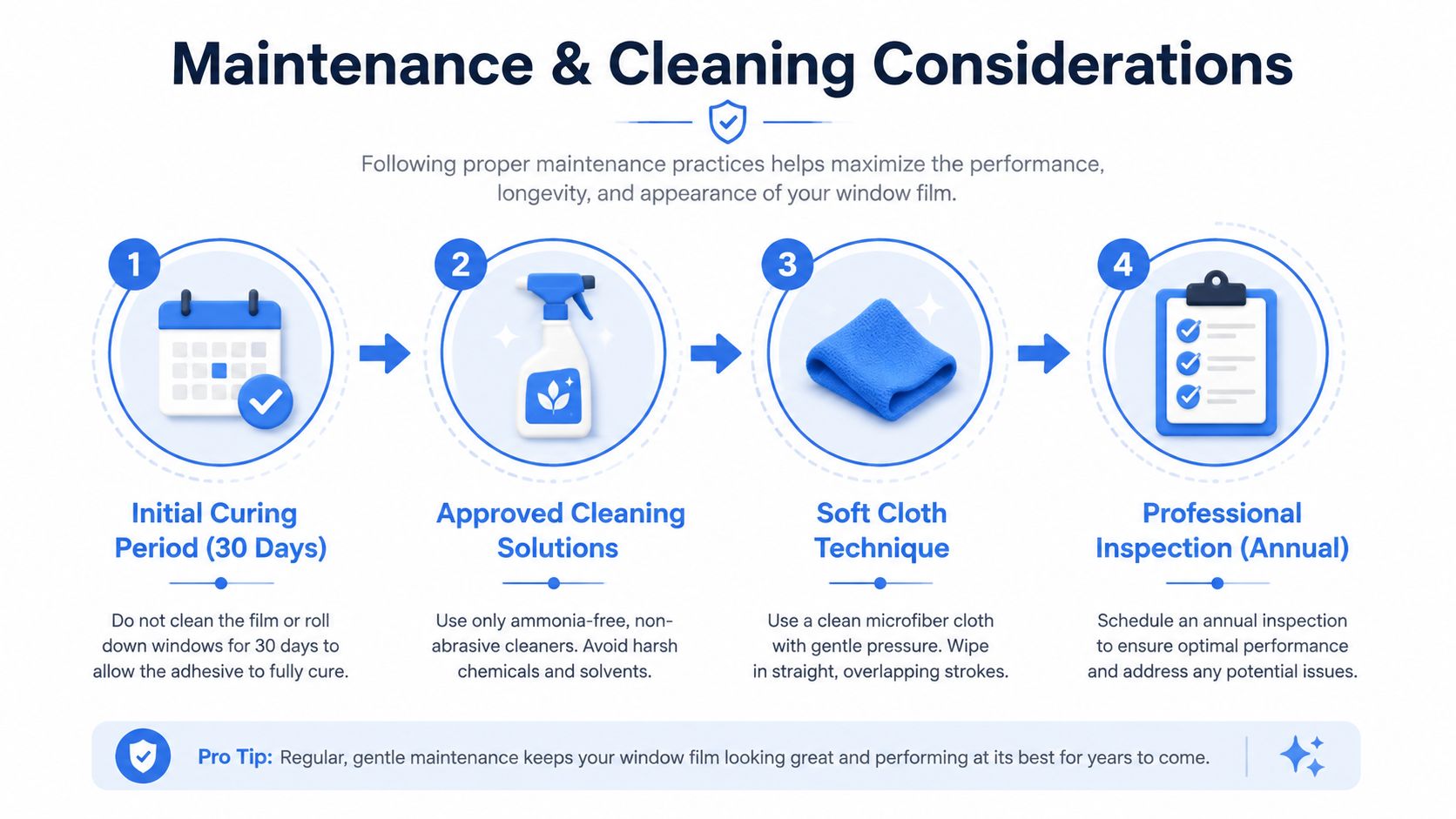
For general window-care principles, this guide to Atlanta window upkeep offers useful maintenance context. For filmed glass specifically, use a compatible non-ammonia product and avoid adhesive tape on the surface. This non-ammonia glass cleaner guidance provides a practical starting point.
Climate changes the value equation. In hot, bright regions, solar heat gain often drives the decision. In milder or cooler areas, an overly aggressive film can reduce desirable winter gains or make interiors darker than occupants prefer.
In Phoenix, Scottsdale, Las Vegas, Tempe, Chandler, Gilbert, and Flagstaff, intense sun exposure makes heat rejection a primary concern, but the film still needs to suit the glass. Ceramic and spectrally selective products are strong candidates where owners want reduced heat and glare without a strongly mirrored façade. Large west-facing windows deserve particular attention because afternoon exposure can create localized hot spots even when the general room temperature seems acceptable.
Las Vegas projects may also need a careful conversation about dust, exterior access, and cleaning frequency. A film that looks excellent immediately after installation can lose its visual appeal if mineral deposits and construction residue remain on the glass.
Denver presents a more balanced design problem. A lighter, clearer film may protect furnishings and reduce glare while preserving more daylight and useful solar contribution than a very dark product. High-altitude exposure, seasonal changes, and building orientation should guide the selection rather than a one-size-fits-all shade.
In every market, request an assembly-specific performance sheet. The film's result depends on the existing window, not just the roll installed by the contractor.
A realistic budget starts with the exact glass and the amount of preparation required. The GSA analysis used an assumed installed cost of $7.75 per square foot, consisting of $4.25 for film and $3.50 for labor, when evaluating clear single-pane glass. The same report noted that removing existing solar-control film can add $1.50 to $2.00 per square foot in labor costs. These figures are project assumptions, not a universal quote, so access, glass condition, height, preparation, and film specification still need review.
The GSA report projected a 2 to 6 year simple payback in its stated single-pane scenario. The European study's broad range of modeled outcomes reinforces why ROI should be calculated for the property rather than borrowed from an advertisement. For more consumer-focused pricing context, review this average price for window tinting, then ask the installer to explain what the quote includes.
Film works best when treated as a building decision, not a cosmetic add-on. Select the assembly carefully, install it on suitable glass, allow the surface to cure, and maintain it with trained cleaning methods.
Professional Window Cleaning offers residential, commercial, and high-rise window cleaning across Arizona, Nevada, and Colorado, with practical experience caring for filmed glass. Visit Professional Window Cleaning to arrange a consultation or schedule maintenance for your solar protection window films.
Read our blog posts regularly and keep learning.