Care and Maintenance
All Seasons Window Cleaning: A Complete Year-Round Guide
All seasons window cleaning explained: how weather affects glass, season-by-season scheduling, methods pros use, and the real benefits of regular service.


Commercial window cleaning is professional glass care for business properties, using two core methods, traditional squeegee cleaning and purified-water water-fed pole cleaning, delivered as a scheduled, safety-governed service from storefronts to high-rises. The UK window-cleaning services industry was estimated at £467.0 million in 2026, with 2,475 businesses operating in the sector, and it had grown at a 6.6% CAGR from 2021 to 2026 (IBISWorld window cleaning services data).
A shop manager may notice fingerprints across the entrance glass before the first customers arrive. Across town, a property manager may be looking at an office tower whose upper windows need a carefully documented access plan, not a bucket and ladder. Both jobs involve glass, but the planning, equipment, scheduling, and safety controls are very different.
Commercial window cleaning means maintaining the glass on business properties, including storefronts, offices, medical facilities, car dealerships, stadiums, industrial buildings, condominiums, and high-rise towers. The work may include interior panes, exterior façades, entrance doors, display glass, frames, and difficult areas that ordinary janitorial teams can't safely reach.
A small retail shop often needs frequent attention because customers touch the doors and look directly through the display windows. An office tower has a different rhythm. Its lower lobby glass may need regular care while upper façades require specialist access planning, equipment inspections, trained technicians, and records that demonstrate the work was controlled properly.
That difference explains why commercial service is more than “washing windows.” It's a building-maintenance task with three connected outcomes:
Professional Window Cleaning has been cleaning windows for over 26 years. Its service footprint includes Las Vegas, Phoenix, Denver, and Scottsdale, along with other communities across Arizona, Colorado, and Nevada.
The useful question isn't just whether a building's windows look dirty. Ask what kind of glass needs attention, how technicians can reach it, how often the property needs service, and what proof the provider can supply afterward. Those answers turn a vague cleaning request into a practical service plan.
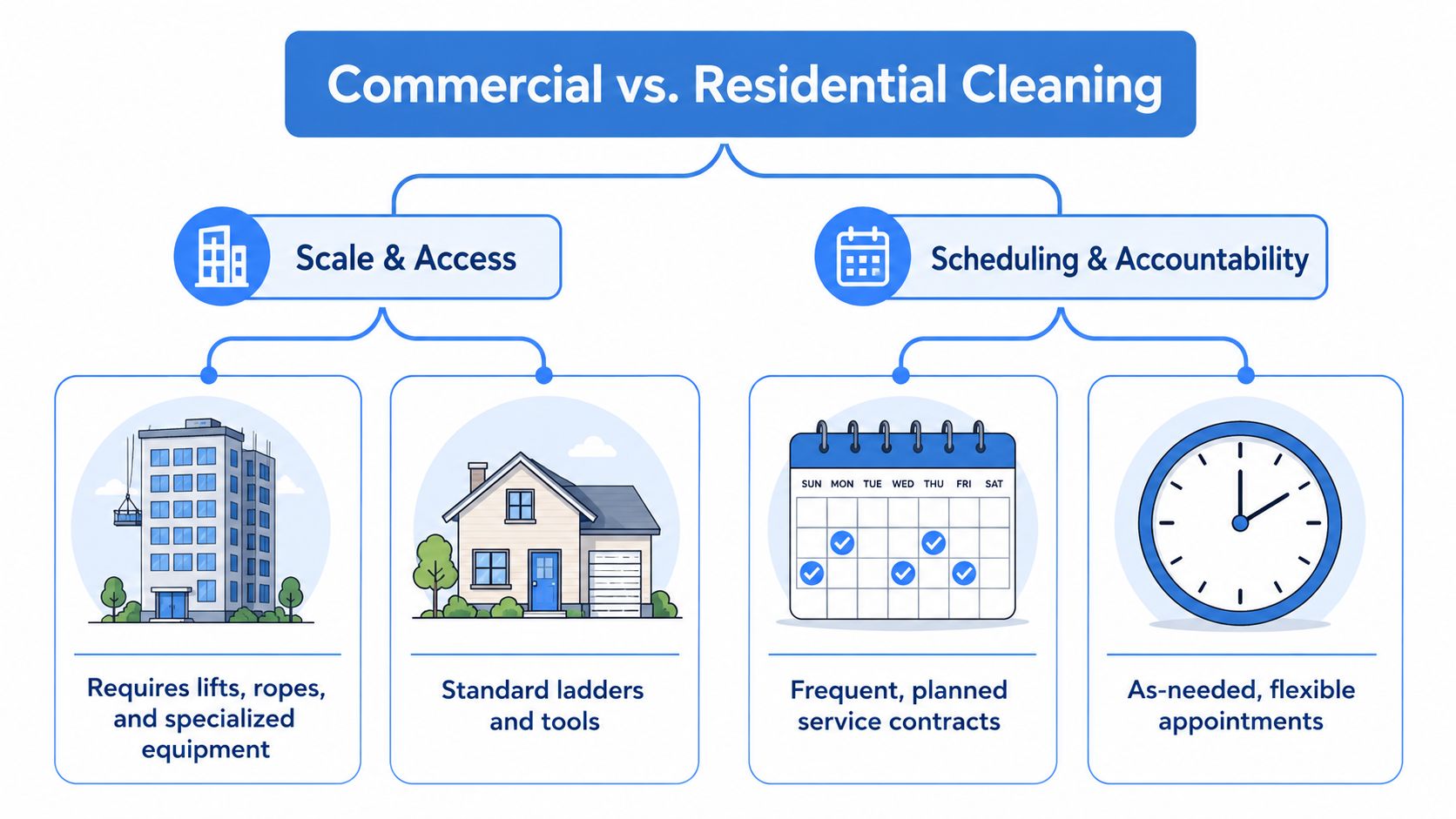
Residential cleaning usually centers on one home, a manageable number of windows, and an appointment arranged around the homeowner. Commercial work operates more like maintaining a building system. The provider has to coordinate access, occupants, security, deliveries, tenant expectations, and sometimes several properties under one account.
A ground-floor boutique is the simplest commercial example. Technicians may work from the pavement or inside the shop with traditional tools, while protecting merchandise and avoiding customer disruption. A multi-story office adds height, façade design, loading restrictions, and the possibility that work must happen before opening hours or after tenants leave.
A high-rise is closer to a vertical neighborhood than a large house. Each elevation may have different anchor points, ledges, setbacks, glass coatings, and wind exposure. The provider must select equipment and procedures that suit the façade rather than forcing one method onto every pane.
A property manager may oversee a medical office, car dealership, stadium, and office complex at the same time. Each site has different priorities:
Recurring agreements make this manageable. Instead of calling only after the glass becomes visibly dirty, the manager can schedule service around occupancy, weather, foot traffic, façade exposure, and lease expectations.
A residential appointment may end when the glass looks clean. A commercial contract often needs a scope of work, access notes, site-specific risk controls, technician records, inspection details, and confirmation of completed areas. That paperwork isn't decoration. It gives the owner, facilities team, and provider a shared record of what was planned and delivered.
Practical rule: Treat the building as a worksite, not just a collection of windows.
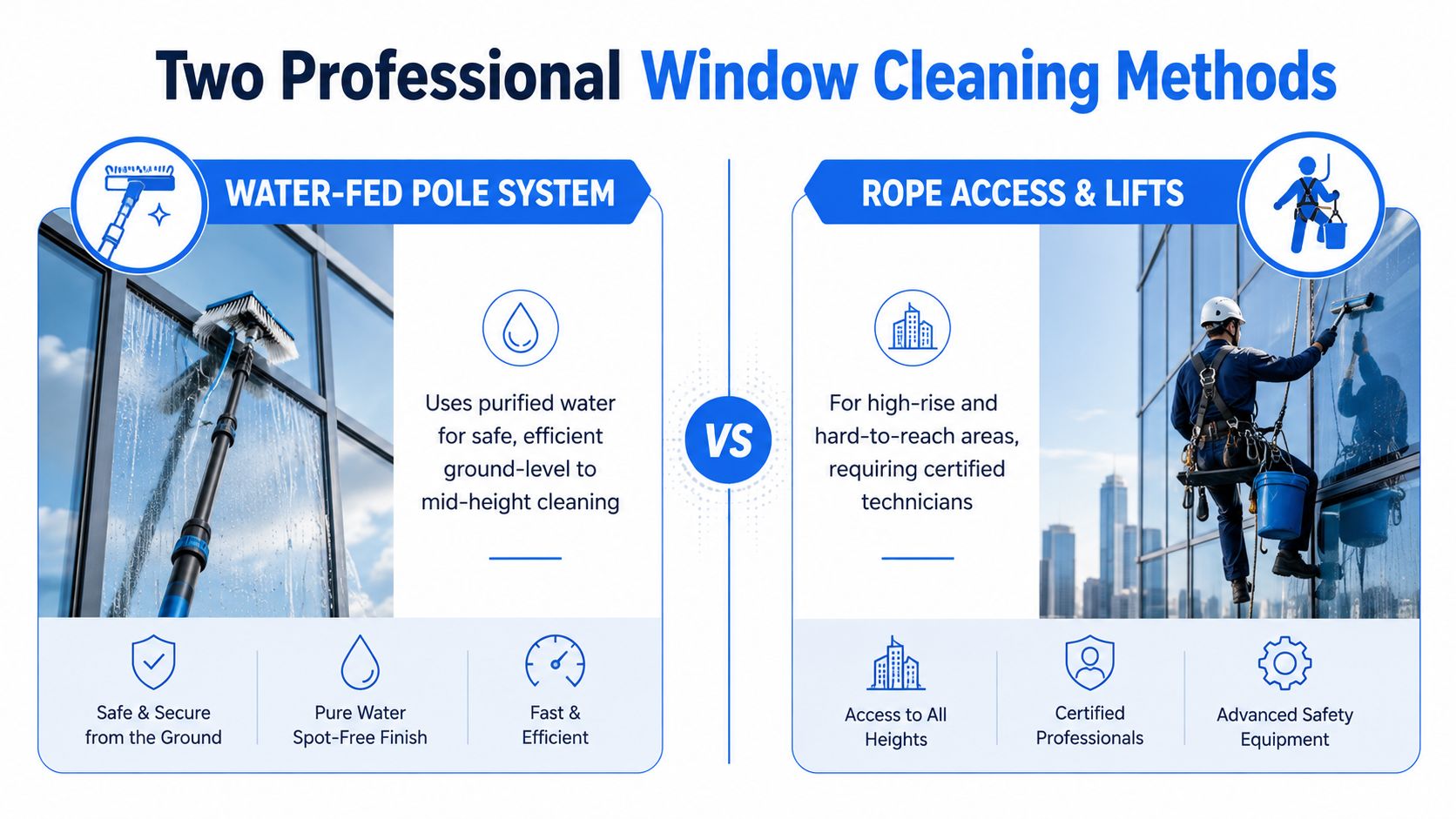
Professional window cleaning uses only two methods: the traditional squeegee, or a pure-water system. Rope access, lifts, and telescopic equipment are ways to reach the glass. They aren't separate cleaning methods.
The squeegee method combines a washer or applicator, cleaning solution, agitation, and a rubber blade that removes water from the glass. It gives the technician direct control over stubborn marks, edges, frames, and interior panes. On accessible glass, it remains a precise and dependable choice.
The pure-water method uses a telescopic water-fed pole fitted with a brush and a delivery system for purified water. The brush loosens dirt, then the water rinses contaminants from the pane. Because the water contains very few dissolved minerals, it can dry without leaving the residue that ordinary tap water may leave behind. The IWCA water-fed pole training module defines the system in these practical terms and treats purified water as integral to the process.
Tap water contains dissolved minerals. When droplets evaporate, those minerals can remain on the glass as spots or streaks. Industry guidance commonly places reliable streak-free work below 10 ppm TDS, with near-zero TDS used for more demanding surfaces (deionized water guidance from Equipmaxx).
A pure-water system removes those dissolved solids before the water reaches the brush. Dark glass, direct sunlight, and hydrophobic coatings make residue easier to notice, so mineral control becomes a performance variable rather than a stylistic preference. A commercial equipment overview explains that water close to 0 parts per million can dry streak-free without a squeegee finish (National Window Cleaning Authority equipment overview).
The modern pure-water breakthrough dates to 1997, when a U.K. window cleaner launched a telescopic pole integrated with a water-purification system (history of window cleaning). That development helped make ground-based cleaning practical across more commercial façades.
Use a squeegee when the technician needs close control, detailed interior work, heavy spot treatment, or a dry finish in a sensitive area. Use pure water when the façade can be reached safely from the ground or with suitable extension equipment and when avoiding ladders or repeated platform positioning improves the work plan.
High-rise glass may still be cleaned with a squeegee or pure water, but technicians may need rope descent systems, suspended platforms, powered platforms, or other access equipment to reach it. The cleaning action remains one of the two methods above.
For adjacent building elements, such as glass balustrades, managers may also benefit from guidance on excellence in balustrade work, especially where glass, fixings, and access considerations overlap.
For a closer look at system components, see this guide to the window washing system.
Clean glass changes how a building presents itself before anyone speaks with a receptionist, salesperson, or tenant. A bright storefront can make merchandise easier to see. Clear lobby glass can make an office feel cared for. In a dealership, clean glazing supports the presentation of vehicles and the wider customer experience.
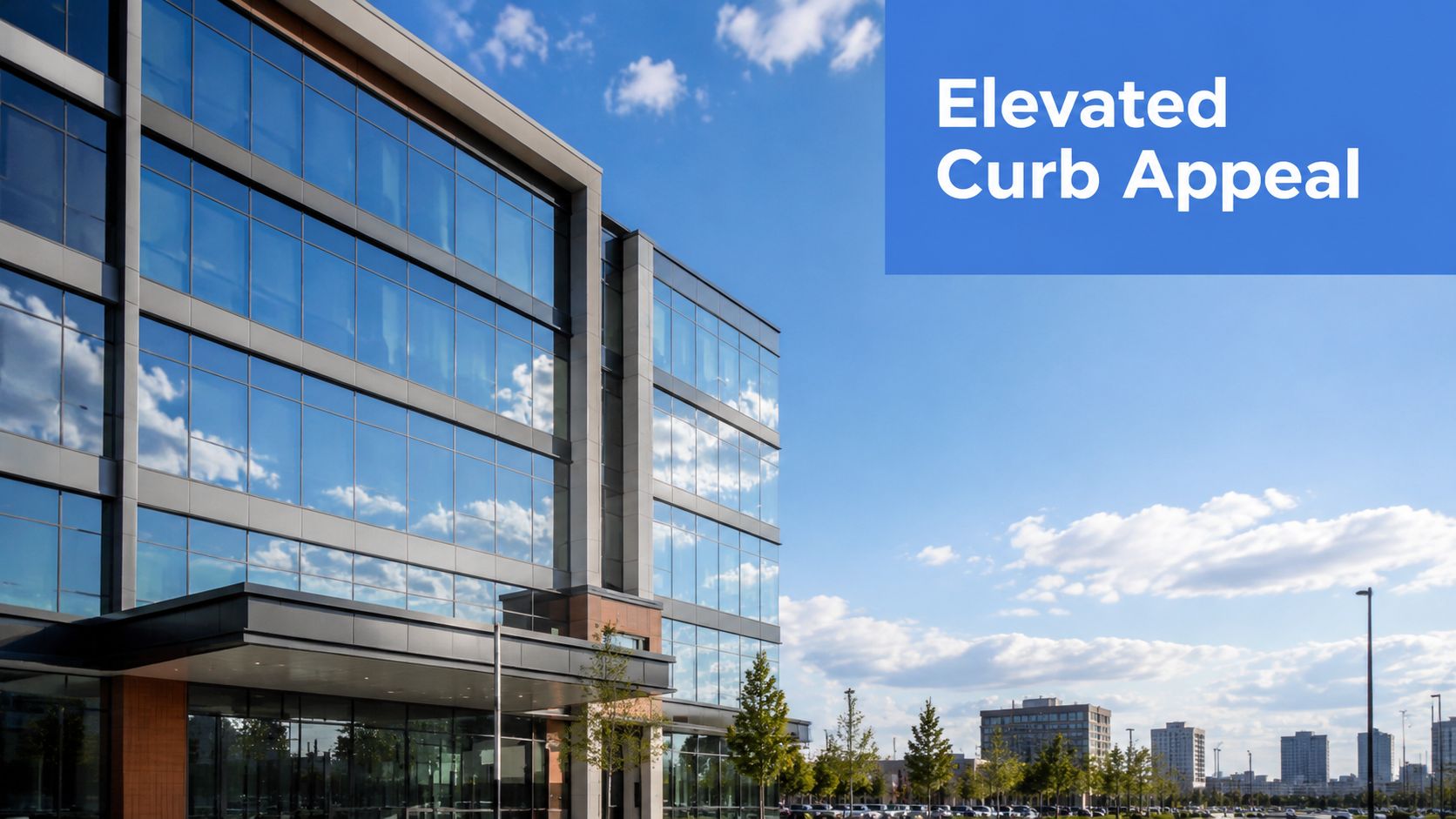
The value goes beyond appearance. Clean windows allow more natural light into occupied areas, help teams notice developing issues on the glass and frames, and give property managers a regular opportunity to observe seals, coatings, scratches, hard-water deposits, and other changes. Cleaning won't repair a failed seal or damaged pane, but it can make those conditions easier to see and report.
A retail store with busy doors and street-facing display glass may need a different schedule from a warehouse. A medical office may prioritize reception areas and patient-facing windows. A high-rise condominium may need a coordinated façade plan that protects residents, manages access, and keeps records for the building team.
Denver, Phoenix, Scottsdale, and Las Vegas each contain commercial properties with different exposure, building designs, and operating patterns. A service plan should reflect the actual site rather than apply the same routine to every address.
A portfolio manager also gains consistency from one documented process. The provider can define which elevations, interior areas, entrances, and ancillary glass are included, then report exceptions such as blocked access or damaged equipment.
A clean façade can support building operations, but it shouldn't be confused with an energy retrofit or a guaranteed reduction in utility use. The responsible business case is more practical: maintain the appearance of the asset, preserve visibility, support occupant experience, and identify issues before they disappear under accumulated grime.
A useful service review should answer:
Here's a short visual example of the type of work commercial teams coordinate across a property:
Height changes the risk profile immediately. In Great Britain, falls from height caused 35 worker deaths across all industries in 2024/25, and the Health and Safety Executive has said falls from height have been the leading cause of workplace death in almost every year since 2001/02 (Working at Heights window-cleaning accident overview). In the United States, OSHA-related reporting has been cited as documenting 88 window-cleaning accidents over a 15-year period, including 62 fatalities, in the same source.
Those figures explain why commercial window cleaning performed at height is treated as a specialist trade. A technician may work with ladders, suspended access equipment, fall protection, powered platforms, rope descent systems, and ground-based tools. Each option creates different planning, inspection, rescue, training, and documentation needs.
OSHA fall-protection rules apply in relevant general-industry and construction contexts. The ANSI/IWCA I-14.1 framework is used as an industry reference for accepted practices involving anchor systems, suspended access, and inspections. California's Title 8 safety requirements for window cleaning illustrate how detailed these controls can become.
A provider shouldn't choose access equipment solely because it owns that equipment. The decision should account for height, façade shape, ledges, setbacks, anchor locations, pedestrian areas, weather, rescue planning, and the building's own access restrictions.
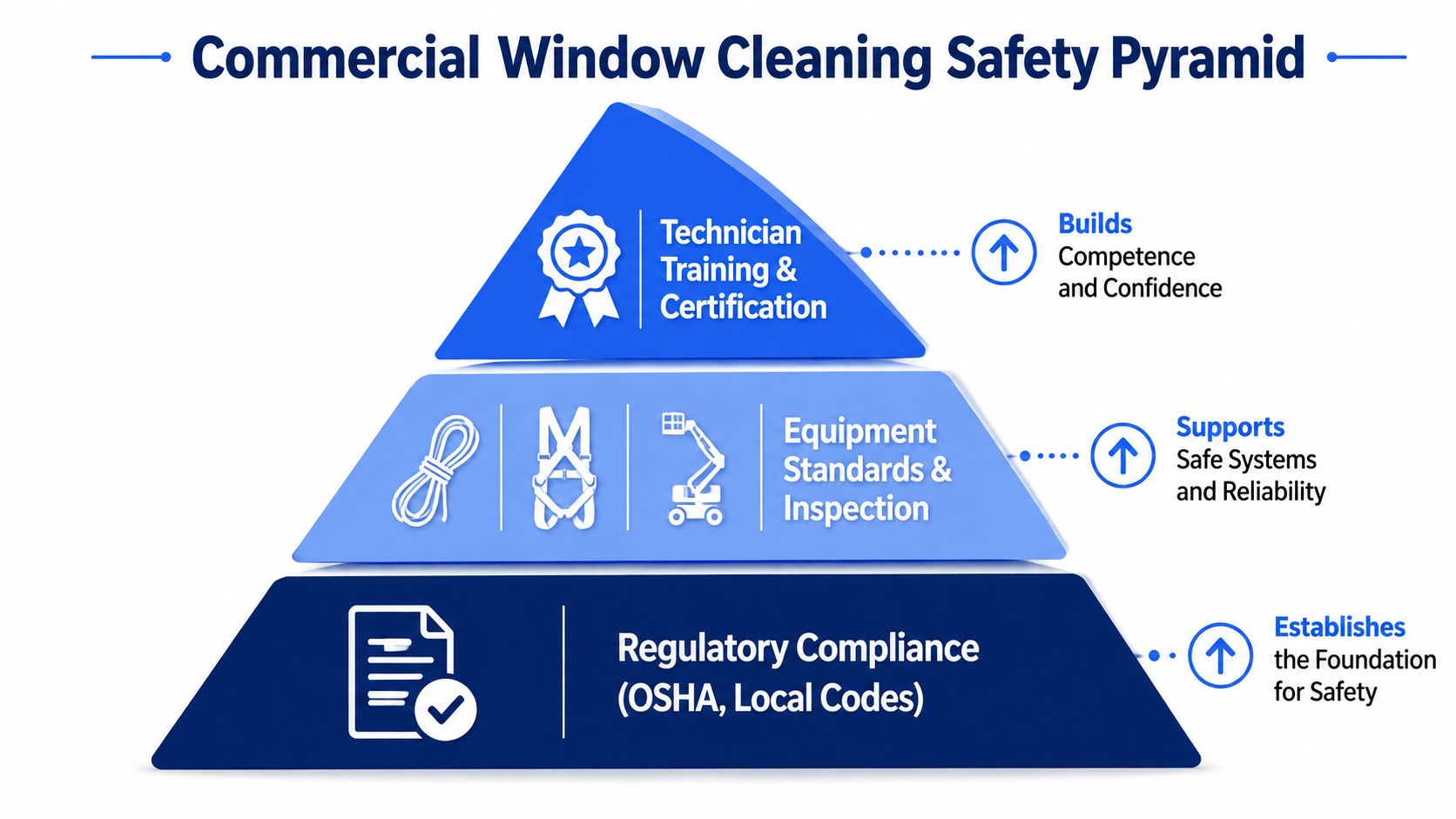
A responsible proposal should make the safety process visible. Ask how the provider handles:
Safety isn't a line item added after the quote. It determines whether the proposed method is suitable in the first place.
Automation may help on façades designed for robotic or building-maintenance-unit integration, but it doesn't remove the need for risk assessment and oversight. The owner still needs to understand who controls the equipment, how inspections are recorded, and how exceptions are handled.
Commercial pricing reflects the work plan, not the number of windows. A compact storefront with easy access may be straightforward, while a smaller building with difficult elevations can require more planning and specialist equipment.
The main variables include:
| Pricing Driver | What It Means for Your Building | Cost Direction |
|---|---|---|
| Access complexity | The crew may need lifts, suspended access, rope systems, or controlled ground zones | More complex access generally raises the service requirement |
| Glass scope | Interior, exterior, doors, frames, and specialty glass may be included or excluded | Broader scope generally increases labor |
| Condition | Heavy residue takes more preparation than routine maintenance | More buildup generally increases the initial workload |
| Frequency | Planned visits keep the scope predictable | Recurring service may support steadier budgeting |
| Site logistics | Parking, security, tenants, and operating hours affect setup | More coordination generally adds planning time |
Market structure also points toward recurring business. The UK window-cleaning services industry was estimated at £467.0 million in 2026, with 2,475 businesses, and an independent report projected UK window-cleaning revenue to reach £532 million by 2030–31 (IBISWorld sector data). Globally, the contract cleaning services market was forecast to rise from $148.0 billion in 2024 to $204.8 billion by 2029, with window cleaning identified as the largest segment in both 2024 and 2029 in that report.
For a practical breakdown of proposal variables, review this guide to commercial window cleaning pricing. A good quote should let you compare providers by scope, access method, safety controls, visit frequency, and reporting, not just by a single total.
Start with the building, not the sales pitch. A provider that handles ground-level retail glass may not be the right fit for a high-rise façade, while a specialist high-rise contractor may be unnecessary for a small office with accessible windows.
Request a walkthrough or detailed site review, then ask:
Manual cleaning remains a sensible choice when the glass is accessible and the site doesn't justify complex equipment. Rope access or lifts become relevant when height and façade geometry prevent safe ground-based work. Automation deserves consideration only where the building, access infrastructure, and operating model can support it. A market report projects the global glass cleaning system market at US$4.2 billion in 2026, while manual systems held 58% share and automatic systems were projected to grow at a 7.8% CAGR through 2033 (Persistence Market Research glass cleaning system report). These are market projections, not a reason to automate every building.
For healthcare managers comparing broader facility services, the practical discussion of how to price medical office cleaning can help frame scope, risk, and scheduling questions. The same principle applies here: compare what the provider will do, how safely it will be done, and what documentation you'll receive.
Professional Window Cleaning serves commercial properties in markets including Denver, Scottsdale, Phoenix, and Las Vegas. Use the checklist above to request a walkthrough, define the glass and access requirements, and compare a service plan that fits your building.
Professional Window Cleaning provides scheduled commercial window cleaning for business properties, including accessible glass, challenging façades, and high-rise work planned around safety and site operations. Visit Professional Window Cleaning to request a walkthrough and discuss the right squeegee, pure-water, or access-supported service plan for your property.
Read our blog posts regularly and keep learning.