Care and Maintenance
Cloth for Window Cleaning Choices That Deliver Results
Choose the best cloth for window cleaning by comparing microfiber, cotton, lint-free, and chamois options, plus care and selection tips.


The real difference between a frustrating, streaky mess and that invisible, crystal-clear glass you’re after? It almost always comes down to the window cleaning liquid you're using. A great formula is the unsung hero of every professional job, whether it’s helping a squeegee glide like a hot knife through butter or prepping a window for a spot-free rinse.
Ever wonder why a professional window cleaner leaves glass looking flawless while your own efforts end in a haze of streaks? It’s not just about the fancy squeegee moves; it’s about the science in the bottle.
Most all-purpose cleaners you find at the store are packed with soaps, perfumes, and dyes. These additives leave behind a sticky, invisible film. Not only does this film cause those annoying streaks, but it also acts like a magnet for new dust and dirt. Your windows actually get dirty again faster.
True professional window cleaning liquids are built differently. They have one job and one job only: dissolve grime and then disappear completely, leaving absolutely nothing behind. This guide will pull back the curtain on these solutions and show you what makes them work where other cleaners fail.
The demand for pristine windows isn't just a matter of preference—it's the engine behind a massive global industry. The window cleaning market, which depends on these specialized liquids, hit an impressive $45.2 billion in 2022 and is expected to climb to $68.7 billion by 2030.
Here in the U.S., the industry pulled in $2.8 billion in revenue in 2023 alone, and these liquids are the lifeblood of every professional service out there. You can dig into more window cleaning industry statistics on Gitnux.org.
At Professional Window Cleaning, we've been in this business for over 26 years, and we can tell you firsthand: the right liquid is non-negotiable. It’s what lets us deliver perfect results on everything from a single-family home to a towering skyscraper.
Our teams work in some pretty diverse climates, and having the right formula is critical. We're tackling sun-baked dust on homes in Phoenix and Scottsdale, and we're cleaning high-rise windows against the bright lights of Las Vegas. Even with the unpredictable weather in Denver, a pro-grade solution is the key to a perfect finish every time.
When it comes down to it, professional window cleaners—including our own seasoned experts—rely on one of two core methods. The liquid is specifically chosen to support the technique.
Traditional Squeegee Cleaning: This classic method needs a solution with excellent "slip." The liquid acts as a lubricant, letting the squeegee blade glide smoothly across the glass. It pulls away dirt and water without skipping or chattering, which is what causes those dreaded streaks.
Pure-Water System Cleaning: With this modern approach, ultra-purified water does most of the heavy lifting. Since it has zero mineral content, it dries completely spot-free. But for windows with serious grime, we’ll often use a specialized, biodegradable additive to help break down the heavy soil before the final pure-water rinse.
This guide will dive into the world of window cleaning liquids, covering everything from commercial-grade concentrates and eco-friendly options to some surprisingly effective DIY recipes. By the end, you'll know exactly what’s in the bottle and how to get a better, longer-lasting clean—or at least appreciate the value a true professional brings to the job.
Ever wonder what makes professional window cleaning liquids so much better than that all-purpose spray under your sink? It’s not some kind of magic—it's just smart chemistry. The secret is a carefully balanced formula built to break down dirt at a molecular level and then disappear without a trace.
At its heart, any pro-grade window cleaning solution is built on two key ingredients: surfactants and solvents. Once you understand how these two work together, you'll see why they deliver that flawless, streak-free shine that plain old soap and water can never quite achieve.
You can think of surfactants as the real workhorses of any cleaning formula. A surfactant molecule has a pretty unique design: one end loves water (hydrophilic), while the other end is drawn to oils and dirt (hydrophobic).
When you apply the cleaning solution to a dirty window, millions of these molecules get to work. Their oil-loving ends grab onto particles of grime, dust, and grease, effectively prying them away from the glass. The water-loving ends then let these captured dirt particles hang out in the water, ready to be rinsed or squeegeed off.
This process is exactly what creates that perfect "slip" for a squeegee blade. Surfactants act like tiny, invisible ball bearings, creating a lubricating layer that helps the blade glide smoothly across the glass without skipping, chattering, or leaving those frustrating streaks behind.
Without good slip, a squeegee blade will drag and shudder across the glass, leaving trails of dirty water. It's a common headache when people try to use household cleaners that weren't designed for professional squeegee work.
While surfactants are great at lifting away everyday dirt, some messes are just more stubborn. That's where solvents come in. Solvents are simply substances that have the power to dissolve other materials.
In many professional window cleaning liquids, a common and highly effective solvent is isopropyl alcohol. Here’s what it brings to the table:
The combination of surfactants and solvents creates a powerful one-two punch. The solvents break down the gunk, and the surfactants lift it away from the glass until your squeegee wipes it all clean.
The chemistry shifts a bit when we talk about the other main professional method: pure-water window cleaning. This technique uses water that's been stripped of all its ions and minerals, which puts it into an aggressive, naturally absorbent state. You can learn more about how this fascinating process works by checking out our guide on pure-water window cleaning systems.
Because this water is so pure, it actively pulls in and dissolves dirt and minerals from the glass, drying to a perfect spot-free finish without any need for a squeegee. For most jobs, the pure water alone is all you need. Our teams in Las Vegas, Phoenix, Denver, and Scottsdale have seen this method work wonders on residential and commercial buildings.
However, for extremely dirty windows—think years of caked-on pollution or post-construction grime—a pro might add a specialized, residue-free additive. These aren't soaps. They're concentrated, biodegradable agents designed to help break down heavy soil before the final pure-water rinse. They're formulated to be rinsed away completely, leaving zero film behind and keeping the spot-free promise of the pure-water method intact.
Now that we've covered the science behind how window cleaning liquids work, it's time to pick the right tool for the job. Think of it like cooking—you wouldn't use a cleaver to peel a grape. The same logic applies here. The right window cleaning liquid depends entirely on the task at hand, and choosing the wrong one can lead to frustrating streaks, wasted time, or even damage to your windows.
Let's walk through the three main players in the game: powerful commercial-grade formulas, simple and effective DIY recipes, and gentle eco-friendly options. Getting to know the pros and cons of each will help you make the best call for your home or property.
When a pro shows up to tackle a commercial building or a home that’s been collecting grime for years, they’re bringing out the heavy hitters: commercial-grade liquids. These are highly concentrated formulas designed for one thing—maximum cleaning power.
These solutions are built to work with professional equipment. They provide just the right amount of "slip," which is what lets a squeegee glide smoothly across the glass without skipping or leaving those annoying streaks. They're also formulated to slice through layers of built-up dirt, pollen, and pollution without leaving any residue behind, which is essential for projects in busy cities like Scottsdale and Las Vegas.
Key takeaway: Commercial-grade liquids are the gold standard for pure performance. They're the go-to for professionals who need reliable, fast-acting results on tough jobs, but they must be diluted correctly.
For homeowners looking for a simple and budget-friendly option for light-duty cleaning, a homemade solution can be surprisingly effective. The best part? You probably have most of the ingredients in your pantry right now.
The most popular bases for DIY window cleaning liquids are white vinegar and isopropyl alcohol. A simple mix of distilled water and white vinegar works wonders on everyday grease and fingerprints. If you need a bit more kick, adding a splash of alcohol helps the solution evaporate faster, which is key to a streak-free finish. You can find some of our favorite formulas in our guide to a DIY window cleaning solution recipe.
But DIY solutions do have their limits. They can struggle with really heavy grime and might leave streaks if your ratios are off or your water is too hard. It's also smart to be careful, as acidic ingredients like vinegar can potentially damage certain window tints or discolor surrounding materials like wood or stone if you're not careful.
If you're weighing whether to go pro or mix your own, this decision tree can help you figure out the best path forward.
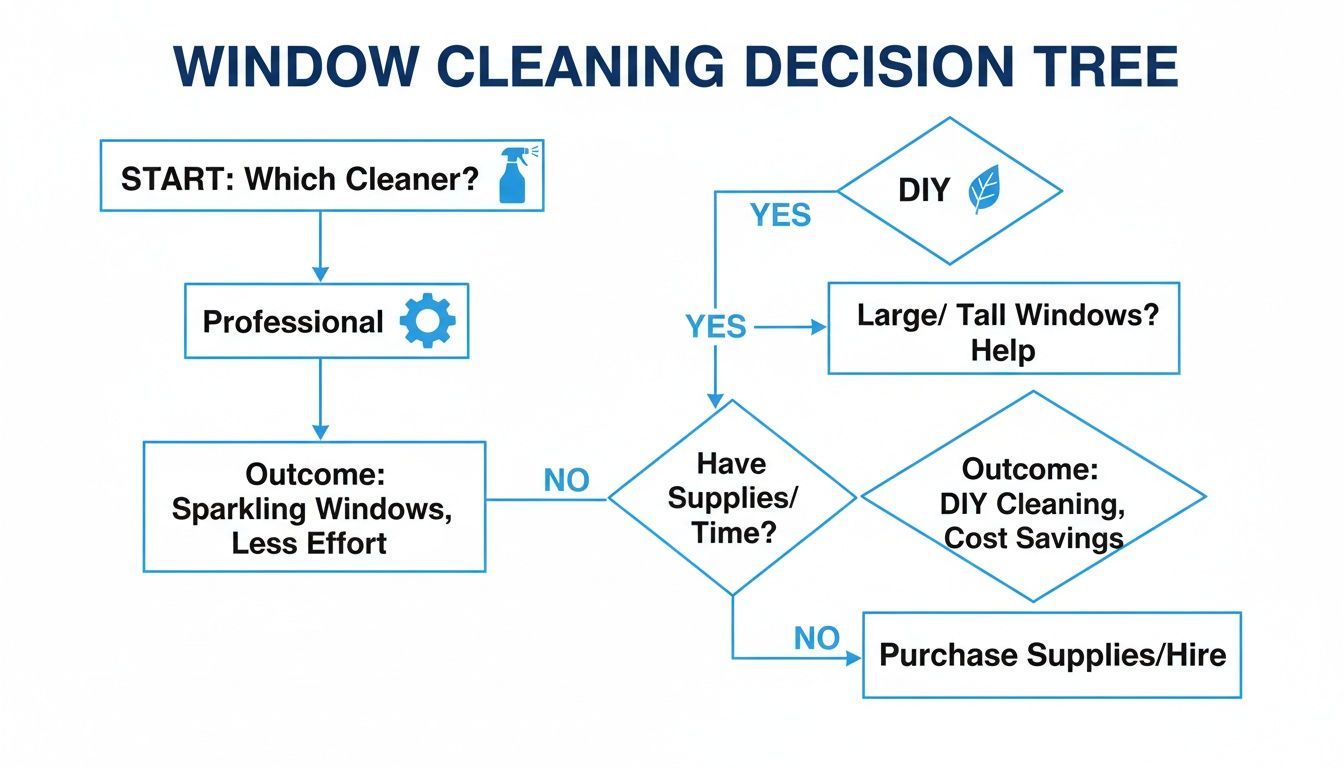
Ultimately, the choice often comes down to balancing cost and convenience against the quality you need and the complexity of the job. For residents in Denver with light dust, a DIY mix might be fine, but for post-monsoon cleanups in Phoenix, a professional service is the wiser choice.
For a clearer picture of your homemade options, we've put together a quick comparison of some popular DIY recipes. This table breaks down what you'll need, how to mix it, and where each solution shines.
Remember to always use distilled water in your mixes to avoid leaving behind mineral deposits from tap water. With the right recipe, you can get surprisingly good results for routine touch-ups.
As more homeowners and businesses look for sustainable solutions, the demand for green cleaning products has exploded. Eco-friendly window cleaning liquids are formulated with plant-based ingredients and biodegradable compounds that are much safer for your family, pets, and the environment.
These solutions skip harsh chemicals like ammonia and phosphates, relying instead on natural solvents and surfactants to get the job done. While some of the first-generation green cleaners couldn't quite compete with traditional formulas, today's options are incredibly effective.
The market for window cleaning equipment, which depends on these liquids, is projected to hit $2.8 billion by 2026. The residential sector makes up a massive 53.2% market share, underscoring just how much homeowners value safe, user-friendly products. This trend is also driving innovation in tools like telescopic poles for water-fed systems, which need compatible liquids to work effectively.
You can see this shift in the professional world, too. A growing number of pros in eco-conscious cities like Denver are switching to green liquids to meet client demand. For our teams providing services in places like Phoenix, and Las Vegas, these advancements allow for safer, more efficient work on both residential and commercial properties.
Whether you’re a homeowner in Scottsdale or a property manager in a downtown high-rise, the liquid you choose matters. It will directly impact the final result, the effort you put in, and the safety of your property.
Getting your hands on the right window cleaning liquid is a great start, but it’s the technique that truly separates the pros from the amateurs. This is where the perfect solution meets skilled execution. The way a professional applies that liquid is what delivers a flawless, streak-free finish, and it all boils down to mastering one of two core methods we use every day: the traditional squeegee or a modern pure-water system.
With over 26 years of experience under our belts, we at Professional Window Cleaning have these techniques down to a science. Let's bridge the gap between the 'what' (the liquid) and the 'how' (the application) to show you exactly how our experts get that perfect clean, every single time.
The traditional squeegee is a classic for a reason, but its success is all about how you apply and manage the cleaning solution. The entire goal is to create just the right amount of ‘slip’ on the glass. This lets the squeegee blade glide effortlessly, pulling away every bit of dirt and water in one smooth, clean pass.
First things first: proper dilution. Pouring in extra concentrate doesn't make the windows cleaner—it just creates a sticky, sudsy mess that’s tough to rinse and actually attracts more dirt. A pro mixes their solution in a bucket with just a few drops or a single capful per gallon of water. It's just enough to get that essential lubrication without a bubble bath.
Next, it’s all about the application tool, usually a T-bar or strip washer. A pro will:
The secret is to keep the glass wet right up until the squeegee makes its pass. If the solution starts to dry, the blade will skip and chatter—and that’s the #1 cause of streaks. This is especially critical when you're working in direct sun or in hot, dry climates like Las Vegas or Phoenix.
As soon as the solution is on, the squeegee work begins. By holding a consistent angle and pressure and wiping the blade clean after each stroke, a professional clears the glass completely, leaving nothing but a perfect shine.
The pure-water method works on a completely different principle. Here, it’s the ultra-purified water itself that does the heavy lifting. Because it’s been stripped of all minerals and total dissolved solids (TDS), the water is in a highly reactive state and actively wants to grab and absorb dirt right off the glass.
For most residential jobs, this pure water is all you’ll ever need. The process uses a water-fed pole equipped with a soft-bristled brush to gently scrub the window. A constant flow of pure water agitates the dirt, dissolves it, and then rinses it away. Since there are zero minerals in the water, it dries perfectly spotless without a squeegee in sight.
But what about windows caked in extreme grime, like after a construction project or on a building next to a busy road? For those jobs, a specialized additive might be needed, and that’s where technique becomes vital once again.
Steps for using additives with pure-water systems:
Whether we’re using a squeegee in Denver or a pure-water system in Scottsdale, it’s the application that transforms a good cleaning liquid into a great result.
Cleaning the windows on a single-family home is one thing. Tackling the glass on a commercial building or a high-rise tower? That's an entirely different league. The sheer scale, the stubborn types of grime, and the critical safety factors all demand specialized window cleaning liquids and true professional expertise.
For property managers and building owners, knowing what sets these jobs apart is fundamental to keeping a property both pristine and safe.

Unlike the dust and smudges you find at home, commercial properties are bombarded with a much tougher lineup of contaminants. Your standard DIY solution simply doesn’t have the muscle for the unique challenges found on buildings in bustling urban centers.
Commercial window cleaning liquids are engineered to be far more potent than anything you’d buy for your house. They are specifically designed to dissolve the stubborn, caked-on substances common on commercial facades, especially on properties like a sprawling medical office in Scottsdale or a large car dealership in Tempe.
These specialized formulas are built to break down:
Because of this, commercial-grade liquids are often highly concentrated. They have to be diluted precisely by a trained professional to be both effective on the grime and safe for the building's surfaces.
When you’re working hundreds of feet in the air, safety becomes the absolute top priority. The liquids used in high-rise and commercial window cleaning must be fully compatible with the sophisticated equipment that keeps technicians safe, like rope-descent systems (rappelling) and aerial lifts.
A critical, yet often overlooked, feature in these professional window cleaning liquids is the inclusion of non-slip additives. These ingredients are vital for ensuring that platforms, ledges, and equipment surfaces don't become dangerously slick when wet, protecting the technicians working at height.
This focus on safety and performance is driving massive growth in the professional sector. Projections show the window cleaning services market is set to explode to $325.8 billion by 2034, a huge leap from $160.3 billion in 2025. This surge is fueled by the demand for advanced cleaning liquids in urban hubs, with commercial applications making up 55% of the market's revenue.
This trend mirrors the needs we see right here in U.S. markets, from high-rise condos in Las Vegas to stadiums in Denver. As you can discover in more detail from this market research, the industry is advancing rapidly to meet these complex demands.
On top of that, with the rise of robotic window cleaning for high-rise tasks, liquids must be formulated to leave zero residue. Any film left behind could interfere with the automated systems. The right liquid is the foundation of a safe and successful commercial window cleaning operation, whether it’s done by a human team or an advanced robot.
We've walked through the science behind getting a perfect, streak-free shine, and as you've seen, it's not as simple as grabbing a bottle of blue stuff and a paper towel. While knowing about different window cleaning liquids is a great start, mastering the art of cleaning is a whole other ballgame. It's one thing to know the ingredients, but it’s another to apply them with a practiced hand that only comes from experience.
Choosing the right formula, guaranteeing safety for your property, and using a technique that leaves nothing behind—that’s a craft we’ve spent decades perfecting. For over 26 years, our team at Professional Window Cleaning has lived and breathed this work, helping homes and businesses look their absolute best.
When you hire a professional, you're not just paying for clean glass. You're investing in peace of mind. A seasoned technician can walk up to a job, instantly spot the unique challenges, and know exactly which tools and solutions will get the job done safely and efficiently.
That kind of expertise is priceless, especially when you’re dealing with tricky situations, like:
We take care of all those complexities so you don't have to. The result is a guaranteed, flawless shine that DIY methods just can't match, saving you time, frustration, and the potential cost of accidentally damaging your property.
The difference between a good result and a perfect one is all in the details. It’s the precise pressure on the squeegee, the exact angle of the blade, and the final buff of the edges—small things that add up to a view that looks like there’s no glass at all.
For a spotless shine and the confidence that comes from hiring seasoned pros, you can trust the team with more than a quarter-century of experience. If you're looking at professional services for a commercial building, it’s always a good idea to have a clear commercial cleaning contract in place to make sure all expectations and service standards are perfectly aligned.
Whether you have a home in Phoenix, a towering high-rise in Las Vegas, a commercial property in Denver, or a beautiful residence in Scottsdale, we have the skills and local knowledge to make your windows disappear.
Contact Professional Window Cleaning today and let us bring our expertise right to your doorstep.
Of course. Here is the rewritten section, crafted to sound completely human-written and natural, following the provided style guide.
Even with a good grasp of the basics, some questions about window cleaning liquids pop up time and time again. After 26 years in this business, we’ve heard just about all of them. Here are the answers to the most common queries we get, helping you troubleshoot issues and make the best choice for your windows.
It seems like a quick, easy fix, right? While a single, tiny drop of dish soap can create a bit of "slip" for your squeegee in a real pinch, we almost always recommend against it. Frankly, it’s one of the most common mistakes we see.
Most dish soaps are loaded with dyes, hand softeners, and heavy-duty degreasers. These are great for getting last night's lasagna off a plate, but on glass, they leave behind a sticky, invisible film. This residue is what causes those frustrating streaks, and worse, it acts like a magnet for fresh dust and pollen, making your windows look dirty again in no time.
Definitely not. You need to be extremely careful with ammonia-based cleaners. While ammonia is a powerful solvent, it’s far too aggressive for many types of windows and the materials around them.
The biggest issue is with tinted glass. Ammonia’s harsh nature can cause certain window films to bubble, peel, or discolor over time, causing permanent damage. It can also wreak havoc on your window frames, stripping paint and degrading rubber seals and caulking. For homes in areas like Denver or Scottsdale, it’s always smarter to go with an ammonia-free option.
Here’s a critical takeaway: what cleans one surface perfectly might destroy another. Always, always check for compatibility before putting a harsh chemical like ammonia on your glass, especially if it's tinted or coated. The risk of irreversible damage just isn't worth it.
If you live in states like Arizona and Nevada, you’re no stranger to hard water. It’s packed with minerals like calcium and magnesium. When tap water from a sprinkler hits your window and evaporates, it leaves behind those stubborn, chalky white spots we call hard water stains.
These mineral deposits bond so tightly to the glass that regular window cleaners and DIY vinegar solutions won't even touch them. This is precisely why our professional teams in Phoenix and Las Vegas have a couple of aces up their sleeves:
When it comes to tough hard water stains, using the right professional approach is the only way to truly solve the problem.
For a guaranteed streak-free shine and the peace of mind that comes from hiring seasoned experts, trust the team at Professional Window Cleaning. We handle all the complexities so you can just sit back and enjoy the perfect view. Visit us at https://www.professionalwindowcleaning.com to get your free estimate today.
Read our blog posts regularly and keep learning.