
Care and Maintenance
Best Squeegee for Cleaning Windows: Expert Comparison
Find the best squeegee for cleaning windows with our expert buying guide. Compare blade materials, handle types, and sizes


Second-story glass gets dirty slowly, then all at once. One day you look up and realize the upper windows are hazy, the lower panes are spotted, and that 16 ft ladder in the garage starts to look like the obvious answer.
Sometimes it is. Sometimes it absolutely isn't.
A 16 ft ladder sits in the danger zone of being common, useful, and easy to underestimate. It's tall enough to tempt people into doing second-story window work, but short enough that many assume it's automatically manageable. That's where bad decisions start. In window cleaning, the ladder is only part of the equation. The cleaning method, the ground conditions, the window layout, and your ability to work without overreaching matter just as much.
A typical homeowner problem goes like this. The upstairs bedroom windows have hard water marks, the entry glass has pollen baked onto it, and the side yard is narrow enough that ladder placement already looks awkward. The first thought is usually simple: grab the 16 ft ladder and knock it out in an hour.
That can work on the right house. It can also turn into a shaky climb, a poor angle, and a half-cleaned window because the reach isn't what you expected once the ladder is set.
In this trade, the mistake isn't owning a 16 ft ladder. The mistake is treating it like a universal solution. A ladder can get you to glass. It doesn't guarantee safe access, solid body position, or professional results once you're there. Window cleaning exposes every weakness in setup because you're not just climbing. You're stopping, working with wet tools, managing detail work, and shifting your position while trying not to lean too far.
Field note: The hard part usually isn't getting up the ladder. It's staying in a safe working position long enough to clean the glass correctly.
That's why experienced cleaners think in terms of access plus technique, not ladder height alone. There are only two methods window cleaning professionals use: the squeegee method and the pure-water system. The ladder only supports one part of that decision.
This perspective comes from long trade experience, not hardware store theory. Professional Window Cleaning has been a trusted name in the industry for over 26 years, with its roots tracing back to 1999 according to this background reference. That kind of longevity teaches one lesson fast: if the setup feels questionable from the ground, it usually gets worse in the air.
A 16 ft ladder only makes sense if it matches the kind of window cleaning you are doing. On a two-story house, I am not asking, "Will this reach the glass?" I am asking whether it lets me work safely, keep my hips between the rails, and finish the pane without overreaching or fighting the setup.
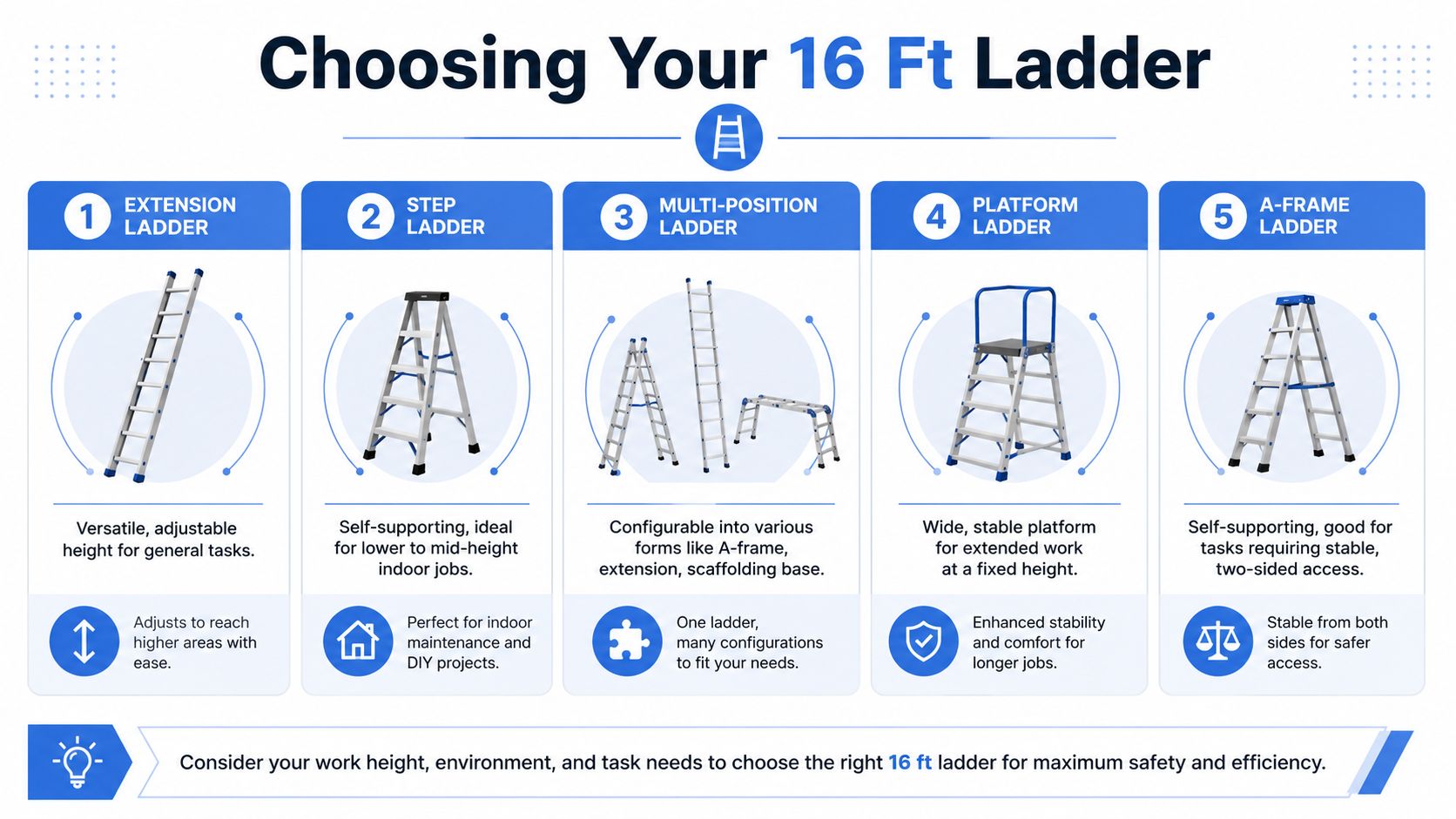
For exterior residential work, a 16 ft extension ladder is usually the best fit when the wall is straight and the landing area is solid. It gives better access to upper glass than a step ladder and lets you move along a run of windows faster.
That does not make it the automatic choice. If the windows sit over shrubs, low roofs, window wells, or uneven concrete, ladder work gets slower and riskier. In those cases, the access method matters as much as the ladder itself. A squeegee job may still require close ladder positioning. A pure-water setup can often keep you on the ground and out of trouble.
If you want a clearer size comparison for residential work, this guide on what size ladder for a 2-story house shows where a 16 ft ladder works and where it starts to fall short.
A 16 ft step ladder earns its keep indoors, in storefronts, and in spots where there is nothing safe to rest an extension ladder against. It gives you a centered working position, which helps on detailing and route work where you are cleaning directly in front of the glass.
The trade-off is footprint and usable height.
A big step ladder needs room to open fully, and many walkways, foyers, and garden areas do not give you that room. It also gets cumbersome fast if you are dragging it from pane to pane on a larger house.
Combination ladders solve access problems that standard ladders cannot. They work well in side yards, over small elevation changes, and in awkward corners where a full extension ladder feels clumsy.
They also ask more from the user. Most are heavier, slower to adjust, and less pleasant to move all day. For a cleaner handling a few problem windows, that may be fine. For a full exterior service, many experienced techs still prefer a dedicated extension ladder because it is faster and simpler to position repeatedly.
| Ladder type | Best use in window cleaning | Main downside |
|---|---|---|
| Extension ladder | Exterior second-story access on open wall sections | Needs a safe lean surface and enough room at the base |
| Step ladder | Interior work, storefronts, atriums, direct front-facing access | Bulky footprint and lower practical reach outside |
| Combination ladder | Tight side yards, awkward access, mixed surfaces | Heavier and slower to reposition |
Aluminum stays common in window cleaning because it is durable, easy to transport, and realistic for repeated moves during the day. Fiberglass has its place, especially around electrical hazards, but many cleaners avoid the extra weight unless the job calls for it.
Duty rating still matters, even on residential work. The ladder has to carry your body weight plus everything on you and in your hands. Belt, tools, towels, solution, and any accessory clipped to the ladder all count. If the rated capacity is close to your real working load, choose a stronger ladder.
One more point from the field. Do not take calls while climbing or repositioning. The distraction is enough to miss a rung or rush a reset, which is why preventing contractor ladder accidents is part of the job, not an afterthought.
Buy for the load you actually carry and the way you actually clean, not for the number printed on the sticker.
The safest ladder setup starts before the ladder leaves the truck or garage. If the ground is soft, sloped, slick, or cluttered, the job has already changed. A 16 ft ladder doesn't forgive rushed setup, especially when you're working wet glass and shifting your upper body during detailing.
Start with the basics. Inspect the rails, feet, rung locks, and hardware. Dirt on the feet matters. Bent rails matter. A lock that “usually catches” is a reason to stop, not a reason to keep going.
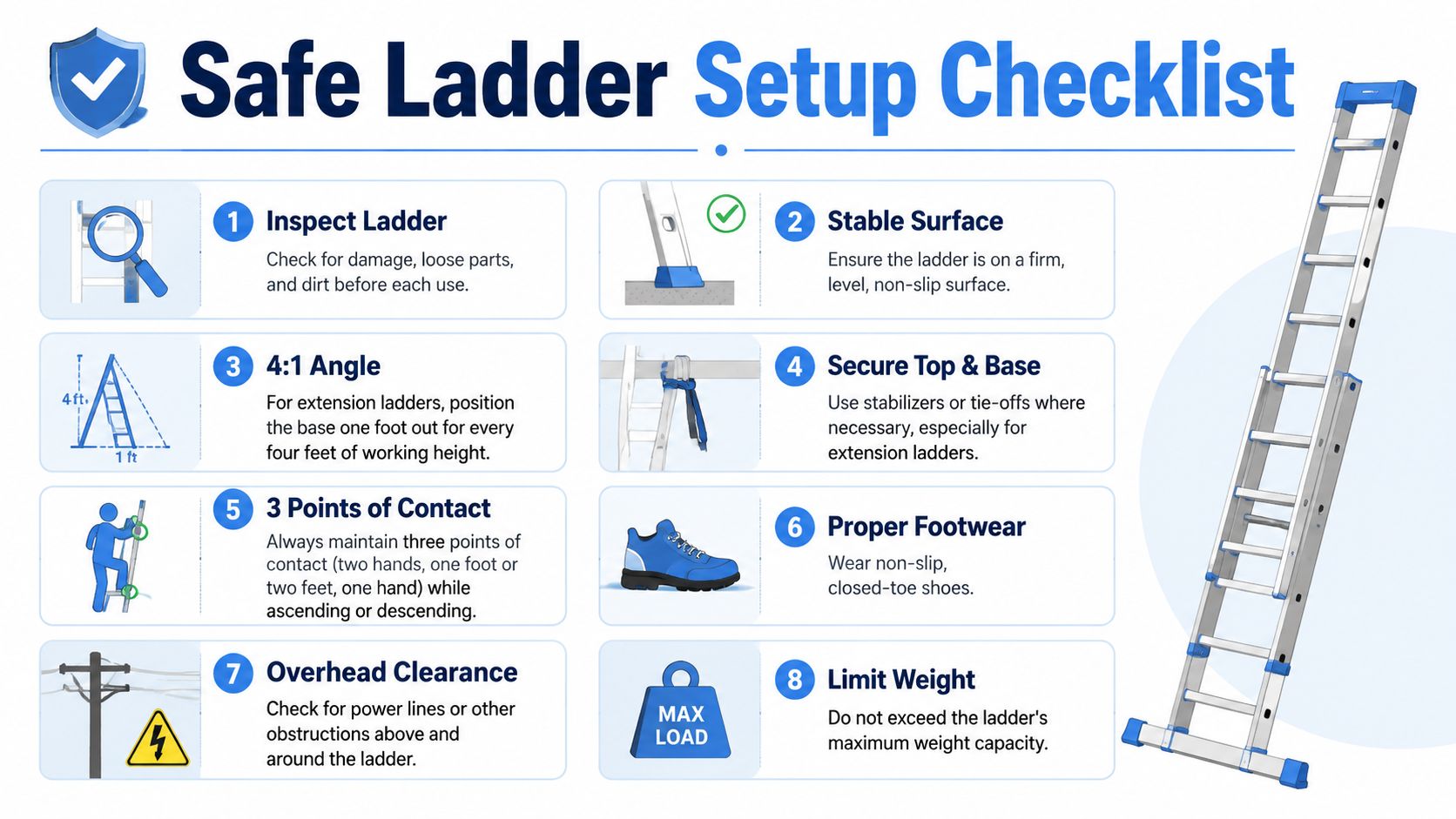
The most important extension ladder habit is the 4 to 1 rule. Set the base one foot away from the wall for every four feet of height. That's the positioning method professionals rely on because a shallow ladder angle increases the chance of slide-out.
Research on ladder setup found a 35.6% probability of users placing ladders at less than a 70-degree angle without instruction, which is exactly why correct setup can't be guessed at, according to this NIOSH-linked analysis of ladder angle and setup behavior. That same source also notes a minimum 3-foot overlap for multi-section extension ladders.
For people in the trades who spend time on ladders all day, broader habits around communication and distraction matter too. This article on preventing contractor ladder accidents is worth reading because many incidents start with divided attention, not just bad equipment.
A more detailed practical guide to ladder lean is available in this article on the correct angle for a ladder.
Use this short checklist before your feet leave the ground:
Later in the setup, this visual walkthrough is useful if you want to see the fundamentals in motion.
A veteran cleaner doesn't just ask whether the ladder reaches. He asks whether the ladder lets him work. Can the applicator move freely? Can the squeegee clear the top edge without leaning out? Can detail towels be reached without twisting?
If you have to choose between cleaning one corner properly and staying centered on the ladder, staying centered wins every time.
That mindset is what keeps routine work from becoming emergency work.
A 16 ft ladder does not give you 16 feet of comfortable working height. That misunderstanding causes a lot of sketchy setups.
With an extension ladder, the usable reach changes because the ladder sits at an angle, not straight up. You also don't stand on the top rungs. In real window cleaning, your working height is always less than the number printed on the ladder.
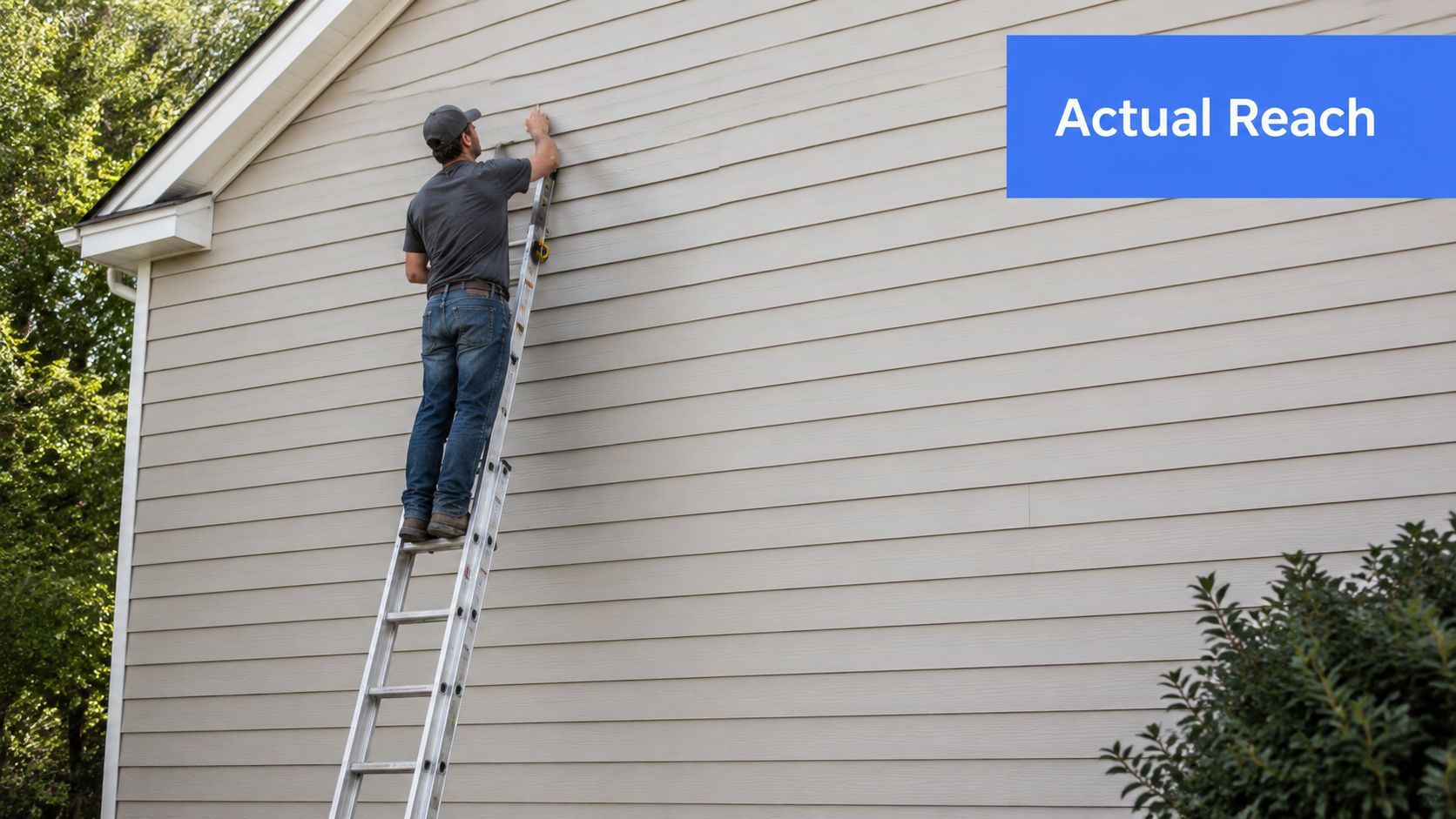
A 16 ft extension ladder is often suitable for single-story facades and some second-story access points, especially windows over garages, lower rooflines, and homes with favorable grade. It gets less useful when the window is set above sloped landscaping, deep wells, or a narrow side yard where you can't establish the base correctly.
A 16 ft step ladder is commonly associated with about a 14 ft working reach in product guidance for industrial use, such as the Werner 416 listing at Werner's product page. That doesn't mean every user should assume the same result in every condition. Reach depends on safe standing level, body size, and whether you can work without stretching.
The dangerous assumption is that lower height means lower consequence. The CDC reported that in 2011, work-related ladder fall injuries led to 113 fatalities in the United States, and nearly 90% of nonfatal ladder fall injuries occurred from heights below 16 feet. The most common band was 6 to 10 feet, accounting for 50% of emergency department-treated ladder fall injuries, according to the CDC report on ladder fall injuries.
That lines up with what cleaners see in the field. People don't always fall from the very top. They fall when they think they're “not that high up” and stop respecting position, angle, and reach.
A bare ladder is only half a system. The right accessories make a 16 ft ladder safer, easier on the building, and more useful for actual window work.
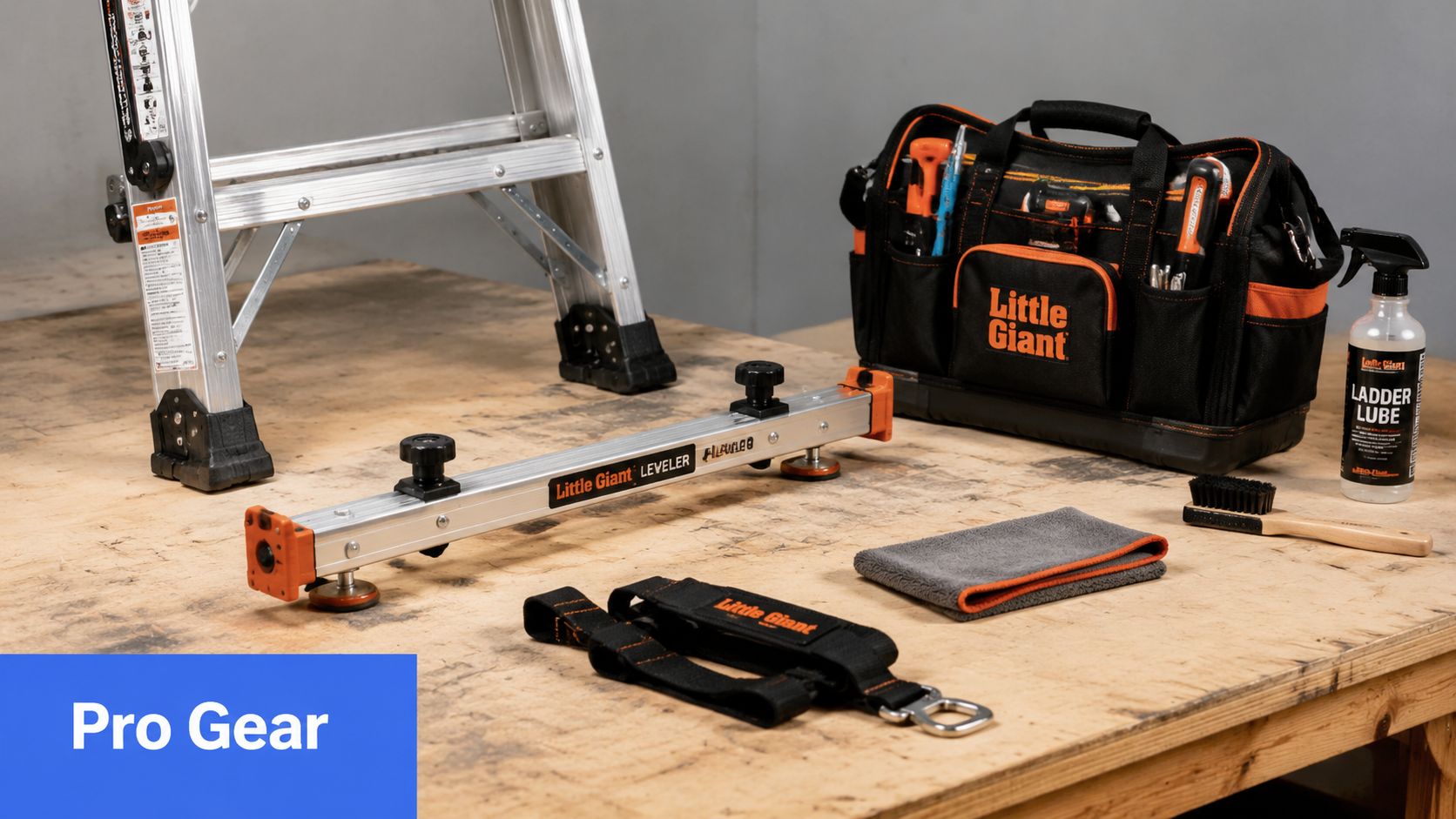
For window cleaning, a few add-ons are more important than often realized:
For professional window cleaning at height, product guidance for aluminum extension ladders also emphasizes D-rungs or D-shape rungs with full serration, secure runglocks, and mar-resistant rail caps, along with inspection for bent rails or cracked rungs under OSHA 1926.1053 practices, as described in this product-based ladder specification reference.
The best accessory is the one that removes a bad compromise. If a stabilizer keeps you off fragile gutters and puts you in better line with the glass, it's not optional.
You don't need a complicated checklist. You need a consistent one.
If anything binds, cracks, or stops locking cleanly, pull it from service. Window cleaning puts repetitive side pressure on ladders because the work isn't static. A small defect gets exposed fast.
Some window jobs look simple from the driveway and get complicated as soon as you start solving access. The glass may be reachable, but not reachable safely. That's the line that matters.
If the window sits above a roof section, over stone beds, behind shrubs, or near uneven walkways, the ladder question changes from “Can I touch it?” to “Can I clean it without forcing a bad position?” If the answer is shaky, the job has already moved out of comfortable DIY territory.
Professional window cleaners don't just bring better ladders. They choose the right cleaning method first.
The only two methods recognized for professional-grade results are the squeegee method and pure-water systems, and they account for over 95% of professional jobs, according to this cited industry-standard claim. That distinction matters because a lot of upper glass can be cleaned from the ground with a pure-water system, removing the ladder from the equation entirely.
The squeegee method still rules when detail, edge control, and certain commercial results matter most. But if a cleaner can safely produce a spot-free finish from the ground, that's often the smarter play than climbing.
Call a professional when one or more of these are true:
For homeowners comparing providers, it also helps to know the warning signs before hiring anyone. This guide on spotting contractor red flags is useful for screening companies that talk confidently but don't explain safety, process, or insurance clearly.
In service areas like Denver, Scottsdale, Phoenix, Las Vegas, Tempe, Chandler, Gilbert, and Flagstaff, the mix of sun exposure, wind, dust, and varied building layouts makes access planning a real part of the job. Good cleaners treat ladder use as one option, not the default answer every time.
Often, yes. But “tall enough” isn't the whole question. You need correct angle, safe footing, and enough ladder extension above the landing area when climbing onto a roof. If any of that feels marginal, don't force it.
Many window cleaners use aluminum because it's durable and practical to move repeatedly during the day. The more important choice is buying the correct duty rating and using a ladder in good condition. For many jobs, handling and setup quality matter more than debating material in the abstract.
No. They work differently and are used differently. A step ladder is self-supporting and useful for controlled access. An extension ladder gains height by leaning into the structure. The label height doesn't translate into identical working reach.
Store it clean, dry, and supported so the rails don't get twisted. Don't leave grit on the rungs or feet. Don't pile heavy materials on top of it. If locks or hinges stop moving cleanly, fix the issue before the next job.
Sometimes. Not always. Window layout, landscaping, ground slope, and obstacles can make one upper window straightforward and the next one a bad idea. That's why pros choose between squeegee work and pure-water cleaning, instead of assuming every pane should be done from a ladder.
If your windows need more than a guess and a garage ladder, Professional Window Cleaning can help. We've been cleaning windows since 1999 and bring the right access method, the right professional technique, and the judgment to know when a 16 ft ladder is the right tool and when it isn't.
Read our blog posts regularly and keep learning.