Care and Maintenance
All Seasons Window Cleaning: A Complete Year-Round Guide
All seasons window cleaning explained: how weather affects glass, season-by-season scheduling, methods pros use, and the real benefits of regular service.


That upper window always looks easy from the driveway. Then you drag out a ladder, look up, and realize a 30 foot extension ladder isn't just a taller version of the step ladder in the garage. It's a serious access tool. In window cleaning, that difference matters fast.
High glass changes everything. Your footing matters more. Your setup matters more. The way you carry tools matters more. If you're cleaning with a squeegee or a pure-water system, the ladder isn't just getting you to the work. It becomes part of the work.
After more than 26 years in professional window cleaning, one lesson stands out: confidence on a ladder doesn't come from guts. It comes from habits. The crews who stay safe are the ones who inspect the ladder, set it right, move it often, and never try to force a bad position into working.
That second-story pane over the entry, the tall stairwell glass, the window above a sloped planting bed. Those are the spots that make people think, “I just need a bigger ladder.” Sometimes that's true. Sometimes it isn't.
A 30 foot extension ladder sits in the range where mistakes stop being small. The risk is real. In the U.S., there are more than 164,000 emergency-room-treated injuries and 300 deaths each year from ladder falls, and 64.4% of fatal construction falls happen from 6 to 30 feet, according to InterNACHI's ladder safety summary. That puts this ladder size squarely in the zone where a bad setup, rushed move, or overreach can turn ugly.
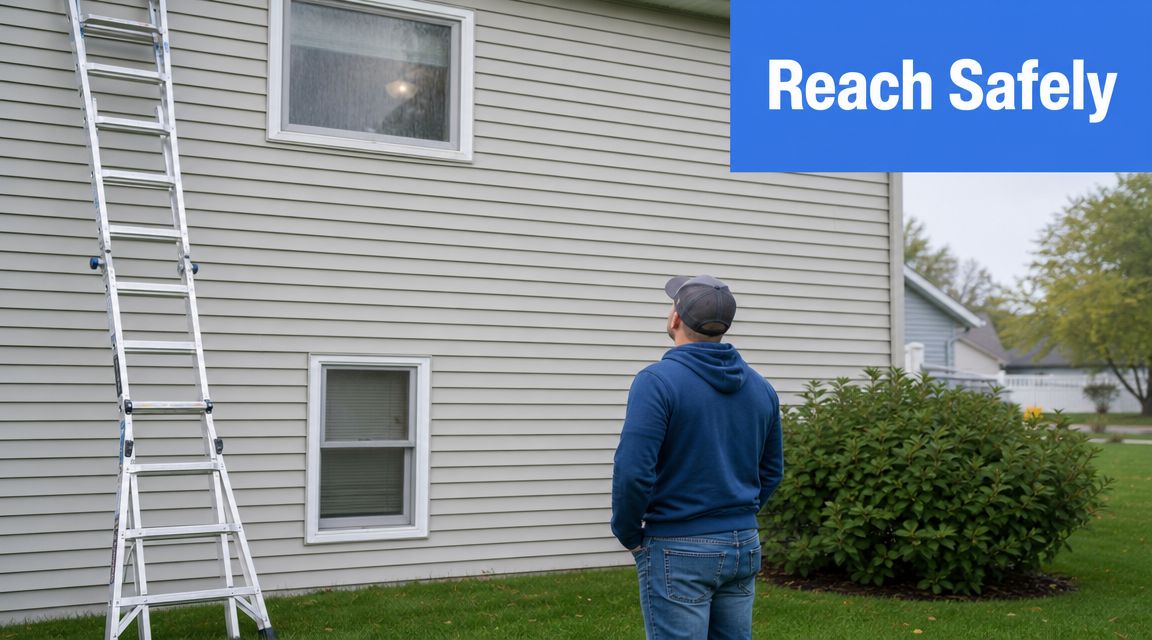
A painter can stay in one spot longer. A roofer may use the ladder mainly for access. A window cleaner has to work while balancing body position, tools, water, edges, frames, screens, and drop lines.
That's why generic ladder advice often misses the point. It tells you how to climb. It doesn't tell you how to clean glass without drifting your body outside the rails or letting a hose tug you sideways.
Practical rule: If the ladder position forces you to stretch for the last bit of glass, the setup is wrong. Move the ladder.
In the field, that's what separates controlled work from risky work. Good ladder use feels almost boring. The base is planted. The top contact is solid. Your hands know where the rails are. Your body stays centered. You clean what's in front of you, then you come down and reposition.
If you want a broader refresher on fall risk and height work, this 2026 Australian heights safety resource gives useful context that lines up with what experienced crews already know. Different countries may phrase rules differently, but the basic truth is the same. Height punishes shortcuts.
For homeowners and property managers in places like Phoenix and Denver, the practical takeaway is simple: a 30 foot ladder can reach serious window-cleaning tasks, but it should be treated with the same respect you'd give any piece of equipment that can hurt you fast if you get casual.
Not every ladder in this class fits window-cleaning work. Some are better for occasional access. Some are better for all-day use. Some feel fine in the store and miserable after moving them around a property.
The first thing to understand is that catalog length isn't the same as usable working reach. A 32-foot extension ladder can be rated Type IA with a 300-lb load capacity and still have a maximum working length of 29 feet, as shown in this Sunbelt Rentals 32-foot extension ladder listing. That's why window cleaners should compare reach height, not just the number printed on the side rails.
If you clean around power drops, service masts, exterior lighting, or commercial facades with mixed utilities, material matters. Even when electricity isn't the main concern, handling matters.
| Feature | Aluminum | Fiberglass |
|---|---|---|
| Weight feel in use | Usually feels easier to maneuver | Usually feels heavier and more tiring to move |
| Around electrical hazards | Not the first choice | Usually the better choice when electrical exposure is a concern |
| Rigidity and field feel | Popular for lighter-feeling handling | Popular for trade use where extra durability is valued |
| Heat and sun exposure | Can get hot fast in direct sun | Also gets hot, but many crews still prefer it for jobsite safety reasons |
| Best fit | Open areas, lighter handling priorities | Mixed jobsite conditions, more safety margin around electricity |
For pure access, some cleaners like aluminum because it feels easier to carry and raise. For mixed exterior work, many pros lean fiberglass because it gives more confidence around electrical exposure. That choice matters in places like Las Vegas, where exterior work often means long sun exposure, wide lots, and plenty of ladder moves in a day.
A ladder can meet the rating and still be a poor fit for actual window cleaning.
Look for these details:
The biggest buying mistake is choosing a ladder that barely reaches if everything goes perfectly.
That's also why it helps to compare your ladder decision against the actual task. If you're trying to decide whether this size is right for a typical residence, this guide on what size ladder for a 2 story house is a useful companion.
Window cleaners only have two real cleaning methods. A squeegee or a pure-water system. Each changes the ladder choice.
With a squeegee setup, you may carry a small tool pouch, scrubber, and detailing cloth. With pure water, you may not need to work directly in front of every upper pane, which can reduce ladder time altogether. If a pole can clean the glass safely from the ground, that often beats climbing with tools.
The right question isn't “Can a 30 foot extension ladder reach it?” The right question is “Can I clean it from that ladder without standing too high, overreaching, or fighting my own equipment?”
Professionals who stay in the trade for years all develop the same habit. They don't glance at the ladder. They inspect it with their hands.
A 30 foot extension ladder works hard. It gets hauled across gravel, leaned against stucco, bounced in racks, and dragged into corners of yards where the footing is never as clean as you want. If you skip inspection, you're trusting damaged equipment without knowing it.
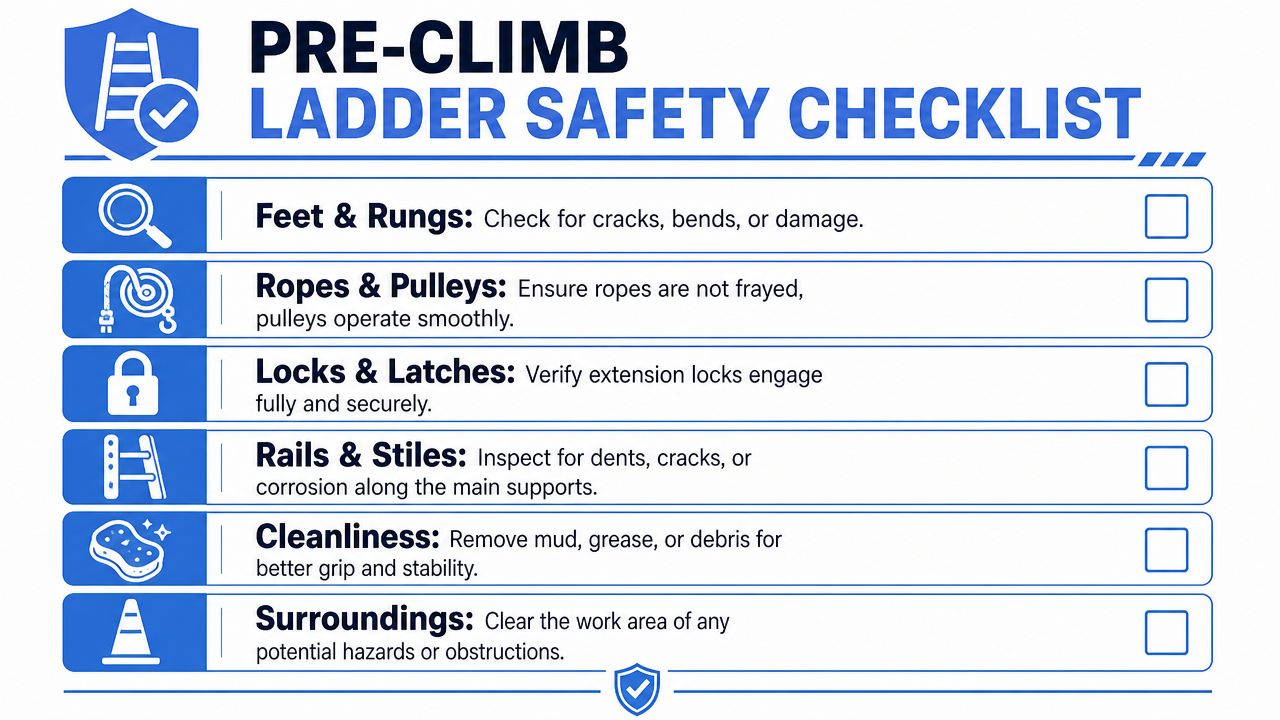
Before the ladder goes up, check these parts in order:
If any one of those looks questionable, that ladder doesn't go up.
Cleanliness sounds minor until you've seen a ladder foot slide because it was carrying mud from the last stop. Window cleaning adds soap residue, wet grass, grit, and overspray. All of that works against stable footing and hand grip.
A good routine is simple:
A ladder usually gives warning before it fails. The problem is most people don't bother looking for it.
This is the same mindset behind any equipment check. The process isn't glamorous, but it prevents avoidable failures. If you like practical maintenance systems, this checklist for maintaining utility trailers reflects the same field logic. Equipment lasts longer and works safer when inspection is routine instead of occasional.
Inspection isn't only about finding damage. It's also about keeping small wear from becoming structural trouble. A sticky lock today becomes a rushed setup tomorrow. A frayed rope today becomes a control problem the next time you raise the fly section.
For window cleaners, the best maintenance habit is consistency. Same check. Every job. No shortcuts because the house looks easy.
Most ladder problems start before the first step. Not from a broken rung. From bad placement.
A 30 foot extension ladder has enough length and mechanical advantage to punish sloppy setup. If the base is too close, the ladder feels steep and twitchy. Too far out, and you invite slide-out. OSHA's portable ladder guidance requires extension ladders to be set at a 4:1 angle, with at least 3 feet of extension above the landing surface when used for access, and for multi-section ladders up to 36 feet, at least 3 feet of overlap between sections, according to OSHA's ladder safety guidance.
Early in the setup, it helps to see the sequence clearly.
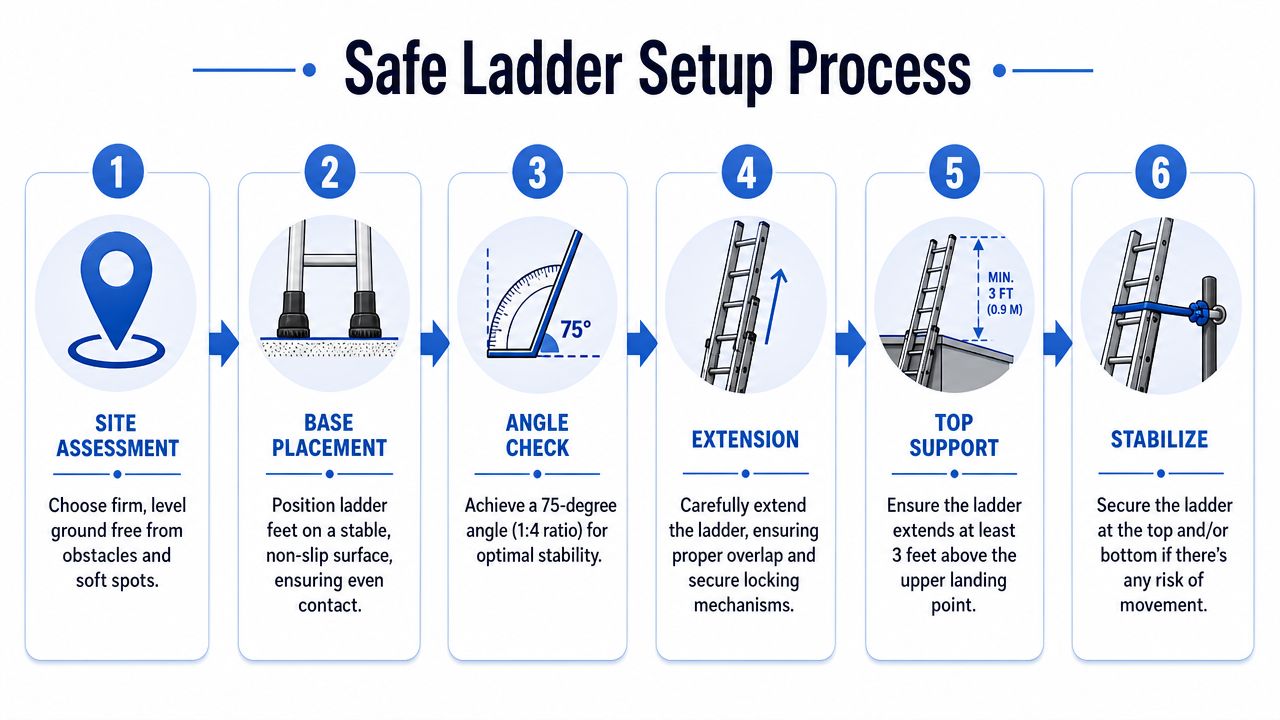
Before the ladder ever touches the wall, look down.
You need firm, level ground. That can be concrete, stable pavers, packed soil, or another surface that won't shift under load. Wet grass, decorative rock, fresh mulch, loose soil, and slick painted surfaces all deserve suspicion.
Use this field sequence:
The 4:1 rule is the standard. For every four feet of vertical height, place the base one foot out from the wall. The American Ladder Institute notes that single and extension ladders should be erected as close to 75 1/2 degrees from horizontal as possible for best resistance against bottom slip, and for a 30-foot ladder that commonly works out to a base offset of about 7.5 feet when measuring along the rail, as described in ALI's ladder setup guidance.
If you don't want to do math on site, use a body check. Stand facing the ladder with your toes at the feet. Reach your arms straight out. If your hands meet a rung comfortably, you're usually in the right neighborhood.
For a more detailed walkthrough on placement, this guide to the correct angle for a ladder is worth reviewing.
A quick visual demo helps too:
Extending a long ladder is where people get sloppy. They rush the rope. They don't watch the locks. They trust sound instead of checking engagement.
Use a controlled process:
Then step back and look at the whole setup. Is the base planted? Is the line straight? Is the top resting where you intended, not where it happened to land?
If the ladder doesn't look settled from ten feet away, it won't feel settled from ten feet up.
For window cleaning, stable placement usually means more ladder moves and fewer hero reaches. That's good practice, not lost time.
Once you're on the ladder, the cleaning method starts to matter as much as the setup. Generic ladder advice, however, often falls short. It tells you to maintain three points of contact, which is correct. But window cleaning asks you to work with one hand, shift tools, manage water, and still stay centered.
That's why your movement has to be deliberate.
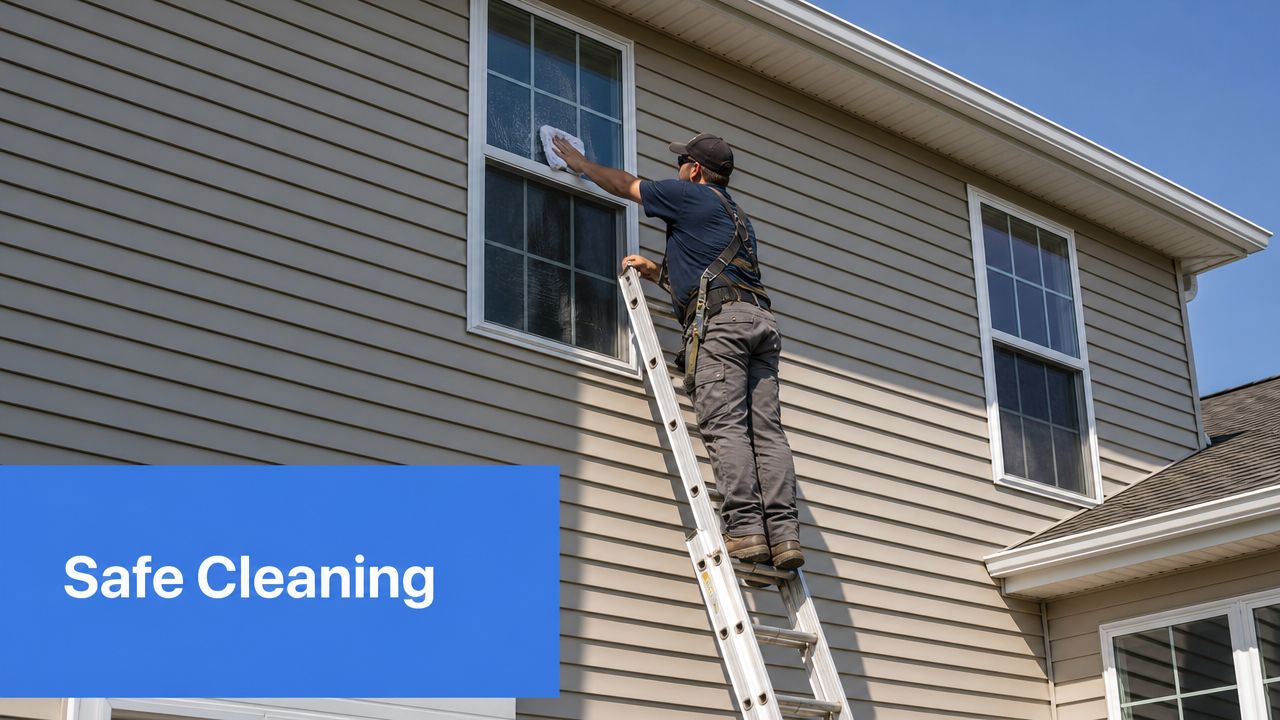
The rule I trust most on ladders is simple: keep your belt line between the rails. The second you start leaning outside them, the ladder starts carrying your off-center weight in a way it wasn't meant to.
Three habits keep you out of trouble:
A lot of falls happen because the worker is almost done and wants one more swipe. That last corner isn't worth it.
Traditional squeegee work on a ladder is still common because it gives detailed control on stubborn glass, edges, and panes that need hand-finished results.
The safest approach is compact and organized:
People often get tempted to stand too high. Don't. If you need the top of the frame and you're running out of safe hand position, the ladder is too short for that exact setup or it needs to move.
Window cleaning rewards patience. Fast ladder work usually means wasted motion, missed edges, or bad body position.
Pure-water systems have changed high-reach window cleaning because they often let you stay on the ground. That's one reason many pros reach for a water-fed pole before they reach for a long extension ladder.
But some properties still create mixed jobs. Maybe the upper panes can be done with pure water, while a stubborn section, architectural detail, or access issue still calls for ladder work. When that happens, hose management becomes a safety issue.
Keep these points in mind:
For delicate exteriors, including stucco-heavy homes in Scottsdale, a standoff can help keep the ladder off fragile surfaces while giving better working space around the window opening.
This doesn't get said often enough. A 30 foot extension ladder is not automatically the right answer just because the window is high.
If the ground is poor, the side reach is excessive, the hose path is messy, the glass spans too wide for centered work, or the ladder move itself creates more risk than the cleaning task justifies, choose another method. A different ladder type, a scaffold setup, or staying on the ground with pure water may be the smarter call.
Experienced cleaners don't prove skill by forcing bad ladder work. They prove it by choosing the method that controls risk.
A lot of people mentally finish the job when the glass is clean. That's when rushed mistakes show up. Fingers get pinched in the fly section. Backs get strained during the carry. Rails get bent loading onto a rack.
The shutdown process should be as disciplined as the setup.
Before you retract the ladder, clear the area under and around it. Make sure no one is walking through the drop zone. Keep your hands clear of pinch points and lower the fly section with control, not speed.
Use a clean sequence:
Once retracted, lower the ladder fully and reset your grip before moving it.
A ladder in this size class is awkward even when it isn't excessively heavy. Find the balance point. Keep the front end high enough to clear obstacles but low enough to stay in control. If wind is pushing it around or the carry path is tight, get help.
Good transport habits matter too:
Store the ladder in a clean, dry place where it won't get hit by vehicles, buried under loose equipment, or left with mud and residue on the feet and rails. Before it goes away, wipe off grime from the day's work.
That last bit of care is what makes the next inspection easier. It also tells you a lot about whether the ladder picked up damage on the job or during transport.
A professional finish doesn't end with clean glass. It ends when the tool is down, loaded, and ready to come back out safely next time.
If you'd rather leave high ladder work to a crew that's been doing it since 1999, Professional Window Cleaning handles residential, commercial, and high-rise window cleaning with the right method for the job, whether that means a traditional squeegee or a pure-water system. We serve properties across Arizona, Colorado, and Nevada, including Las Vegas, Phoenix, Denver, Scottsdale, Tempe, Chandler, Gilbert, and Flagstaff.
Read our blog posts regularly and keep learning.