
Care and Maintenance
How Much Can a Window Cleaning Business Make in 2026
Wondering how much can a window cleaning business make in 2026? See real revenue, profit margin, and owner income numbers for solo, crew, and high-rise


A lot of property owners start in the same place. They stand in a room that feels darker or flatter than it should, look at a plain exterior wall, and know the house needs something more. More light. More character. More usable space.
That’s when the bay or bow window question shows up.
The two styles get grouped together because both project outward and both can completely change a room. But they don’t behave the same way once they’re installed. They look different from the curb, they frame views differently, and from a maintenance standpoint, they create very different cleaning challenges over time.
That long-term part matters more than is often assumed. A window that looks great in a showroom can become frustrating if the geometry traps dust, the outer panes are awkward to reach, or the design doesn’t fit the structure of the house. Property owners planning additions or exterior updates often benefit from broader guidance on choosing the right windows and doors for extensions and renovations, especially before they commit to a style that changes both the inside and outside of the building.
One homeowner wants a reading nook in the living room. Another wants the dining area to feel wider and brighter. A property manager wants to update a façade without creating a maintenance headache. All three may land on the same shortlist: a bay or bow window.

After more than 26 years in the window cleaning trade, one thing becomes obvious. The right feature window can improve a property immediately, but the wrong choice shows up later in glare, difficult access, trapped debris, and awkward upkeep. The decision isn’t just about looks.
Those asking about a bay or bow window are trying to solve one or more practical problems:
A bay window usually gives you a more defined architectural statement. It creates a stronger nook and a sharper projection.
A bow window leans softer. It spreads the glass across more panels and creates a gentler curve.
Practical rule: If you care most about creating a functional interior feature, bay often wins. If you care most about a softer façade and a broader sweep of light, bow usually makes more sense.
The right answer depends on the room, the elevation, and how much effort you’re willing to put into maintaining the glass over the years. That last part gets overlooked, and it shouldn’t.
A bay window projects outward with noticeable angles, forming a small architectural bay that extends from the wall. In most residential applications, it reads as a center window flanked by angled side units.
A bow window also projects outward, but it does it with a curve rather than a strong angle. Instead of a three-panel look, the bow usually appears as a sweep of multiple matching units.
The easiest way to tell them apart is by the line they create from outside the house.
That visual difference affects everything else. It changes the amount of wall space you need, the style of trim that looks right, the kind of seat or ledge you can build inside, and how easy the outside panes are to clean.
Bay assemblies are commonly associated with stronger angles. The side units turn outward and create a clear projection from the wall plane.
The result is a window that often feels like a small bump-out. Inside, you get a shelf-like or seat-like area that feels intentional rather than decorative only.
Bow windows use more units to form an arc. The overall effect is smoother and less abrupt.
That softer line often works well on broad walls where an angular bay might feel too heavy. It can also suit homes where you want the feature to look elegant rather than pronounced.
The modern popularity of these windows didn’t come out of nowhere. Bay and bow windows originated in the English Renaissance (late 17th century), evolving from Gothic cathedral chapels and spreading globally, with bow variants, curved assemblies of four or more casement windows, emerging prominently in 18th-century England and the American Federal Period, powering their integration into Victorian homes (1837-1901) and Chicago School skyscrapers by 1890 (Morgan Exteriors).
That history still shows up in how they’re used today. Bay windows often feel more architectural and traditional. Bow windows often read more graceful and panoramic.
A quick visual helps if you're comparing forms side by side:
They share a few obvious traits:
That’s why people use the terms interchangeably. In practice, though, installers, cleaners, and remodelers don’t treat them as interchangeable at all.
A bay gives you edges. A bow gives you sweep. That one distinction usually tells you which direction the project should go.
If you’re evaluating quotes, sketches, or showroom samples, it helps to compare a bay or bow window on the points that affect ownership most. Not just appearance, but how the unit sits on the wall, how it handles light, and how it behaves when it’s time to clean it.
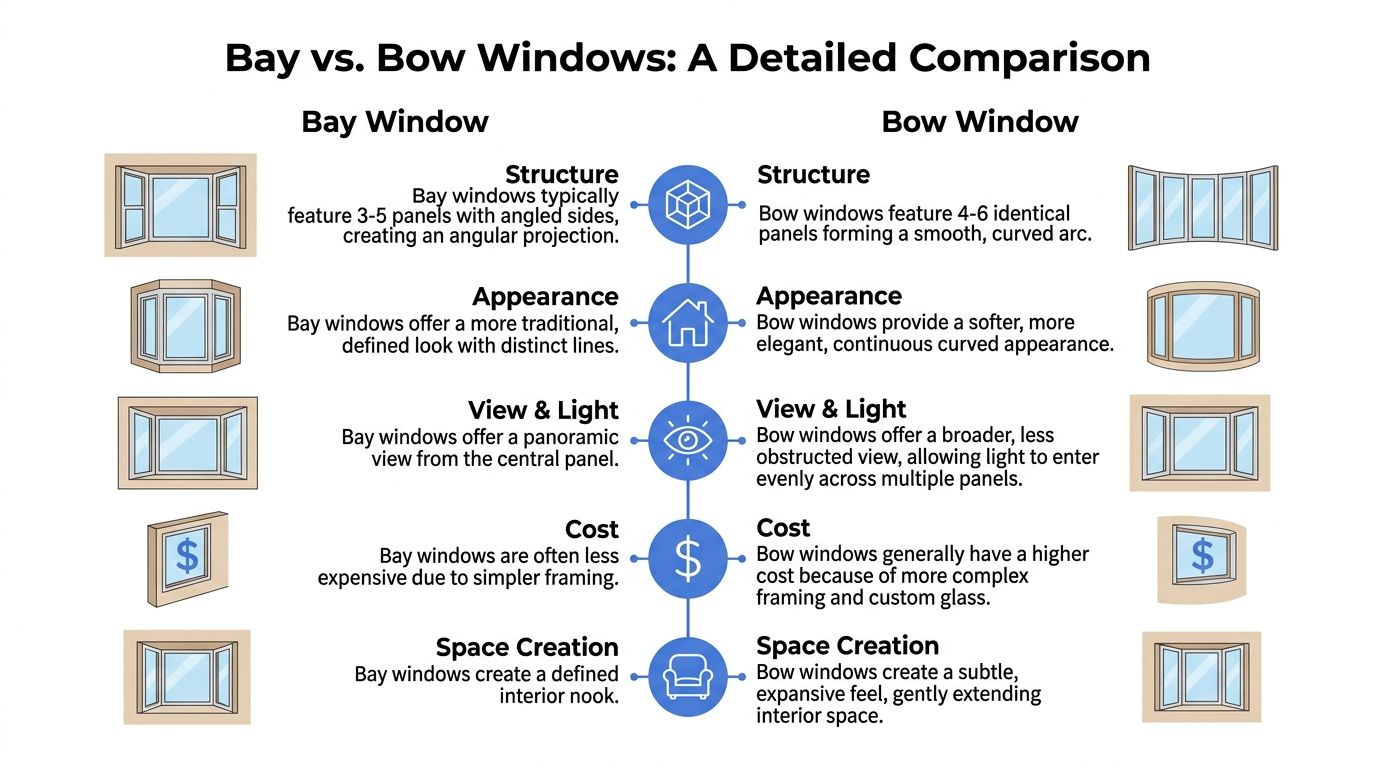
A bay window is usually the more angular option. A bow window spreads the projection across more panels and a gentler arc.
Bay windows, particularly 30-degree double-hung configurations, feature standardized widths from 4’6” to 12’1” (137-368 cm) and projection depths of 1’2” to 2’ (35.6-61 cm). Bow windows typically require wider openings and feature 4 to 6 equally sized casement units joined at 10-15 degree angles, impacting thermal performance and cleaning access differently than the angular bay design (Dimensions.com).
That matters because dimensions don’t just affect fit. They affect trim work, support needs, furniture layout, and access to outer glass.
Bay windows create a more defined interior shape. If you want a noticeable nook for seating, plants, or a bench, bay is often the easier choice.
Bow windows feel more expansive than deep. The arc softens the perimeter of the room and can make the wall feel less interrupted.
Bow windows tend to distribute daylight more evenly across multiple panes. Bay windows can create a dramatic focal point with a strong center view.
Neither is automatically better. It depends on whether you want a framed outlook or a broader wraparound effect.
In practical terms, bow windows often involve more custom coordination because they use more units and a smoother arc. Bay windows are often simpler to frame and easier to align with a distinct center-and-flank layout.
That doesn’t mean one quote will always be lower than the other. It means the labor and fabrication logic are different. Property owners should expect the framing details, support requirements, and finishing work to drive price as much as the glass package itself.
More joints mean more places to watch over time. In dry climates such as Phoenix and Denver, owners should pay attention to seal condition, edge cleanliness, and any early signs of condensation or dirt buildup around mullions.
A bow’s multi-panel curve can be beautiful, but every added joint is another area that needs proper fabrication and long-term maintenance.
| Feature | Bay Window | Bow Window |
|---|---|---|
| Structure | Angular projection, typically centered around a strong geometric form | Curved projection formed by multiple units |
| Typical panel count | Commonly reads as a three-part composition | Commonly uses 4 to 6 equally sized units |
| Overall feel | Defined, architectural, more pronounced | Softer, sweeping, more elegant |
| Interior effect | Creates a clearer nook or ledge area | Creates a broader, more open feeling |
| Best fit | Rooms that benefit from a focal point and functional bump-out | Wider walls and spaces where panoramic glass matters |
| Cleaning access | Tight corners and angled side panes need careful detailing | More panes and curved reach can slow down exterior cleaning |
| Framing complexity | Often more straightforward visually | Often more complex because of the arc |
| Light quality | Strong central view with side-angle light | Broad, even light across multiple panels |
Some choices look good on paper but don’t age well in real use.
The best-looking installation is usually the one that matches the proportions of the wall. A bow needs room to breathe. A bay needs room to project without looking cramped.
From a cleaner’s standpoint, bay windows usually create more corner detail. Bow windows create more repetitive glass. If you dislike upkeep, don’t choose based only on the showroom photo. Choose based on how the unit will be reached, rinsed, and detailed year after year.
Once the technical differences are clear, the decision gets simpler. You’re matching the window to the house and to the way the room needs to work.
Bay windows suit homeowners who want the window to behave almost like a built-in element. The projection feels deliberate. The interior space feels usable.
That makes bay a strong choice when you want:
If you like operable side units and a center focal point, bay usually feels more practical than decorative.
Bow windows work best when the goal is visual expansion. They don’t usually create the same strong nook effect, but they do make a room feel more open.
A bow is often the better fit if you want:
This is especially useful in larger living areas where the wall can support a more sweeping form.
Bow and bay window assemblies are differentiated by their total arc, with bows having a greater than 45° total arc versus angular bays. They use configurations of 3-5 casement/awning units with mullion angles of 10°, 30°, or 45°, yielding total widths up to 9’8 5⁄8” (2962 mm). This structural difference directly impacts how they fit into different architectural facades and room layouts (Kohltech sizing guide).
That’s why a window style that looks great on one home can look out of place on another. The wall width, roofline, exterior trim, and furniture plan all matter.
Ask yourself these questions:
Do you want a nook or a view?
If it’s a nook, bay often wins. If it’s a broader sweep of glass, bow usually wins.
Is your house angular or soft-lined?
Stronger lines often pair better with bay. Softer elevations often suit bow.
How much wall do you have?
Wider walls usually give bow windows the proportions they need.
How much maintenance tolerance do you have?
If you’re already dealing with multiple operable units, trim details, or second-story access, simpler is often smarter.
If you’re comparing styles beyond this one project, it also helps to understand how other operable formats behave in real homes. This breakdown of https://www.professionalwindowcleaning.com/post/casement-style-windows is useful if you’re considering how side units will open, seal, and clean over time.
If the window has to do two jobs, improve the room and stay manageable to own, practicality should break the tie.
A bay or bow window installation isn’t a basic swap. It’s a remodeling project that affects structure, exterior finish, interior trim, and waterproofing.
Because the unit projects beyond the wall plane, the opening has to be planned correctly. The framing above the window has to carry load properly, and the support strategy below has to match the design.
A clean-looking finished unit depends on work that most owners never see after the drywall and trim go back on.
Bay windows often make support details more obvious because the projection reads more strongly. Bow windows distribute the form differently, but they still need careful structural planning.
Poor installation shows up later as water intrusion, drafts, movement, and trim separation. On projecting windows, those failures can be more frustrating because there are more joints and more exterior exposure.
The installer has to get several things right at once:
Miss one of those, and the window can look fine at handoff but become a problem later.
If you’re opening a wall, changing projection lines, or reshaping the room, treat the work as part of a larger remodeling plan. Homeowners thinking through sequencing, scope, and design priorities often benefit from outside guidance on how to plan a home addition, because a projecting window changes more than the glass opening alone.
A projecting window should never be chosen as an isolated product decision. It’s part window, part framing project, part exterior detail package.
They focus on the glass and forget the finish work. The trim profile, seat depth, drywall returns, casing style, and exterior cladding transitions all shape whether the final result looks custom or patched in.
That’s why the best projects start with the whole wall in mind, not just the catalog page.
The practicalities of ownership become clear. A bay or bow window can look fantastic on installation day and still be annoying to maintain if nobody thought through access, projection, and debris patterns.

The geometry is the reason. The same outward projection that brings in more light also creates more exposed glass, more corners, and more surfaces that catch dust.
The unique geometry of bay and bow windows increases cleaning complexity. Bay windows' sharp 45-90 degree angles create crevices where dust accumulates, while bow windows' 10-15 degree curves and 4+ panes require specialized tools like water-fed poles to avoid streaks, a fact often overlooked in arid climates like Arizona, Colorado, and Nevada (Pella).
In plain terms, bay windows collect grime in the corners and at the angle changes. Bow windows spread that challenge across more panes and a longer reach.
In professional window cleaning, there are only two methods that matter:
That’s it.
A squeegee is the right choice when the glass is accessible and the detail work matters, especially on interior panes or exterior panes you can safely reach and hand-finish.
A pure-water system is the right choice when the design makes traditional ladder-and-hand work inefficient or unsafe. It uses purified water through a water-fed pole, allowing the cleaner to scrub and rinse without leaving mineral spotting behind.
Best for:
It produces a very crisp finish when the technician can work the glass directly.
Best for:
For owners in Scottsdale and Las Vegas, this matters because dry air, dust, and mineral-heavy residue can leave glass looking hazy fast if the wrong method is used.
On projecting windows, access decides the method. If the glass is difficult to reach safely, pure water usually wins on the exterior.
They clean the center glass and leave the side returns, the lower angles, or the outer curve edges untouched. That leaves the window looking partly clean, which is common on bay and bow assemblies.
Another issue is tool mismatch. Standard household tools struggle with projection depth and angle changes. That’s why many owners end up with streaks on bow windows and dirty corners on bay windows.
The takeaway is simple. Bay and bow windows aren’t hard to live with, but they do reward a maintenance plan. The owners who stay ahead of buildup keep the view, the light, and the finished look that made the window appealing in the first place.
Some questions come up on almost every project. The answers below keep the focus on what matters once you move from inspiration photos to a real installation decision.
| Question | Answer |
|---|---|
| Can a bay or bow window be added to a flat wall? | Yes, but it’s usually more than a simple replacement. The wall opening, support, and finish details often need remodeling work. |
| Which one gives more usable interior space? | Bay windows usually create a more defined nook or ledge. Bow windows create a gentler expansion across a wider area. |
| Which one brings in more light? | Both increase light compared with a flat wall opening. Bow windows often spread light more evenly across multiple panes, while bay windows create a stronger directional effect. |
| Are these windows only for older homes? | No. They have historic roots, but both styles can be adapted to traditional or more current designs if the proportions are right. |
| Do they affect long-term maintenance? | Yes. Their projecting form and multi-pane layout make exterior access, corner cleaning, and detailing more involved than on flat windows. |
| Can they still add value today? | They remain desirable because they add light, visual interest, and a sense of space when installed well. |
A lot of people think bay windows are just a decorative holdover from older architecture. The history is more practical than that.
The significant 1894 Building Act amendment in the UK allowed bay windows to protrude from external walls, transforming them from rare architectural features into a standard element in Victorian and Edwardian properties. This regulatory shift cemented their status as a desirable feature that adds space, light, and value, a legacy that continues today (Scott James Windows).
That helps explain why they still appeal to property owners now. They aren’t just ornamental. They solve familiar problems by opening up a room, improving views, and making a façade more interesting.
If you’re still stuck between a bay or bow window, use this tie-breaker. Pick the one that fits the wall, the room’s purpose, and your willingness to maintain it. Not the one that only looks best in a sample photo.
The best window choice is the one that still feels right after the installers leave and the first cleaning day arrives.
If you’re ready to keep your bay or bow window looking clear, bright, and easy to enjoy, Professional Window Cleaning provides residential, commercial, and high-rise window cleaning with the two methods professionals rely on most: squeegee cleaning and pure-water cleaning. If your property is in Arizona, Colorado, or Nevada and your projecting windows are collecting dust, haze, or hard-to-reach buildup, their team can help you maintain the view properly.
Read our blog posts regularly and keep learning.