Care and Maintenance
Best Commercial Window Cleaning: Top Providers for 2026
Compare the best commercial window cleaning providers across AZ, CO, and NV, with criteria for high-rise access, pricing factors, and how to choose a vendor.


If you're staring at rattling storm panels, sticky tracks, oxidized frames, or cloudy glass and thinking the whole setup belongs in a dumpster, that's a normal reaction. Old aluminum storm windows can be awkward to clean, frustrating to operate, and easy to misjudge.
After 26+ years in window care, I can tell you this much. Some old storms are absolutely worth keeping. Others deserve a targeted repair. And some have reached the point where replacement is the smarter move. The trick is knowing which category yours fall into before you start forcing sash out of brittle tracks or spending money in the wrong place.
A homeowner opens an old storm panel for a routine cleaning, it sticks halfway, the frame rattles, and the first thought is usually replacement. I understand that reaction. Old aluminum storms can look spent long before they are done.

Over the years, I have seen plenty of ugly storm windows that still protected the primary window well. I have also seen neat-looking units fail the moment a sash was removed because the corners had gone brittle or the frame was slightly out of square. Appearance matters less than condition, fit, and how the unit operates.
Aluminum storm windows became common because they gave older homes a practical way to improve weather protection without replacing the original wood sash. Preservation guidance still recognizes that role, especially on older and historic homes, as noted in historic storm window guidance.
That matters because the primary window is usually the expensive one to rebuild. If the original sash is still intact, a functional storm window helps by taking the weather, reducing dirt and water exposure, and adding another layer between the house and the outside air.
Some old aluminum storms deserve retirement. Many do not.
The useful question is not whether they are old. The useful question is whether the frame is sound, the glass is secure, and the panels still move and seat the way they should. A storm window with oxidation, dirty tracks, and tired hardware may still be a good repair candidate. A storm window with bent rails, failing corner keys, or widespread corrosion may not justify the effort.
That distinction saves money. It also prevents a common mistake, spending on full replacement when basic maintenance or a targeted repair would have bought several more years of service.
On older homes, storm windows often protect more than glass. They help preserve the original look of the house and buy time before a larger window project becomes necessary. That is often the better financial move, especially when the main sash is still worth keeping.
After 26 years in the field, my advice is simple. Judge these windows by what they are telling you in real use. Do they close squarely? Do they hold tight in the frame? Do the corners stay solid when handled carefully? Those answers matter more than faded aluminum or a rough first impression.
A second look usually gives you a clearer choice: maintain them, repair a few specific problems, or stop putting money into a unit that has reached the end of its useful life.
Before you remove a single panel, inspect the whole assembly. This is the part many homeowners skip, and it's where avoidable breakage starts. If the frame is bent, corners are brittle, or the sash is binding from damage rather than dirt, cleaning alone won't solve the problem.
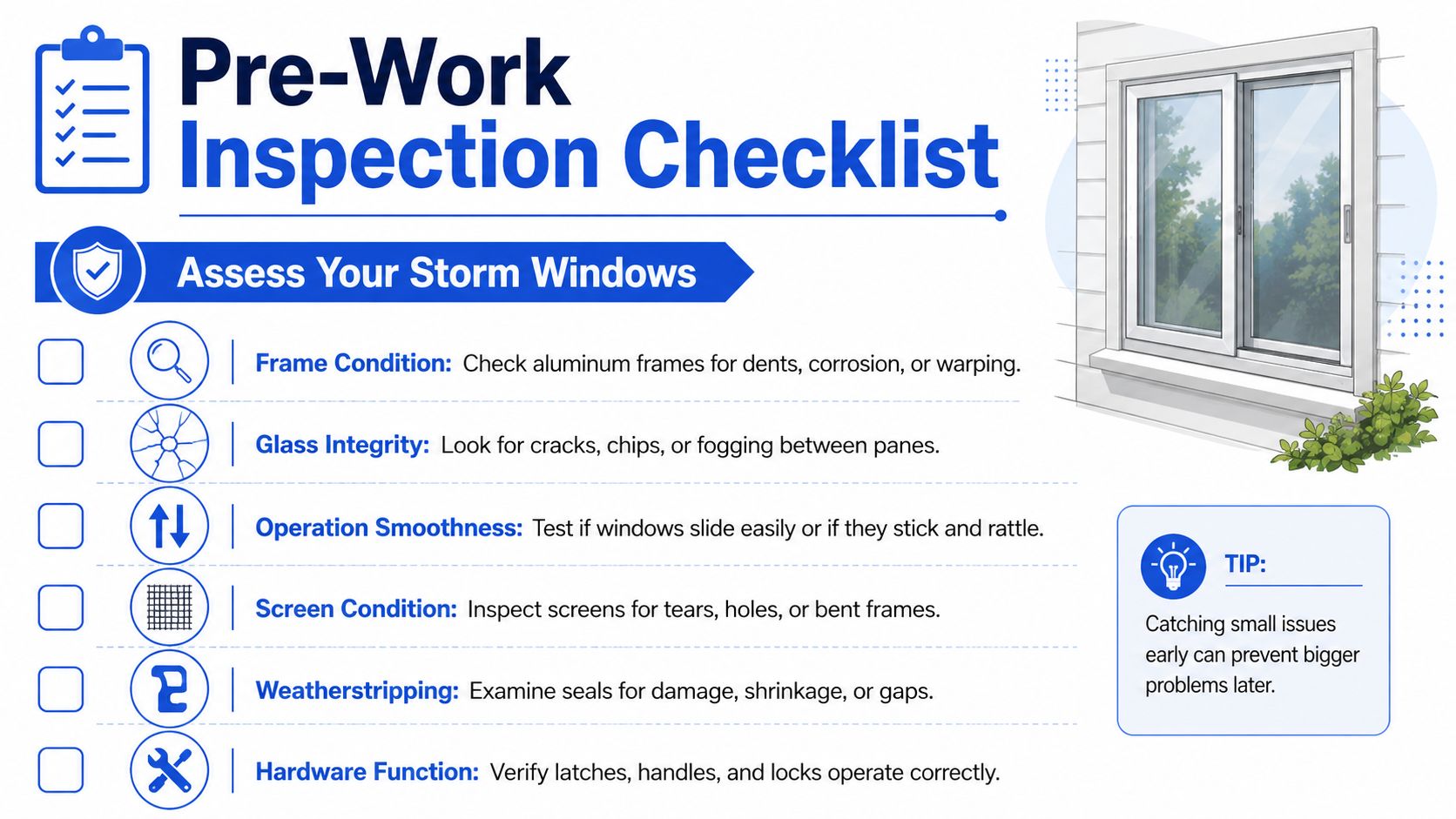
Start with the perimeter frame and the meeting points at the corners.
A storm window that's out of square often rattles, drags, or refuses to seat tightly. Homeowners sometimes blame the track when the underlying problem is frame geometry.
Don't focus only on the aluminum.
If a latch doesn't travel cleanly, don't assume force will free it. Old hardware often binds because dirt has packed into the guide or because the frame has shifted slightly over time.
If a panel only moves when you shove one corner harder than the other, stop. That usually means the insert is misaligned, not merely dirty.
Operate each insert through its travel range while the window is still assembled.
A quick field checklist works well:
A homeowner can usually handle cleaning and light service if the frame is intact, the glass is sound, and the inserts move without obvious distortion. Hold off on DIY removal if you find any of the following:
| Inspection result | What it usually means |
|---|---|
| Panel binds hard at one corner | Frame twist or track damage |
| Corner insert is cracked or crumbling | High break risk during removal |
| Glass is loose in frame | Removal can turn into a reglazing job |
| Track is packed and deformed | Cleaning alone may not restore operation |
| Frame has visible bend | Refit may require pro handling |
That inspection takes a little time, but it keeps you from turning a maintenance job into a parts hunt.
Patience pays off. Old aluminum storm windows don't respond well to speed. Most damage happens when somebody assumes the panel should pop out like a modern insert.
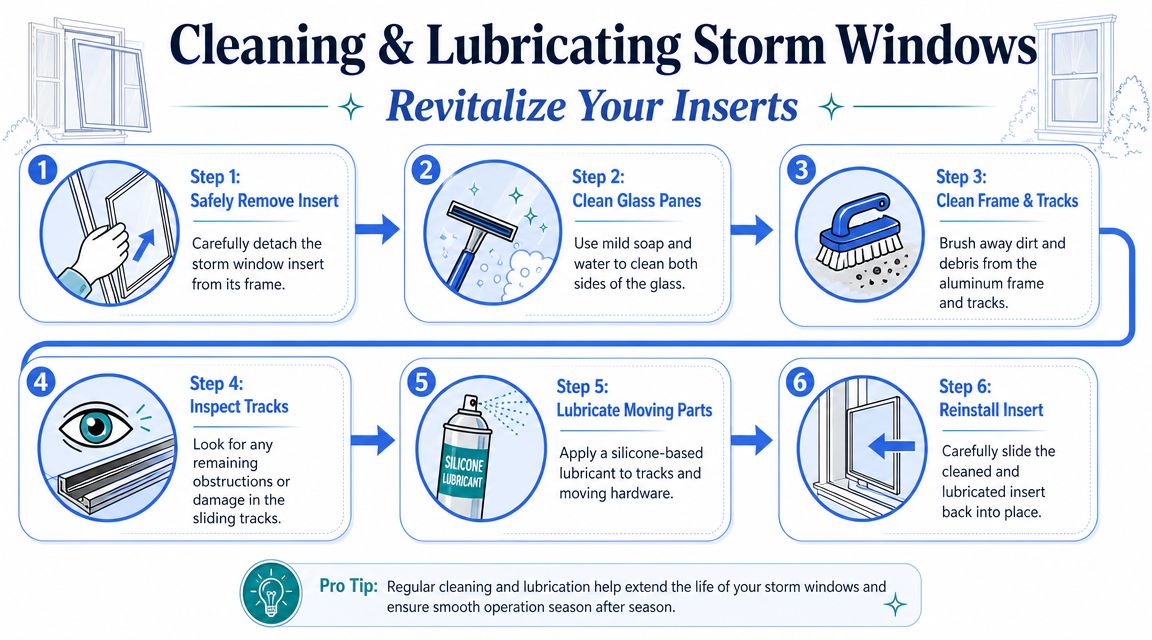
For old aluminum storm windows, the safest workflow starts by identifying whether you have a two-track or three-track self-storing design. Many older units need the sash or screen moved fully up and then tilted inward at about a 45-degree angle to clear the track, and forcing a brittle frame is a common way to break a corner, as noted in this old storm window removal discussion.
That one detail saves a lot of trouble. If you don't know which insert is tensioned by the top track, you can fight the wrong panel for ten minutes and still get nowhere.
Use steady hands, not fast hands.
Set the insert on padded sawhorses, a folded moving blanket, or a thick towel on a flat surface. Leaning a removed panel against concrete is a great way to chip glass corners.
Here's a visual that helps if you want to see a basic cleaning approach in action:
The glass is often cleaned first because it's what's visible. On old storms, the track and frame deserve attention before the panes.
Use a soft brush, a vacuum with a crevice tool, and a microfiber towel to remove loose debris from the channels. Packed grit in the track acts like sandpaper. It also keeps the insert from sitting where it should.
For oxidized aluminum, keep your cleaner mild and your pad non-abrasive. If the frame leaves gray residue on your towel, that's oxidation, not just dirt. If you're dealing with heavier chalking on aluminum surfaces, this guide on how to clean oxidized windows is a useful reference before you scrub too aggressively.
Clean the track until the insert can move freely. Then decide whether you still need lubricant. Dirt mixed with lubricant becomes paste.
Glass cleaning is simpler. Professionals really use only two methods. A squeegee for direct, controlled glass cleaning, or a pure-water system for a spot-free rinse on suitable exterior work. On removable storm inserts at ground level, a squeegee is usually the better tool because it gives you control around narrow frame edges and older glazing.
Once the tracks are dry and clean, test movement before spraying anything. If the panel still drags, use a light silicone-based lubricant on the track and any moving hardware. Avoid heavy oily products that collect dust.
A practical order works best:
Too much lubricant causes as many problems as too little. You want the panel to glide, not skate.
Not every bad storm window needs replacement. A few small repairs often solve the problems homeowners live with for years. The best DIY jobs are the ones that improve fit, reduce rattling, and restore normal movement.
If the panel moves but still feels drafty or chatters in the frame, weatherstripping is often the culprit. Old material hardens, shrinks, or pulls away at the corners.
You can usually handle this yourself with:
The key is fit. Too thick, and the panel binds. Too thin, and you still get movement and leakage.
Many old aluminum storm windows get wobbly at the corners before they completely fail. If the frame flexes when you hold opposite corners, inspect the corner keys or inserts.
A manageable repair often looks like this:
This is one of those repairs where gentle handling matters more than muscle. If the frame metal has deformed, new corner hardware alone won't make it square again.
A loose corner can sound like a draft problem because the panel vibrates in the opening. Fix the frame first, then judge the seal.
A sticky storm panel doesn't always need a new panel. Sometimes it needs a cleaner path and a little correction.
Look for these easy wins:
Use needle-nose pliers carefully on minor bends. Use them too aggressively and you can crease the aluminum. If a track is sharply deformed, stop there. That's a repair that can get worse fast.
Some tasks sound simple but become time sinks.
That's the point where DIY shifts from practical to expensive. If the parts are delicate, the frame is distorted, or the sash has to be coaxed out with tools, it's usually smarter to bring in a pro.
Most homeowners don't need a speech about preservation or a sales pitch for replacement. They need a clean decision. Keep the old aluminum storm windows and fix what matters, or replace them and move on.
The best answer usually comes down to fit, condition, leakage, and how much original window you're trying to preserve.

Modern standards for exterior storm windows set an air leakage benchmark of not more than 1.0 cfm per foot of crack perimeter at 1.56 psf, and the same specification notes that storm window installation can deliver 12 to 33% heating and cooling savings when the assembly is properly sealed and maintained, according to this metal storm window performance specification.
That doesn't mean every old unit in your house is suddenly efficient. It means sealing, fit, and condition matter more than appearance. A battered-looking storm that closes tightly can outperform a cleaner-looking one with gaps and failed weatherstrip.
| Criteria | Repairing Existing Windows | Replacing with New Windows |
|---|---|---|
| Upfront cost | Usually lower if the frame is intact and parts are limited to seals, corners, or hardware | Higher because you're buying new units and fitting them |
| Historic appearance | Keeps the original look and supports homes where the prime sash should stay | Can change the visual character depending on profile and finish |
| Performance potential | Good if the unit can be squared, sealed, and operated properly | Better path if the old frame is too loose, bent, or leaky to restore |
| Labor | Can be time-consuming, especially with multiple sizes and fragile inserts | Less tinkering after install, but more commitment at the start |
| Risk | Hidden fragility may show up during disassembly | Ordering errors or poor fit create their own problems |
| Best use case | The prime window is worth preserving and the storm still has a sound frame | The old unit is distorted, repeatedly failing, or no longer practical to service |
Repair usually wins when the frame is basically sound, the glass is serviceable, and the main complaint is operational. That includes sticking tracks, failed weatherstripping, loose corners, light oxidation, and hardware issues.
This is also the point where appearance work can matter. If the frame finish is tired but stable, repainting can extend usable life and improve curb appeal. If that's on your list, this guide on repainting aluminium window frames is a sensible next read.
If you live in a hot climate and want a broader view of frame material behavior under long-term sun exposure, this article on choosing window frames for Texas heat gives useful context for how material choice affects comfort, maintenance, and durability.
Replacement becomes the practical option when repair keeps stacking up. Think bent frame, repeated binding, brittle corners throughout, poor closure, and chronic leakage that can't be solved by cleaning and resealing.
A simple way to decide:
If you use that framework, the decision gets much less emotional and much more useful.
You are standing on a ladder in Scottsdale heat, one hand on an old storm panel that will not budge, the other trying to keep your balance. That is the point where a cleaning job turns into a repair bill, or an injury.
Old aluminum storm windows can be cleaned by a careful homeowner. They do not forgive bad access, extra force, or guesswork. After years of field work on older storm units, I can say the handoff point is usually simple. If removing the panel safely is harder than cleaning the glass, call a pro.
Professional help is usually the better call when you are dealing with:
I also get calls after a homeowner has spent an hour fighting one insert that was never meant to come out from that side. With older storms, force is expensive.
A qualified window cleaner or storm window specialist does more than wash the panes. The primary value is in how the unit is handled. A pro checks the removal sequence, confirms whether the panel is supported properly, looks for hidden fasteners or spring clips, and watches for frame twist as the insert starts to move.
That matters on old aluminum storms because many failures happen during handling, not during cleaning. One wrong angle can crack a pane, snap a corner, or leave a frame that never slides right again.
Professional Window Cleaning has been handling windows since 1999. On older storm jobs, the work often comes down to careful panel removal, proper glass cleaning with the right tools for the condition, track cleanup, and reinstalling the unit without putting extra stress on aged aluminum.
If a storm panel feels like it needs force, it usually needs a different removal method.
If you need local help, service is available in Phoenix, Scottsdale, Denver window cleaning, and Las Vegas window cleaning. That is especially useful when the problem includes stuck inserts, sun-baked gaskets, corroded fasteners, or windows placed where safe access is the bigger issue.
If your old aluminum storm windows need careful cleaning, safer removal, or an experienced opinion on whether they are still worth keeping, contact Professional Window Cleaning. A solid inspection can save a serviceable panel, and it can also tell you when repair money should stop and replacement should start.
Read our blog posts regularly and keep learning.